9 Top Test Automation Companies in the USA
September 10, 2026



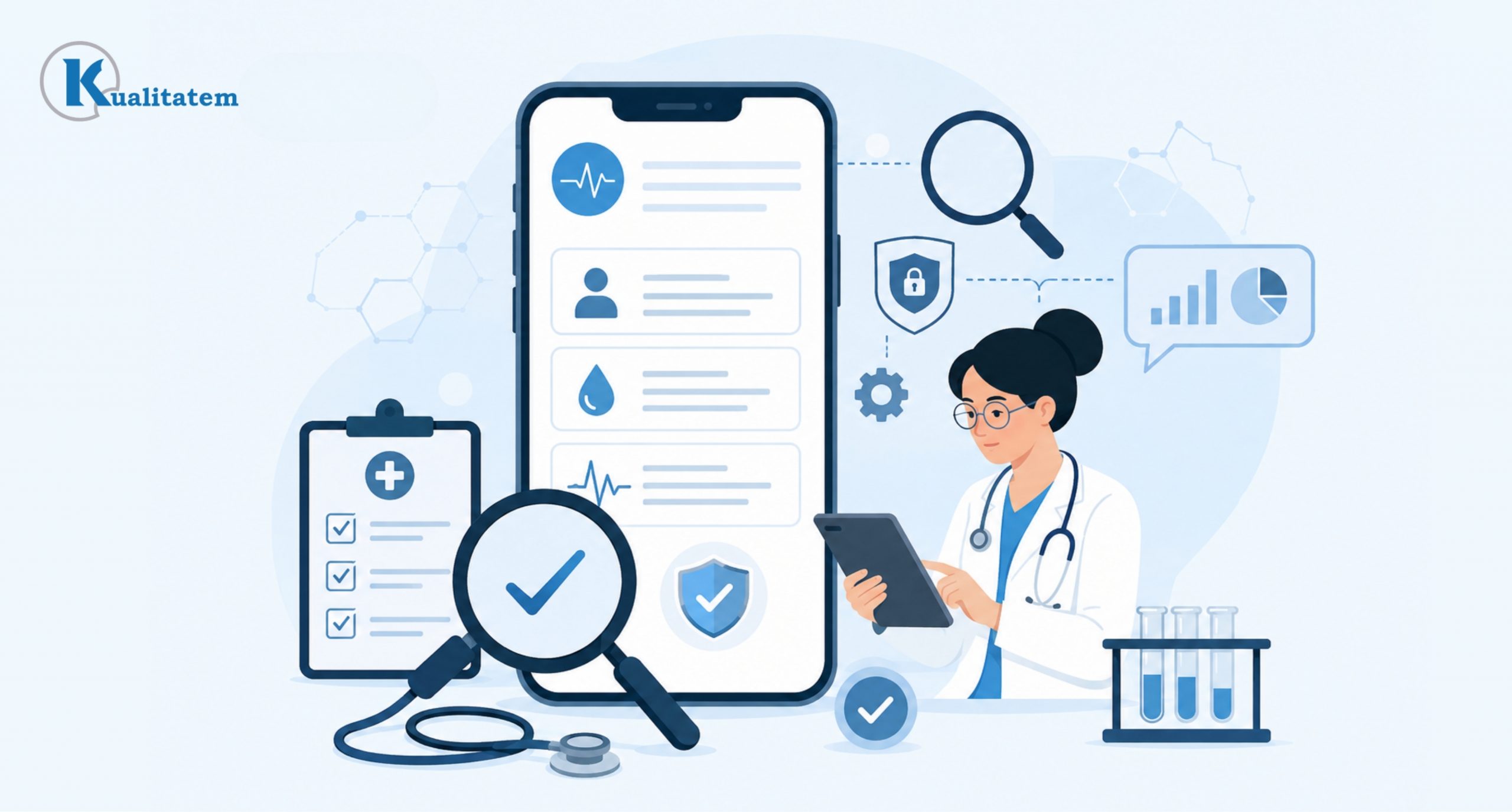
Digital healthcare has grown fast. Healthcare applications now support telemedicine, remote patient monitoring, electronic health records, wearables, AI-powered diagnosis, ePrescription, and chronic disease management. Millions of patients and providers depend on this software every day.
A software failure in healthcare carries higher consequences than a failure in an ordinary mobile app. A crashed shopping app costs a sale. A crashed medication dosage screen or a failed EHR sync can affect patient safety directly. Healthcare has also been the most expensive industry for data breaches for 14 straight years, with the average breach costing $7.42 million in 2025 (IBM, 2025). That difference is why healthcare software testing gets treated as a distinct discipline, not a smaller version of standard QA.
Healthcare app testing is the process of ensuring healthcare software is reliable, secure, compliant, interoperable, and safe for patients and providers. This guide covers what healthcare app testing involves, why it differs from standard software testing, the regulations it has to satisfy, the testing types it requires, and how to build a strategy that holds up under real regulatory and clinical scrutiny.
Healthcare app testing is the structured process of validating a healthcare application’s functionality, security, performance, and compliance before and after release. Its objectives include catching defects early, verifying regulatory compliance, confirming safe data handling, and proving the app behaves correctly under real clinical conditions.
Healthcare testing differs from standard application testing in one key way. Standard testing asks whether the software works.
Healthcare testing asks whether the software works, stays compliant, protects patient data, and stays safe for someone whose health depends on it. That fourth requirement changes the whole testing approach.
Patient safety sits at the center of this work. A missed defect in a dosage calculator or a delayed alert in a remote monitoring app has consequences no other software category carries in the same way. The business benefits follow directly from that seriousness: fewer compliance violations, fewer costly recalls, stronger trust from providers and patients, and a faster path through regulatory review.
Healthcare software spans many categories, and each one carries a different testing priority.
| App Category | Primary Testing Focus | Key Risk |
|---|---|---|
| Telemedicine | Video and audio reliability, real-time performance | Dropped sessions during a clinical consultation |
| EHR and EMR Systems | Data accuracy, interoperability, HL7 and FHIR compliance | Incorrect or lost patient records |
| Patient Portals | Usability, authentication, accessibility | Patients locked out of their own health data |
| Remote Patient Monitoring | Device integration, real-time data accuracy | Delayed or missed vital sign alerts |
| Wearable Health Apps | Sensor accuracy, battery-aware performance | Inaccurate health readings |
| AI Healthcare Applications | Model validation, bias testing, output accuracy | Incorrect diagnostic or triage suggestions |
| ePrescription Systems | Data integrity, drug interaction logic | Wrong dosage or medication errors |
| Hospital Management Systems | Workflow accuracy, integration testing | Scheduling or billing errors affecting care |
| Medical Billing Software | Compliance, calculation accuracy | Billing errors and compliance violations |
| Wellness and Fitness Apps | Usability, data privacy | Lower risk, but still handles personal health data |
Healthcare software carries sensitive patient data, and that alone raises the stakes on every test cycle. Compliance requirements add a second layer most software never has to satisfy. High availability matters more too, since a hospital system going down affects care in real time.
Patient safety depends directly on some of these applications, which is not true of most consumer software. Many healthcare apps integrate with medical devices, and that integration has to work correctly across many device manufacturers and firmware versions. Healthcare organizations also run software across multiple platforms and often keep legacy systems in production for years, since replacing a hospital’s core system is slow and expensive. Regulatory audits add ongoing pressure, since compliance has to hold up under inspection, not just under internal review.
Several regulatory frameworks apply to healthcare software, and most applications need to satisfy more than one at the same time.
| Standard | Scope | What It Covers |
|---|---|---|
| HIPAA | United States | Patient data privacy and security |
| GDPR | European Union | Personal and health data protection |
| FDA SaMD | United States | Software that performs a medical function |
| IEC 62304 | Global | Medical device software lifecycle |
| ISO 13485 | Global | Quality management for medical device organizations |
| HL7 | Global | Clinical data messaging standards |
| FHIR | Global | API-based healthcare data exchange |
| OWASP | Global | Application security testing standards |
HHS proposed a rule change in January 2025 that would require covered entities to run penetration testing at least once every 12 months, codified at 45 CFR 164.312(h)(2)(iii) (U.S. Department of Health and Human Services, 2025). The final rule was still pending as of this writing, but it signals where HIPAA enforcement is heading.
Healthcare applications need a wider range of testing than most software categories, and each type protects against a different failure mode. Many organizations pair in-house QA with a dedicated functional testing and performance testing partner for the categories below that carry the highest patient risk.
| Testing Type | Purpose | Priority |
|---|---|---|
| Functional Testing | Confirms features work as intended | Critical |
| Integration Testing | Confirms systems and devices work together correctly | Critical |
| Security Testing | Finds vulnerabilities before an attacker does | Critical |
| Penetration Testing | Simulates real attacks against the application | Critical |
| Performance Testing | Confirms the app holds up under real load | High |
| Usability Testing | Confirms patients and clinicians can use the app correctly | High |
| Accessibility Testing | Confirms the app works for users with disabilities | High |
| Compatibility Testing | Confirms the app works across devices and platforms | High |
| Interoperability Testing | Confirms HL7 and FHIR data exchange works correctly | Critical |
| API Testing | Confirms data flows correctly between systems | High |
| Localization Testing | Confirms the app works correctly in different languages and regions | Medium |
| Regression Testing | Confirms new changes have not broken existing functionality | Critical |
| AI Model Validation | Confirms AI outputs stay accurate and free of harmful bias | Critical |
| Disaster Recovery Testing | Confirms systems recover correctly after an outage | High |
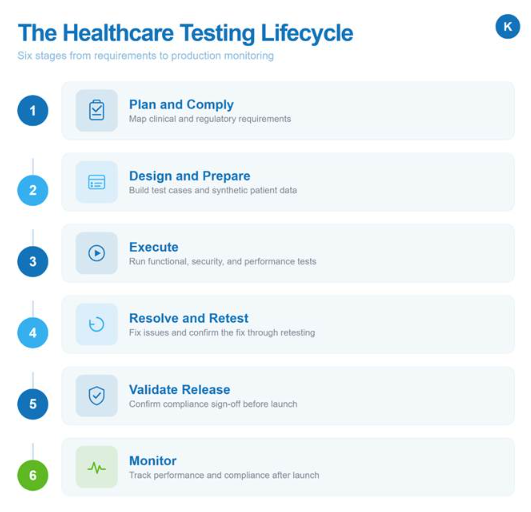
A healthcare testing strategy works best as a defined sequence, not an ad hoc checklist.
Each stage feeds directly into the next. Skipping one, especially compliance planning or continuous monitoring, tends to surface as a costly gap later.
Legacy integrations slow testing down, since older systems often lack modern APIs or documentation. The fix is building an integration test harness around the legacy system’s actual behavior, not its outdated documentation.
Compliance complexity multiplies when an application has to satisfy HIPAA, FDA guidance, and international standards at the same time. Mapping every requirement to a single compliance matrix keeps this manageable.
Medical device compatibility is hard to test broadly, since manufacturers use different firmware and communication protocols. Partnering with device vendors for test access solves most of this.
Data privacy adds constraints most testing teams are not used to working under. Synthetic and de-identified test data removes the risk without slowing testing down.
Large datasets, common in EHR and imaging systems, slow down test execution. Performance testing against production-scale data volumes, not a small sample, catches this early.
Cross-platform support adds real testing overhead across iOS, Android, web, and desktop clients. A shared core test suite with platform-specific extensions reduces duplicate effort.
Frequent regulatory updates mean a compliant application can become non-compliant without a single code change. Continuous compliance monitoring catches this before an audit does.
Teams typically build a healthcare testing toolchain from a few categories rather than one all-in-one platform. Automation testing commonly runs through Selenium, Playwright, or Appium. API testing commonly runs through Postman. Performance testing commonly runs through JMeter. Security testing commonly runs through Burp Suite or OWASP ZAP. Accessibility testing commonly runs through Axe. Cross-device and cross-browser testing commonly runs through platforms like BrowserStack or LambdaTest. The right combination depends on the application’s platforms and compliance requirements, not a single universal toolchain. AI-powered healthcare applications add one more layer on top of this toolchain, and organizations validating an AI diagnostic or triage model often bring in dedicated AI testing services to check model outputs for accuracy and bias before release.
| KPI | What It Measures |
|---|---|
| Defect Density | Number of defects relative to application size |
| Defect Leakage | Defects that reach production despite testing |
| Crash Rate | Frequency of application crashes in real use |
| API Response Time | Speed of data exchange between systems |
| Uptime | Percentage of time the application stays available |
| Compliance Coverage | Percentage of regulatory requirements verified through testing |
| Automation Coverage | Percentage of test cases covered by automation |
| Test Pass Rate | Percentage of test cases passing in a given cycle |
Healthcare app testing covers far more than finding software defects. It protects patient safety, regulatory compliance, data security, interoperability, and reliable performance across healthcare ecosystems that keep getting more complex.
Combining manual testing, automation, security validation, compliance verification, and continuous quality assurance gives healthcare organizations a real path to trustworthy digital health experiences. That combination reduces operational and regulatory risk at the same time, which is exactly what a healthcare application needs to earn and keep patient trust.
Successful healthcare applications depend on more than innovative features. They require rigorous testing throughout the software development lifecycle. By implementing a comprehensive healthcare app testing strategy that prioritizes security, compliance, interoperability, and user experience, organizations can deliver reliable digital health solutions that improve patient outcomes while meeting the industry’s highest quality and regulatory standards.
IBM. (2025). Cost of a data breach report 2025. IBM Security. https://www.ibm.com/reports/data-breach
U.S. Department of Health and Human Services. (2025). HIPAA security rule to strengthen the cybersecurity of electronic protected health information. Federal Register. https://www.federalregister.gov/documents/2025/01/06/2024-30983/hipaa-security-rule-to-strengthen-the-cybersecurity-of-electronic-protected-health-information

Nabeesha is a Digital Content Executive at Kualitatem Inc. With a background in communication and extensive knowledge of QA and cybersecurity, she brings a business-first lens to technical content. Her work helps CTOs and engineering leaders cut through the noise and make confident decisions about software quality.
Not sure where your QA stands?
Speak to an Expert


Our experts are all ready. Explain your business needs, and we’ll provide you with the best solutions. With them, you’ll have a success story of your own.
Contact us now and let us know how we can assist.