Testing Services for Temenos Banking Systems
October 2, 2026



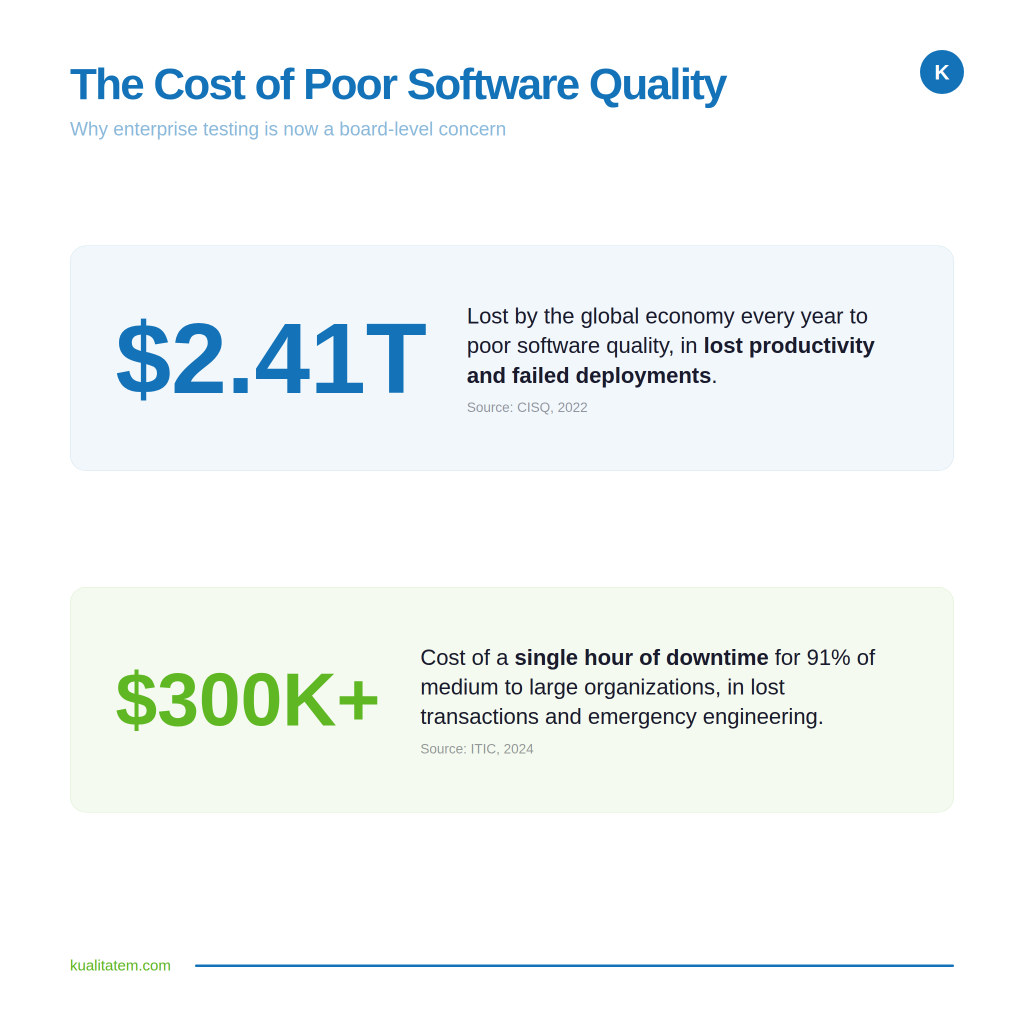
Poor software quality costs the global economy an estimated $2.41 trillion every year in lost productivity and failed deployments, according to CISQ’s 2022 report.
For enterprises specifically, the stakes are sharper: 91% of medium to large organizations report that a single hour of system downtime costs more than $300,000 in lost transactions and emergency engineering, per ITIC’s 2024 survey.
That is why enterprise testing is now a board-level concern. Enterprise applications run business-critical operations. They:
A single undetected defect cascades into downtime, compliance exposure, and reputational damage.
This guide breaks down:
Enterprise software testing, sometimes referred to as enterprise application testing, is the structured process of validating large-scale, business-critical applications for functionality, security, performance, and usability before and after they reach production.
Unlike testing a standalone app, enterprise testing has to account for software that operates inside a complex ecosystem including:
Enterprise applications differ from traditional applications in a few core ways:
QA matters more in enterprise environments for that reason. Comprehensive testing supports organizations by:
For large-scale systems, a partner offering dedicated Software Testing Services rather than adhoc QA support determines whether a testing function scales.
Enterprise software is inherently more complex than consumer-facing or small-business applications. It serves a large, relies on interconnected systems, and processes sensitive data at scale. That complexity is why a standard QA approach falls short.
Comprehensive testing protects enterprises in several concrete ways:
There is also a delivery-speed argument that is often overlooked. Gitlab’s Global DevSecOps survey found that 47% of development teams identify testing as the top reason their releases get delayed. That delay comes from testing that happens too late, not from too much testing.
Enterprise systems process millions of transactions daily and demand testing approaches standard applications never need.
An enterprise strategy is not a scaled-up small-team process. It needs:
No single type of testing can cover the full surface area of an enterprise application. A comprehensive strategy combines multiple testing types, each addressing a different layer of risk.
What it does: Functional testing verifies that every feature and workflow performs as intended, including edge cases and error conditions.
In an enterprise HR system, this means confirming that payroll calculations, benefits enrollment, and approval workflows behave correctly under real business rules, not just ideal-path scenarios.
What it does: Integration testing validates that different modules and external systems exchange data correctly.
For an enterprise CRM connected to a marketing automation tool, this means confirming customer records sync accurately and trigger the right downstream actions without data loss.
What it does: API testing checks that the interfaces connecting enterprise systems handle requests, responses, and error states correctly.
Given how many enterprise workflows depend on internal and third-party APIs, from payment gateways to identity providers, this layer catches failures that never surface in the UI until they cause a system-wide outage.
What it does: Regression testing confirms that new code changes have not broken existing functionality.
In enterprise environments with frequent releases, this is usually the highest-volume test type and the one most in need of automation, since manually re-testing every workflow after every release is not sustainable at scale.
What it does: Performance testing measures how an application responds under expected and peak workloads.
For an ERP system, this could mean simulating thousands of employees submitting expense reports simultaneously at month-end to confirm the system does not slow down or fail.
What it does: Load and stress testing push a system beyond normal operating conditions to find its breaking point.
Unlike standard performance testing, the goal is to find where the system fails under extreme load and how it recovers.
What it does: Security testing identifies vulnerabilities that could expose enterprise data to unauthorized access or attack.
This includes validating encryption standards, authentication protocols, and role-based access controls, particularly for systems handling financial, health, or personal data.
What it does: Usability testing evaluates whether an application is intuitive and accessible for its intended users, technical and non-technical alike.
For an internal communication platform used across an enterprise, this means confirming that employees across departments, not just power users, can navigate it without friction.
What it does: Accessibility testing ensures software is usable by people with disabilities, in line with standards such as WCAG.
For enterprises operating in public-facing or regulated sectors, accessibility is a legal requirement, and gaps can trigger compliance action.
What it does: Compatibility testing confirms that an application performs consistently across browsers, operating systems, and devices.
Enterprise software often has to support a wide range of legacy and modern environments simultaneously, since large organizations rarely standardize on a single device or OS across every department.
What it does: Compliance testing validates that software meets industry and legal requirements such as GDPR, HIPAA, or PCI-DSS.
For a payment processing system, this means verifying that cardholder data is encrypted correctly and that data collection practices align with regional privacy law, not just checking a box at release time.
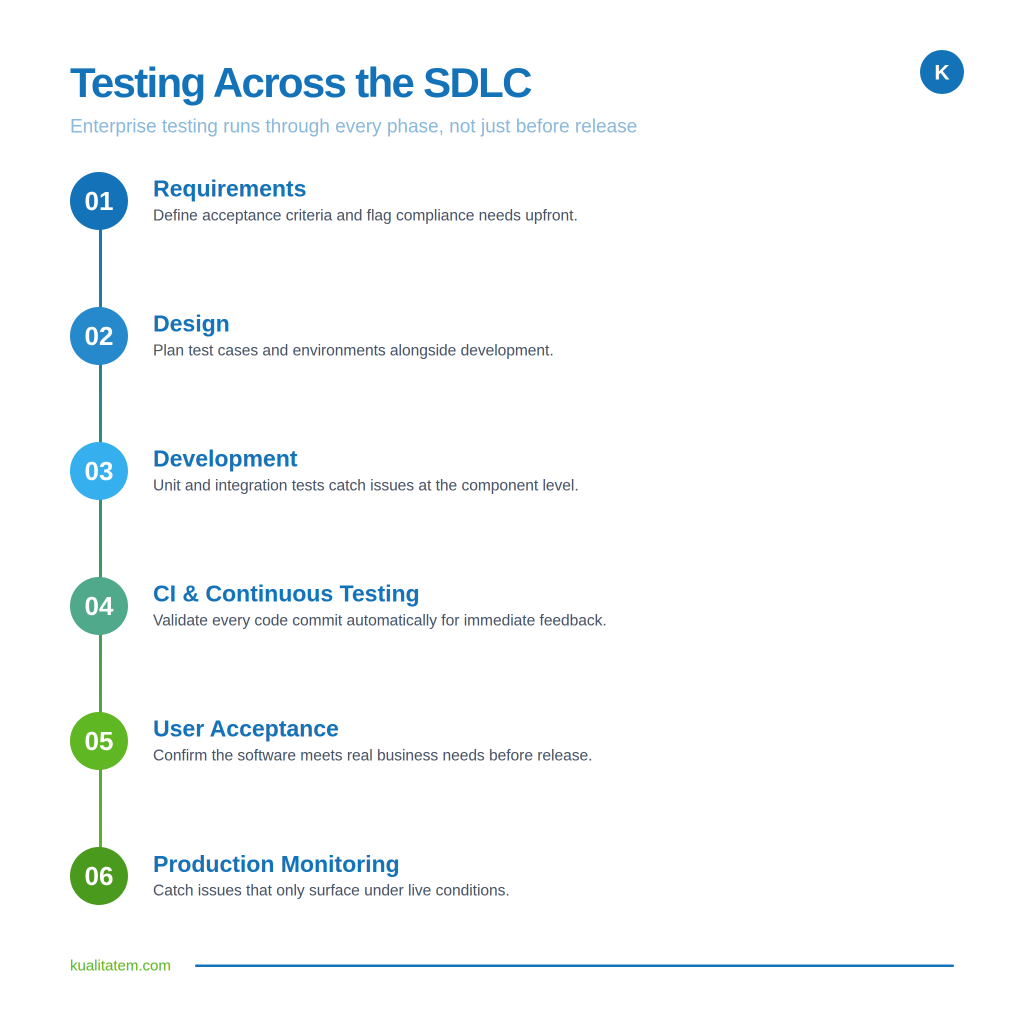
Enterprise software testing works best when embedded throughout the software development life cycle rather than treated as a final gate before release.
The diagram below shows how testing fits into each phase:
The right combination of methodologies determines whether a testing program is efficient or constantly playing catch-up.
An enterprise testing strategy connects every testing effort to a business outcome. Without one, even a well-resourced QA team ends up reactive rather than strategic.
A solid strategy requires:
Manual testing alone cannot keep pace with enterprise release cycles. Test automation makes frequent, reliable releases possible at scale, but knowing what to leave manual matters as much.
What should be automated:
What should remain manual:
Key Enhancements:
Enterprise testing comes with a distinct set of challenges that smaller-scale QA teams rarely face.
The most critical challenges include:
Measuring the effectiveness of an enterprise testing program requires tracking the right key performance indicators, not just counting tests executed.
Essential KPIs to track include:
Selecting the right tools depends on matching each category to the specific testing need, since no single platform covers every layer of enterprise application testing.
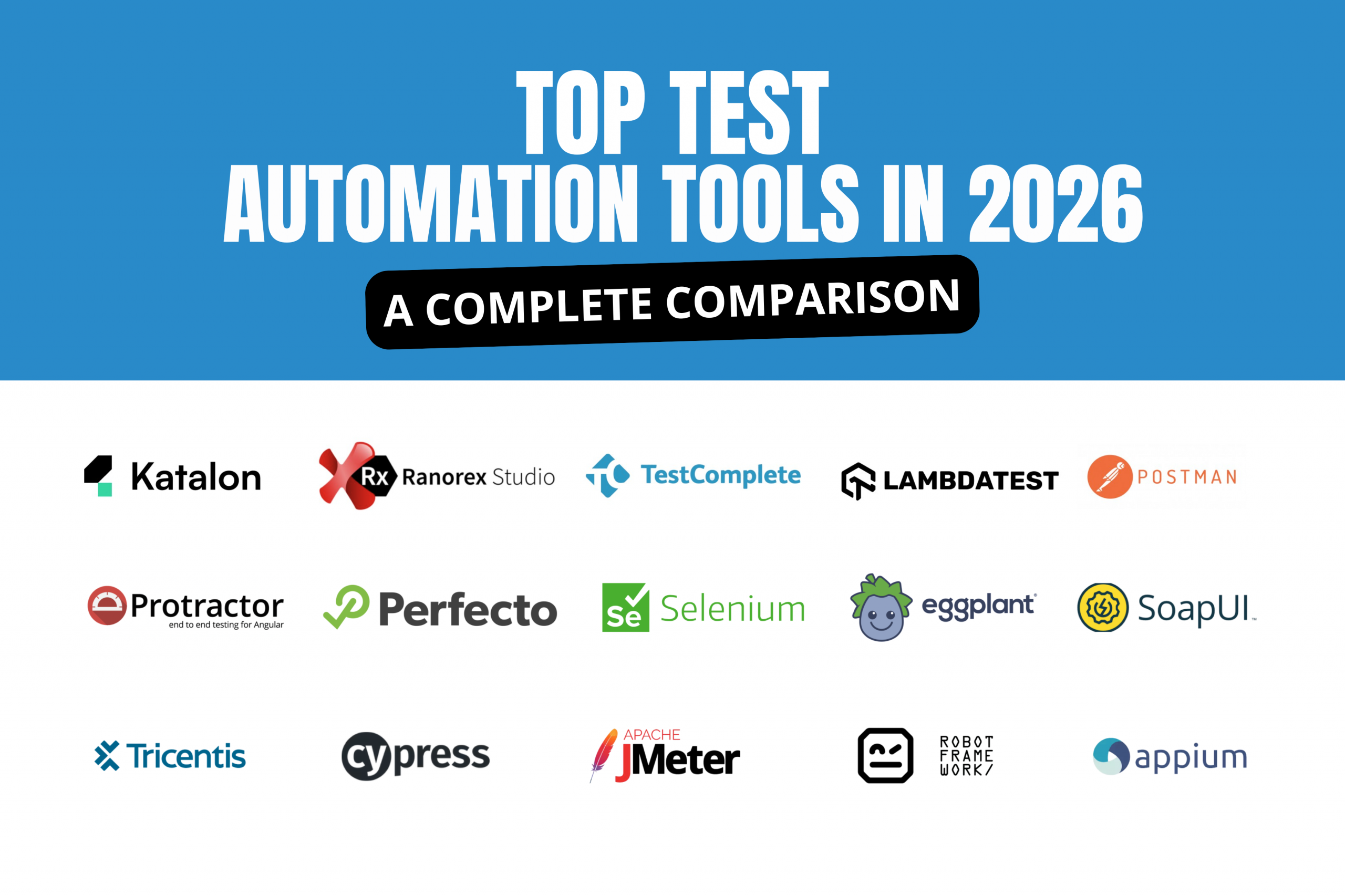
Selenium, Playwright, and Cypress lead the automation category for web application testing, each offering different tradeoffs in language support, speed, and cross-browser coverage.
Postman and REST Assured are the standard tools for validating API requests, responses, and error handling across enterprise integrations.
JMeter, Gatling, and k6 handle load and performance testing, simulating high traffic volumes to identify bottlenecks before they affect real users.
TestRail, Zephyr, and Xray organize test cases, track execution, and centralize reporting so distributed QA teams can work from a single source of truth.
Jenkins, GitHub Actions, and Azure DevOps integrate testing directly into the deployment pipeline, enabling the continuous testing that enterprise release cadences depend on.
Selecting an external testing partner is a strategic decision. A few criteria will tell you which partners will scale and which will stall:
Kualitatem works across these criteria as an enterprise QA partner, combining ISTQB-certified engineers, TMMi Level 5 process maturity, and ISO 27001-aligned security practices with hands-on experience in regulated sectors including banking, healthcare, and government.
Kualitatem works as an extension of your existing engineering and QA teams, not a standalone vendor.
Organizations evaluating testing support for a specific feature area can also review Functional Testing Services as a starting point for scoping a focused engagement before expanding into a full enterprise testing program.
Enterprise apps rarely need just one type of testing. See how Kualitatem’s QA services cover every layer, from automation to security and compliance.
A few practices consistently mark the difference between programs that scale and programs that buckle under complexity.
Shifting testing left, starting validation earlier in development, catches defects when they are cheapest to fix. Automating repetitive test cases frees testing teams to focus on higher-value exploratory and risk-based work. Prioritizing risk-based testing ensures limited resources go toward the areas of highest business impact rather than being spread evenly across every feature.
Maintaining realistic test environments prevents the case where software passes in staging but breaks in production.
Regularly reviewing and updating test cases keeps the suite relevant as the application evolves, since outdated tests create false confidence. Integrating testing into CI/CD pipelines supports continuous delivery without sacrificing quality gates.
Monitoring applications after deployment closes the loop, catching issues that only surface under real user behavior and load. AI-powered testing tools, used responsibly alongside human expertise, can meaningfully improve efficiency without introducing the blind spots that come from removing human oversight entirely.
Enterprise software testing is moving from an end-of-cycle activity to continuous testing across the SDLC.
Key trends shaping the future of the industry include:
Book a free call with Kualitatem to find where your testing carries the most risk and how to fix it before defects reach production.
Enterprise software testing is the process of validating large-scale, business-critical applications for functionality, security, performance, and usability across the complex, interconnected systems that enterprise organizations rely on.
It prevents costly downtime, protects sensitive data, ensures regulatory compliance, and reduces the financial and reputational risk of software failures in systems that support critical business operations.
Enterprise testing deals with greater architectural complexity, larger user bases, deeper system integrations, stricter compliance requirements, and higher automation demands than standard-scope application testing.
Functional, integration, API, regression, performance, load and stress, security, usability, accessibility, compatibility, and compliance testing together form a comprehensive enterprise testing approach.
Common tools include Selenium, Playwright, and Cypress for automation, Postman and REST Assured for API testing, JMeter, Gatling, and k6 for performance testing, TestRail, Zephyr, and Xray for test management, and Jenkins, GitHub Actions, and Azure DevOps for CI/CD integration.
Automation should prioritize high-volume, repetitive, and predictable test cases such as regression and API testing, while manual testing remains valuable for exploratory and usability work that depends on human judgment.
Common challenges include legacy system limitations, complex third-party and ERP integrations, microservices architectures, hybrid cloud environments, large test datasets, and the ongoing burden of regulatory compliance.
Look for industry-specific expertise, proven scalability, strong automation capabilities, compliance experience, security testing depth, quality reporting, and flexible engagement models that adapt to release cycles.

Not sure where your QA stands?
Speak to an Expert

Our experts are all ready. Explain your business needs, and we’ll provide you with the best solutions. With them, you’ll have a success story of your own.
Contact us now and let us know how we can assist.