

Summary
Website usability testing companies help businesses identify navigation problems, confusing interfaces, and barriers that prevent users from completing important tasks. The right provider depends on research goals, target audience, budget, and the need for design or software QA support.
- Kualitatem may be relevant when usability testing needs to complement broader software QA; confirm its proposed scope and research capabilities.
- AnswerLab and Nielsen Norman Group are options to evaluate for research-focused engagements.
- Blink UX, UX Team, Perpetual, and other design-oriented providers may suit projects where research informs interface or product development.
- NN/g lists Rapid User Testing starting at $40,000 and Quantitative User Testing starting at $70,000. These are provider-specific starting prices, so request a current quote for the exact study.
Editorial summary · Read the full guide below
A website can pass functional QA and still create user friction. Visitors may struggle to find information, complete forms, or finish checkout, which can affect conversions and product adoption.
The scope of the issue: Baymard Institute says its average online shopping cart abandonment rate is approximately 70.22%, based on 50 studies. One area of checkout usability that businesses can explore to learn why customers are leaving is the checkout process itself.
Website usability testing companies offer websites a way to discover user problems, reasons for the problems, and prioritize them for release or when a product is still under development.
In this guide, you will look at eight providers in terms of their research, breadth of service, project suitability, and transparency around pricing.
8 Best Website Usability Testing Companies in the USA
The way each provider defines usability is unique. Some focus on specific UX research; others are involved with research and interface design, product development or software testing. The profiles below describe where each company might fit in and what the buyer should check before signing a contract.
1. Kualitatem: Website Usability Testing Combined With Software QA
Website: Kualitatem
Best Suited For: SaaS businesses, ecommerce, enterprise software teams, and organisations getting websites or mobile apps ready for launch.
A site might pass the functional tests and yet still irritate users. Form fields may not be understood, navigating through a dashboard may be difficult, and checkout may be problematic. These usability problems can impact conversions, product adoption, and customer satisfaction.
Kualitatem provides website usability testing in addition to other software quality assurance services. This helps companies gauge how easily users can complete tasks and address functional defects and other application quality issues.
What Does Kualitatem Offer for Website Usability Testing?
Kualitatem’s website usability testing services list several evaluation methods:
- Expert Review: Find confusing labels, inconsistent navigation, and interface problems.
- Remote Usability Testing: Observe how users interact and identify friction points in key workflows.
- UI Testing: Check the UI elements and interactions.
- UX Testing: Evaluate the experience and usability of performing tasks.
- A/B Testing: Test different interfaces with specific goals.
- Hallway Testing: Collect initial user feedback from available people to identify apparent usability issues.
This will vary based on the project goals. Testing with representative users will find practical problems for real tasks, and expert reviews will find apparent problems with the design. When an outcome is measurable, and there are enough data, A/B testing is useful to compare alternatives.
The company also recognizes support for desktop and mobile platforms, such as iOS and Android. Check details of the specific browser coverage, how participants are recruited and what is to be delivered before the engagement.
How Does the Testing Process Work?
Kualitatem describes a structured process covering five stages:
| Stage | Purpose |
|---|---|
| Planning | Define objectives, tasks, and testing requirements. |
| Test Execution | Conduct evaluations and record observations. |
| Analysis | Identify usability issues and patterns. |
| Optimization | Develop improvement recommendations. |
| Reporting | Document findings and priorities. |
Ask whether the final report includes task completion results, issue severity, supporting evidence, recommendations, and retesting options.
Why Combine Usability Testing With Functional QA?
Functional testing is used to confirm that a feature is functioning properly. Usability testing assesses how effectively people understand and use a feature.
For instance, functional QA will ensure that team invitations are sent and permissions are applied to the SaaS platform. Usability testing looks at how easy it is for users to find the invitation option and to understand the permissions. Together, these findings can help the team prioritize fixes based on user impact and functional risk before release.
Combining these activities can help teams distinguish functional defects from interaction problems and coordinate fixes before release.
What Makes Kualitatem Worth Considering?
The published company information on Kualitatem reveals their level 5 process maturity, ISO 27001 certification, and over 200 ISTQB-certified QA engineers. These are credentials that give an organization context, but buyers should evaluate the proposed team’s UX research skills and project experience on their own.
Its published industry coverage includes banking, healthcare, retail, education, telecommunications, and transportation.
Potential Advantages
- Usability evaluation and functional/mobile QA.
- Several usability evaluation techniques.
- A systematic testing and reporting system.
- Gain experience in a variety of industries.
- Created QA process and security credentials.
What Buyers Should Verify
Verify that participants are recruited, research is conducted, usability is measured, device and browser coverage is planned, project time-frame is acceptable, reporting is in place, and follow-up testing is scheduled.
Example: Testing an E-Commerce Checkout
A website that’s looking into making a checkout redesign may discover that the payment process is working fine, but the mobile form fields are an issue that customers are having problems with.
Confusing labels, validation errors, and navigation problems might be discovered during usability testing. Payment processing, order creation, and error handling would be checked by functional QA. These findings combined provide teams with a way to prioritize suitable fixes prior to launch.
Is Kualitatem the Right Fit?
For cases where usability testing has to be performed as part of the software QA environment, Kualitatem is worth consideration. If it is a project with a significant amount of discovery research or behavioral research needed, you should compare its proposed methodology and its behavioral research expertise with specialist UX providers.
2. AnswerLab: Best for Enterprise UX Research
Website: AnswerLab
Best suited for: Best for Enterprise UX Research. AnswerLab is a tool designed for enterprise-level UX research.
AnswerLab is about UX research and UX strategy. It’s applicable in any organization that wants to grasp the user’s behavior in digital products, customer interactions, and business-critical workflows.
It has published case studies in various sectors such as financial services, healthcare, retail, and B2B technology. Some examples are identifying mobile-to-purchase conversion, drug safety information display optimization, and a streamlined online drug order platform.
Services and Research Fit
AnswerLab can support teams in the research process to explore the needs of their users, assess prototypes, examine digital experiences, and identify friction points, depending on the engagement. It also has a track record of research operations and studies with specialized audiences in its publications.
This renders the company a good option to consider when researching questions involving multiple customer groups, complicated products, or decisions involving multiple stakeholders.
Advantages
- There are published case studies of experience in several industries.
- Research can be used to explore the why of user behavior.
- Appropriate for organisations that require evidence to guide strategic product decisions..
Considerations
- Ask if the proposed study will involve usability testing, interviews, quantitative research, or a mix.
- Discuss recruitment and screening of participants.
- Ask for a comprehensive proposal that includes scope, schedule, and cost.
AnswerLab might be appropriate for organisations that require a research partner to research complex user journeys. The best place to check the scope and commercial terms of a particular engagement is its official web page.
3. Nielsen Norman Group: Best for Specialist Usability Research
Website: Nielsen Norman Group
Best suited for: Organizations looking for specialized usability research, expert analysis, and prioritized recommendations.
Nielsen Norman Group (NN/g) has long been focused on research for user experience that is grounded in evidence. Its consulting services encompass customised user research for websites, apps, prototypes, and other digital interfaces, usability testing, and expert reviews.
The company’s published rapid user testing service is a good example of a structured research engagement. NN/g states that rapid user testing begins at $40,000, and normally requires 5-10 users and 3 days of testing conducted by an NN/g researcher.
The published quantitative user testing service costs $70,000, and testers typically include 20-200 users for one to four weeks of testing.
These are indicative prices, not all quotes. Final scope and cost will be dependent on the research requirements.
What Makes It Relevant?
NN/g can assist teams in exploring users’ understanding of an interface, when tasks become challenging, and when change is warranted. It also conducts expert reviews, which give a different kind of feedback to the interface evaluation, as it evaluates the interface according to usability principles.
Advantages
- Structured testing methods and specialist research expertise.
- Published pricing will give a good idea for enterprise planning.
- Findings may be prioritized recommendations and presentations for stakeholders.
Considerations
- It may have published starting prices which are too high for a small, narrowly focused study.
- Teams must differentiate between an expert review and research with real users.
- This will vary depending on the questions that the business requires answering.
NN/g should be considered if rigor in research and interpretation by experts is a key requirement. For smaller projects, another engagement model might be more appropriate; compare the deliverables before agreeing.
4. Blink UX: Best for Product Research and Design
Website: Blink UX
Best suited for: Product teams needing research input to guide UX strategy and decisions.
Blink UX is a tool for user experience research and design. The power of this combination is in the ability to relate evidence of user behavior to decisions about the interface for those teams working to develop or enhance digital products.
A usability study could show that consumers are not able to locate a feature, do not understand a navigation label, or stop a workflow at a specific point. Those findings can then be used by a design team to consider alternatives and to test the improvements.
What to Evaluate
If you ask about Blink UX, you’ll want to know how the researchers work with designers, how the results of their research are documented, and whether the engagement is followed up with validation after changes are made.
Advantages
- Research and design can aid in a connected product improvement process.
- Possible candidates for team development for new product ideas and product development.
- Appropriate for situations in which research should be used to inform decisions other than one test report.
Considerations
- Verify the type of usability testing services available for your project.
- Ask for case studies that are appropriate for your product and audience.
- Explain if it includes implementation, prototype refinement, and retesting.
Businesses that wish to use user research to drive product design should consider using Blink UX. The official website and the project proposal should be followed to check the actual scope of the existing services.
5. UX Team: Best for UX/UI Projects With Research Requirements
Website: UX Team
Best suited for: Companies looking for both usability testing and UX/UI design.
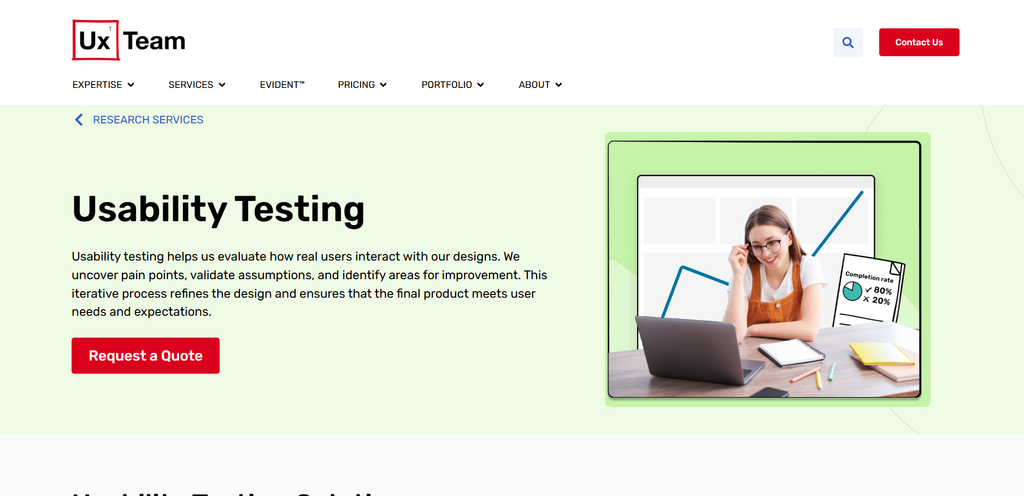
UX Team provides a fully fledged usability testing service for moderated and unmoderated testing. Its published methodology comprises prototype building, participant recruitment, session conducting, observation, design revisions, etc.
Moderated sessions are claimed to last about 30 to 60 minutes per person, while unmoderated tests will last about 15 to 20 minutes. It also details that moderated research offers room for follow-up questions, whereas unmoderated testing will be able to gather feedback from a greater number of participants.
These durations are helpful planning guides, but depend on the tasks and audience.
Advantages
- Evident, documented testing options (with and without moderation).
- A clear process from research to design refinement.
- Helpful for testing prototypes before development.
Considerations
- Unmoderated sessions may give less information about what’s going on with a participant.
- The buyer must verify the criteria for recruitment, sample size, and analysis depth.
- The final proposal should be able to differentiate research activities from design and development activities.
UX Team is suitable when a business needs to test an interface and leverage the results to enhance the design. Verify the proposed scope by usability testing service page.
6. Glow Design Agency: Best for Design-Led Usability Projects
Website: Glow Design Agency
Best suited for: Companies looking to learn about UX/UI design services, as well as research-driven interface enhancements.
Glow Design Agency is a usability testing provider in the design category. It may be suitable for engagements in which the research capabilities are incorporated.
If a website or digital product is being redesigned, usability evaluation can assist the redesign team to determine if proposed layouts, navigation, and interaction patterns are intuitive for intended users.
However, a design portfolio alone does not establish that an agency provides a complete usability research service.
What Buyers Should Check
Ask Glow to explain whether it conducts moderated user sessions, unmoderated testing, expert reviews, or other research activities. Request an example showing how a usability finding influenced a design decision.
Potential advantages
- May be applicable for projects where interface design is a critical need.
- Should be considered when research and visual design must be employed together.
Considerations
- Check for direct user research; don’t assume it.
- Seek out some relevant case studies, participant numbers information, and sample reports.
- Make sure that retesting and post-design validation are included in the engagement.
Use Glow’s official website to confirm current services, deliverables, and project availability before including the agency in a final procurement shortlist.
7. Perpetual: Best for Digital Product Design and Development
Website: Perpetual
Best suited for: Companies that work on the improvement of digital products through research, design, and development.
Perpetual provides a user experience research service, including usability testing. Other published capabilities include web and mobile UX audits, stakeholder interviews, analytics evaluation, competitive analysis, user interviews, user-flow development and persona creation.
This range might be helpful when usability issues are linked to other issues related to customer needs, product direction, navigation, etc.
Research in the Product Development Process
Think of a subscription service where the customer has a hard time deciding which subscription to choose. Usability testing can help identify if users are aware of the difference between plans and if they are able to go through the selection process. Interviews and analytics can give you more context regarding customer expectations and where they’re dropping off.
There are also examples of UX across different industries on Perpetual’s UX research page, such as financial services, media, healthcare, and technology. It has been used by clients such as US Bank, Reuters, and others.
Advantages
- Focused UX research and usability testing solutions.
- Potential for research to link to product design and development.
- A variety of research techniques and published examples of clients.
Considerations
- Verify the way that usability testing will be integrated into the proposed development engagement.
- Ask if the recruitment of participants and retesting is part of the package.
- Distinguish between research and design/engineering expenditures.
Perpetual could be a good choice for an organization that wants a product development partner with a research-based approach. Check out its UX research services and what it can offer and how it does it.
8. Neuron: Best for UX/UI Design With Research Support
Website: Neuron
Best suited for: Businesses seeking UX/UI design with supporting user research.
Neuron focuses on digital product design and UX/UI strategy. It is also listed in Clutch’s usability testing directory, where its profile identifies usability testing and user research among its service focus areas.
This makes Neuron a candidate for teams that want to investigate user needs while developing or refining product interfaces.
When Might Neuron Be a Fit?
A B2B software company may discover that users struggle to locate reporting features or understand a complex dashboard. Research can help the team identify where the interface conflicts with user expectations, while design work can translate those findings into alternative layouts or workflows.
The important consideration is how much direct testing the engagement includes.
Advantages
- UX/UI design and strategy are central to its positioning.
- Listed usability testing and user research capabilities provide a starting point for evaluation.
- May suit businesses that want research to influence interface decisions.
Considerations
- Verify which testing methods are available for the proposed project.
- Ask for examples involving similar products, audiences, or workflows.
- Confirm participant recruitment, research reporting, and validation arrangements.
Neuron is worth considering when design and research need to work together. Visit its official website and request a detailed proposal before comparing it with specialist research providers.
Usability Testing Companies Compared at a Glance
The following table summarizes each provider’s primary fit, the service details worth investigating, and publicly available pricing information. Pricing is shown only where a source provides a usable reference.
| Agency | Best Suited For | Main Evaluation Criteria | Pricing |
|---|---|---|---|
| Kualitatem | Usability testing alongside software QA | Testing methods, reporting, QA coordination | Request a quote |
| AnswerLab | Enterprise UX research | Research scope, recruitment, deliverables | Request a quote |
| Nielsen Norman Group | Specialist usability research | Research depth, expert recommendations | $40,000 for Rapid User Testing and $70,000 for Quantitative User Testing |
| Blink UX | Product research and design | Research-to-design workflow | Request a quote |
| UX Team | UX/UI projects | Moderated and unmoderated testing | 100–149/hour; $5,000+ minimum project |
| Glow Design Agency | Design-led projects | Verified research and design integration | 50–99/hour; $10,000+ minimum project |
| Perpetual | Digital product engagements | UX research and product development | 100–149/hour; $25,000+ minimum project |
| Neuron | UX/UI design with research support | Testing methods and evidence | 150–199/hour; $25,000+ minimum project |
NN/g’s published user testing pricing provides a verified starting point for specialist research. For other providers, obtain current proposals rather than assuming that unpublished prices indicate a higher or lower cost.
Clutch offers another useful comparison source. Its US usability testing directory publishes provider profiles, service-focus percentages, project-size information, and hourly rates for listed companies. For example, its October 2026 listing shows UX Team at $100 to $149 per hour, with a minimum project size of $5,000. These directory figures are useful for initial screening, but they are not guaranteed quotes for a particular study.
What Services Should You Expect From a Usability Testing Agency?
The right scope depends on what your team needs to learn. Before comparing proposals, check which of the following services each provider actually includes.
- Moderated usability testing: A researcher guides participants through tasks and asks follow-up questions to understand their decisions.
- Unmoderated usability testing: Participants complete predefined tasks independently, often through an online platform.
- Remote and in-person testing: Sessions take place online or in a physical research setting, depending on the audience and study goals.
- Website and mobile app usability testing: Researchers evaluate navigation, forms, content clarity, task completion, and important user journeys across relevant devices.
- Prototype testing: Teams evaluate wireframes, clickable prototypes, or early designs before committing to full development.
- Participant recruitment: Researchers identify people who match the target audience and screen them against agreed criteria.
- Usability reporting: Findings document observed problems, supporting evidence, severity, and recommended improvements.
- Accessibility evaluation: Where offered, accessibility assessments examine barriers affecting users with disabilities. Confirm whether this involves expert inspection, assistive technology testing, or testing with participants with disabilities.
Not every agency offers all these services. Ask for a written scope specifying the methods, participants, devices, deliverables, and follow-up activities included in the engagement.
How Much Do Usability Testing Services Cost in the USA?
Usability testing prices depend on research complexity, participant requirements, specialist expertise, and the depth of analysis.
Nielsen Norman Group publishes starting prices of $40,000 for rapid user testing and $70,000 for quantitative user testing. Its rapid offering typically includes five to ten participants and three days of testing. Its quantitative offering generally involves approximately 20 to 200 participants and one to four weeks of testing. See its official pricing and service details.
These figures represent one provider’s published consulting packages. They should not be treated as a market-wide average.
Other agencies may quote a project fee, hourly rate, or customized engagement. For example, Clutch’s US usability testing directory lists providers with different hourly rates and minimum project sizes. Those figures can help with initial budgeting, but a directory’s advertised rate does not reveal the full cost of a research project.
The main cost factors include:
- Participants: Recruitment becomes more involved when users must meet specialized professional, demographic, or industry criteria.
- Research method: Moderated interviews and quantitative studies require different resources.
- Scope: Multiple workflows, devices, products, and user groups can increase the workload.
- Analysis and reporting: Detailed findings, prioritized recommendations, and stakeholder presentations require additional effort.
- Follow-up testing: A second round can validate whether proposed changes resolve the original problems.
Before signing, request an itemized proposal covering recruitment, methodology, session numbers, deliverables, timeline, retesting, and any additional fees.
How to Choose the Right Usability Testing Agency
Start with the business problem. A team investigating abandoned checkout sessions needs a different study from a company testing a new dashboard or validating a mobile app prototype.
Use the following process to compare providers.
1. Define the decision you need to make. Identify the user problem, the workflow involved, and the product decision the research must inform.
2. Specify your target audience. Explain whether you need existing customers, first-time visitors, enterprise buyers, mobile users, or participants with particular accessibility needs.
3. Choose the right partner model. A specialist UX research agency may suit complex behavioral questions. A provider such as Kualitatem may be relevant when usability testing also needs to complement functional QA.
4. Review relevant evidence. Ask for comparable case studies, sample deliverables, and examples of how findings influenced product decisions.
5. Understand the methodology. Ask why the provider recommends moderated sessions, unmoderated tests, expert reviews, or quantitative measurement for your situation.
6. Compare the complete proposal. Consider participant quality, research design, reporting depth, timeline, and follow-up validation alongside the quoted fee.
During consultations, ask:
- How will you recruit and screen representative participants?
- How will you measure task completion and identify interaction friction?
- What will the final report include?
- How will you prioritize findings by severity and business impact?
- Can you validate the changes after our team updates the product?
A useful proposal should explain how the study will answer your questions and how the results will support practical product decisions.
Conclusion
Choosing among website usability testing companies requires a clear understanding of your research goals, target audience, methodology, reporting requirements, and budget. Kualitatem is worth considering when usability testing needs to complement broader software quality assurance activities. AnswerLab and Nielsen Norman Group may suit research-intensive engagements, while UX Team and Perpetual offer documented usability research capabilities connected to design or product development.
Compare proposals against the needs of your project rather than relying on agency descriptions alone. To discuss your requirements, explore Kualitatem’s usability testing services and request a consultation about your website, mobile application, or software product.
Frequently Asked Questions
What Does a Usability Testing Agency Do?
A usability testing agency evaluates how people interact with a website, mobile application, prototype, or software product. It observes users completing relevant tasks, identifies difficulties, analyzes patterns, and recommends improvements. Depending on the engagement, the agency may also recruit participants, conduct expert reviews, and validate updated designs.
How Much Does Usability Testing Cost in the USA?
Costs vary by provider and scope. Nielsen Norman Group publishes rapid user testing starting at $40,000 and quantitative user testing starting at $70,000. Other providers may offer different pricing structures. Request a project-specific proposal that clearly defines participants, methods, reporting, and follow-up work.
What Is the Difference Between UX Research and Usability Testing?
UX research is the broader discipline of understanding users, their needs, behaviors, and experiences. It includes interviews, surveys, diary studies, competitive research, and usability testing. Usability testing is a specific method that evaluates how effectively users complete tasks with an interface.
Should I Hire a Usability Testing Agency or Use a Testing Platform?
A testing platform may suit teams with established research skills that want to run studies independently. An agency can provide research planning, participant screening, moderation, interpretation, and recommendations. Your decision should depend on internal expertise, research complexity, and available time.
When Should Usability Testing Be Performed?
Test early when concepts or prototypes are available, during development when important workflows can be evaluated, and after launch when real user behavior reveals problems. Repeat testing after significant interface changes to check whether the intended improvements have addressed the original issues.