9 Top Test Automation Companies in the USA
September 10, 2026



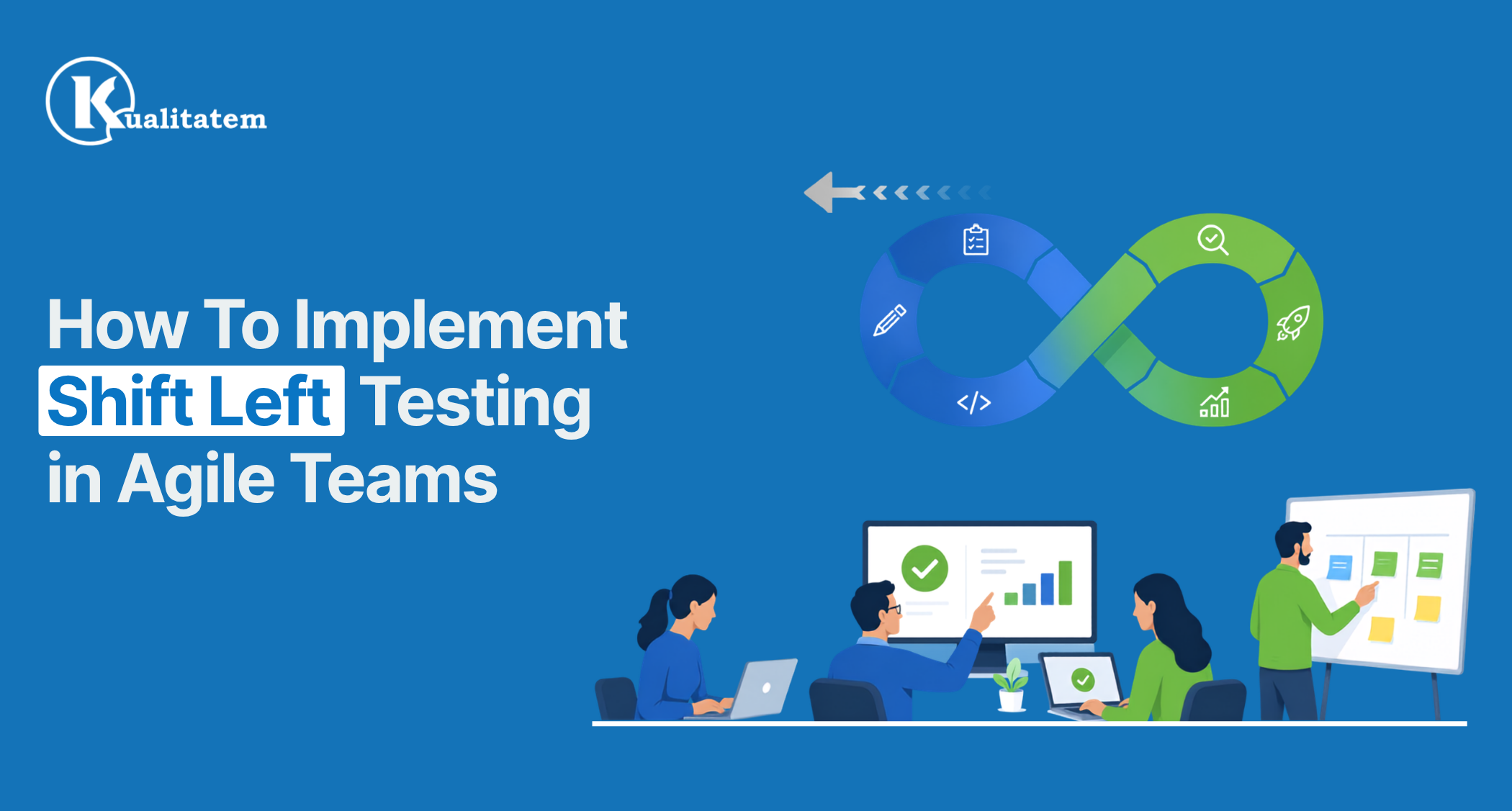
Most engineering leaders find out their testing process is broken the hard way: a defect hits production, the incident review kicks off, and someone asks why it wasn’t caught three weeks ago when it cost pennies to fix.
That question sits at the center of this blog.
Traditional QA runs at the end of the software development lifecycle (SDLC). That timing is the real problem.
A defect caught during requirements or design costs a fraction of what the same defect costs once it ships. Late validation isn’t a process detail. It’s a budget line disguised as a workflow choice.
Shift Left Testing changes that. It moves quality activities earlier in development so teams surface and resolve issues before they compound.
But true implementation requires more than just running automation scripts earlier. A comprehensive shift left testing strategy restricts your entire approach, targeting:
When continuous validation and automation-driven coverage are done right, they run inside your pipeline instead of bolting onto the end of it, which is exactly where test automation services earn their return.
Shift Left Testing pulls validation to the start of your development cycle. Instead of treating quality as a final gatekeeper at the end of the line, you distribute it across requirements, design, coding and integration.
Why is it called Shift Left? Picture the SDLC drawn left to right, from planning through release. Moving validation toward the earlier stages pulls it to the left of that timeline. Hence the name.
Its role in Agile and DevOps fit: In two-week sprints and continuous delivery, an end-of-cycle QA phase becomes the problem that everything waits on. Shift Left stops the trade-off between velocity and reliability because quality checks happen alongside development.
The core benefit. Early detection means cheaper fixes, faster feedback, and shared ownership across developers, testers, and operations.
The difference between traditional QA and a shift left approach is easiest to see side by side.
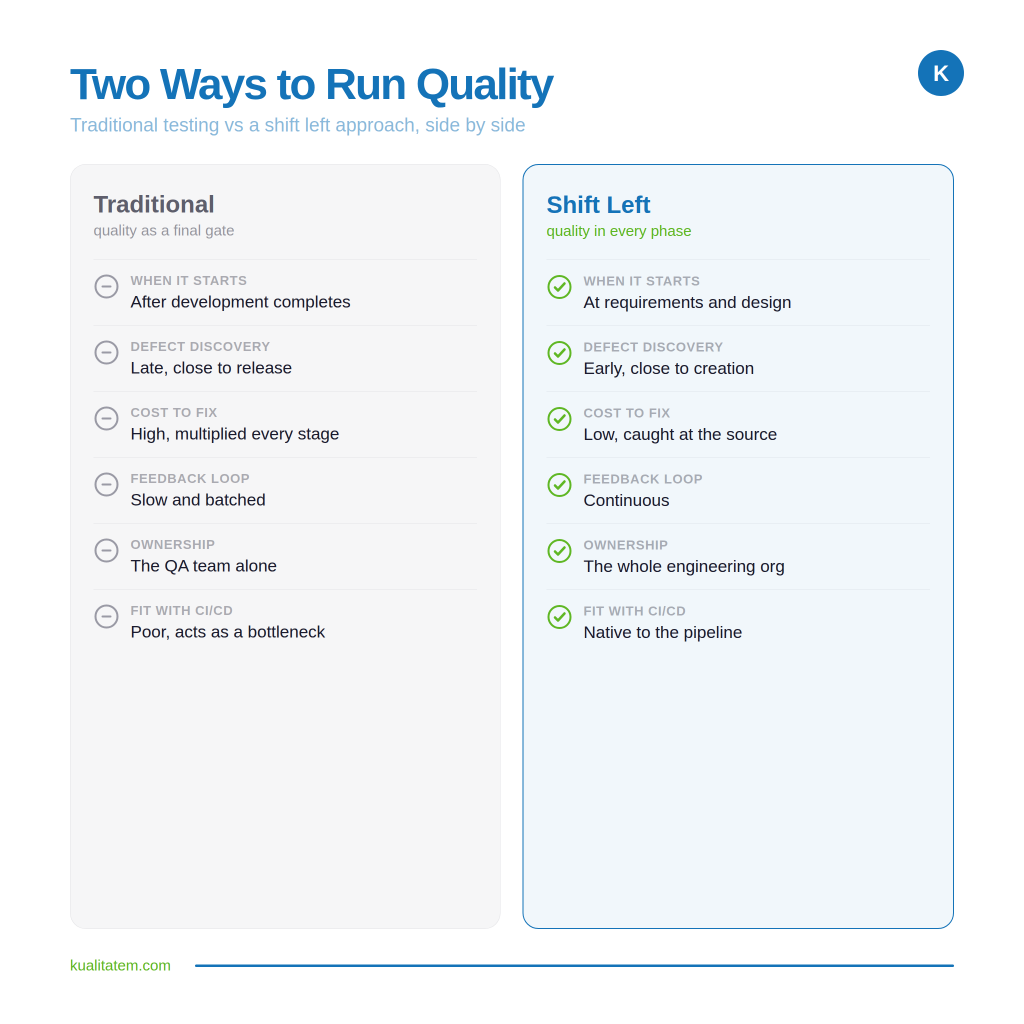
| Dimension | Traditional Testing | Shift Left Testing |
|---|---|---|
| When it starts | After development completes | At requirements and design |
| Defect discovery | Late, close to release | Early, close to creation |
| Cost to fix | High, multiplied by every later stage | Low, caught at the source |
| Feedback loop | Slow and batched | Continuous |
| Quality ownership | The QA team alone | The whole engineering org |
| Fit with CI/CD | Poor, acts as a bottleneck | Native to the pipeline |
The shift isn’t driven by testing theory. It’s driven by delivery economics. Moving quality earlier produces a stack of business outcomes that show up on the roadmap and the P&L:
Industry data confirms that a defect fixed after release costs 10 to 100 times more than the same defect caught in requirements or design.
The reason is compounding costs. A production defect doesn’t just need a code change. It needs:
Scale that up, and it stops being a QA line item.
The Consortium for Information & Software Quality estimated the cost of poor software quality in the United States at roughly $2.41 trillion in a single year.
Every defect caught in a pull request instead of production is money that never leaves the building.
Shift Left works when it sits on a stable foundation. Try to layer it onto a broken pipeline and you don’t remove the bottleneck, you just move it earlier.
Before Step 1, ensure these are in place:
The order of execution matters. Rushing to CI/CD gates before you have unit coverage, or automating regression before defining what “done” means, is how rollouts stall.
Work through these in sequence:
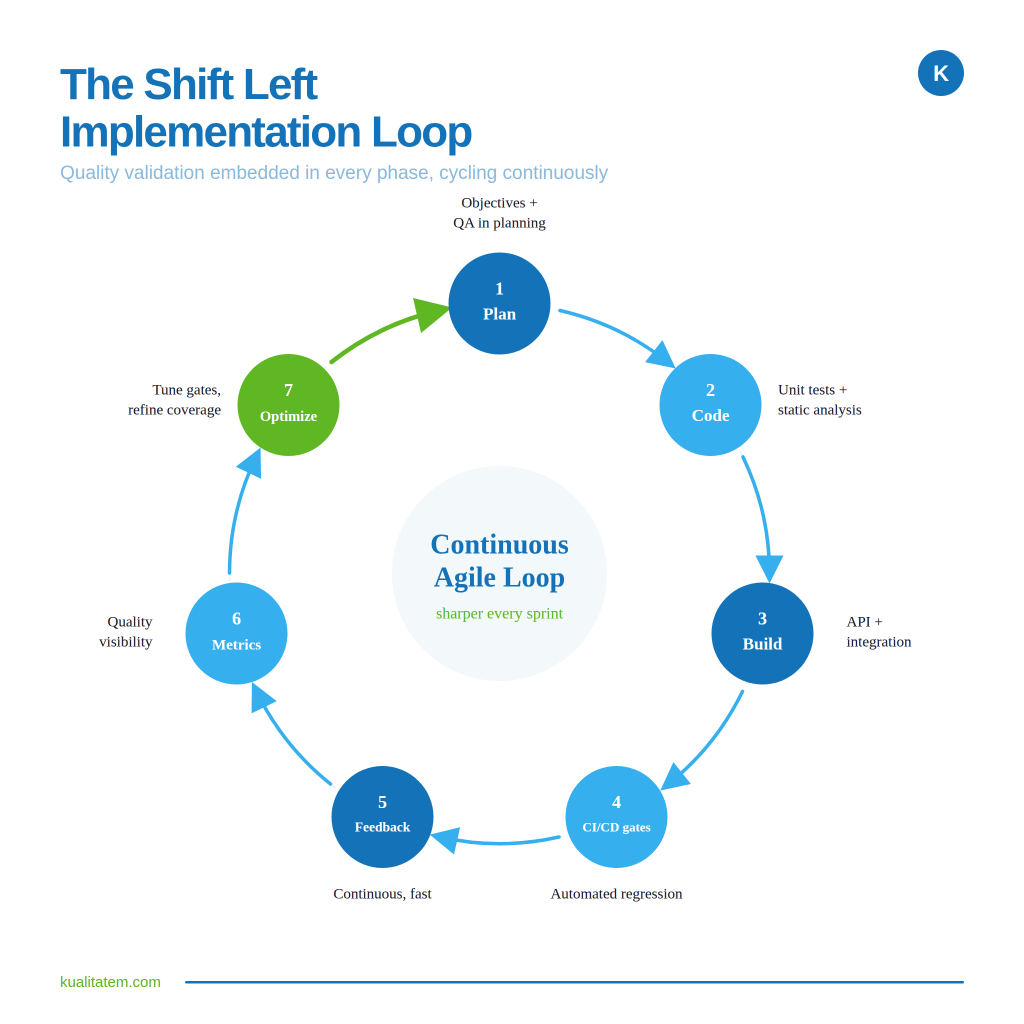
Step 1: Define quality objectives
Decide what quality means before anyone writes code. Set measurable exit criteria, coverage targets, and acceptance thresholds tied to business risk.
Step 2: Integrate QA into planning
Bring testers into sprint planning and backlog refinement not just in execution. When quality specialists help shape acceptance criteria upfront, ambiguity is caught in a conversation instead of a defect ticket.
Step 3: Automate unit testing
Make developer-owned unit checks the first quality gate. Catching a fault the moment the code is written is the cheapest possible detection point.
Step 4: Introduce API testing early
Validate contracts and integration points before the interface exists. API-level checks catch integration defects before they become expensive and tangled up with other work.
Step 5: Automate regression testing
Build a maintainable regression suite to protect every change. This automation allows teams to move fast repeatedly, rather than slowing down as the codebase expands.
Step 6: Integrate testing into CI/CD
Wire checks into the pipeline so they run automatically on every commit and merge. A broken build fails fast and stops before the bad code spreads.
Step 7: Run static code analysis
Analyze source code for defects and security issues without executing it. This automatic gate is the cheapest detection method available and catches vulnerability before a single test runs.
Step 8: Implement continuous feedback
Route results back to developers instantly with actionable context. Slow or noisy feedback kills engineering adoption faster than anything else.
Step 9: Monitor quality metrics
Instrument the pipeline so quality is visible to leadership, not anecdotal. Track defect leakage and build health to prove the shift is working and spot where coverage is thin.
Step 10: Continuously optimize the process
Treat Shift Left as highly iterative. Review coverage, tune quality gates, retire flaky checks so the programme gets sharper every sprint.
The sequence operates as a continuous Agile loop. This brings validation into every phase. Read left to right, then back around:
Every rollout hits friction. Here’s what to expect, and the practical move for each:
| Challenge | How to Overcome It |
|---|---|
| Resistance to change | Start selectively on one team or service. Show early wins before scaling the mandate. |
| Lack of automation | Build the framework first. Don’t ask engineers to shift left onto a manual process. |
| Poor collaboration | Embed QA in sprints and set shared quality goals so ownership is genuinely joint. |
| Limited test coverage | Prioritize with risk-based testing rather than trying to cover everything at once. |
| Legacy systems | Apply Shift Left to new work and contain the old. Don’t block the program on a rewrite. |
| CI/CD complexity | Integrate incrementally, one quality gate at a time, so each step stays diagnosable. |
| Skills gaps | Upskill developers on testing, or leverage QA outsourcing services to close the gap fast without slowing down delivery. |
Tooling enables Shift Left, but it doesn’t create it. The process and the ownership do.
These are the categories high-performing teams draw from to build their pipeline gates:
What matters is that your chosen stack plugs directly into automatic gates, not that you adopt any single vendor.
If you can’t measure the shift, you can’t defend the investment.
These KPIs that tell you whether quality has moved left:
| KPI | What It Tells You | Target |
|---|---|---|
| Defect leakage | Defects escaping to production | Down |
| Defect detection rate | Share of defects caught pre-release | Up |
| Build success rate | Pipeline stability and gate health | Up |
| Deployment frequency | How often you can safely ship | Up |
| Mean time to resolution | How fast you recover when something breaks | Down |
| Test automation coverage | Breadth of automated validation | Up |
| Release frequency | Overall delivery cadence | Up |
| Production defects | Real-world quality customers experience | Down |
Most failed rollouts fail quietly in one of these ways:
Use this as a readiness scorecard. If any box is unchecked, that should be your next priority:
Successful Shift Left software testing isn’t about moving tests earlier. It’s about embedding quality into every stage of development so defects surface where they’re cheapest to fix. Organizations that get this right ship faster, carry fewer defects, spend less on rework, and build software they can actually rely on.
Start small. Pick one team or service, expand automation gradually, and measure quality outcomes from day one. The teams that win don’t attempt a big-bang transformation. They compound small early wins into a program that runs on its own.
Shift Left is a cultural and technical shift as much as a technical one. It asks developers, testers, and operations to share ownership of quality instead of handing it off. Combine early validation, automation, continuous integration, and genuine collaboration, and you catch defects sooner, accelerate delivery, and ship with real confidence.
If your release cadence has outgrown the QA model built for it, that gap is fixable and measurable.
Kualitatem has embedded shift-left programs inside enterprise and regulated environments for over 15 years, backed by TMMI level 5 process maturity and a Fortune 500 track record.
If that is a conversation you need to have with your board, we can help you frame it.

Nabeesha is a Digital Content Executive at Kualitatem Inc. With a background in communication and extensive knowledge of QA and cybersecurity, she brings a business-first lens to technical content. Her work helps CTOs and engineering leaders cut through the noise and make confident decisions about software quality.
Not sure where your QA stands?
Speak to an Expert



Our experts are all ready. Explain your business needs, and we’ll provide you with the best solutions. With them, you’ll have a success story of your own.
Contact us now and let us know how we can assist.