Payment Gateway Testing: Complete Guide, Test Cases & Checklist 2026 – Content gap
October 11, 2026



Integration testing is how teams catch the defects that only appear when separate parts of a system start working together. A module can pass every unit test on its own and still fail the moment it talks to a database, an API, or a third-party service in production. That gap is where most real-world software breaks.
Integration testing on one line: it checks that separately built components work together correctly once combined. It runs after unit testing and before system testing, and in modern CI/CD it runs continuously.
Why it is worth your attention:
This guide covers what integration testing is, when to run it, the types and strategies you can choose from, real examples, tools, how it fits into CI/CD, how it applies to AI systems, and the practices that separate teams who ship with confidence from teams who ship and wait for the pager to go off.
The ISTQB defines integration testing as a test level that focuses on the interactions between components or systems. In practice, that means combining individual units or modules and testing them as a group, so the focus shifts from whether each part works to whether the parts work together.
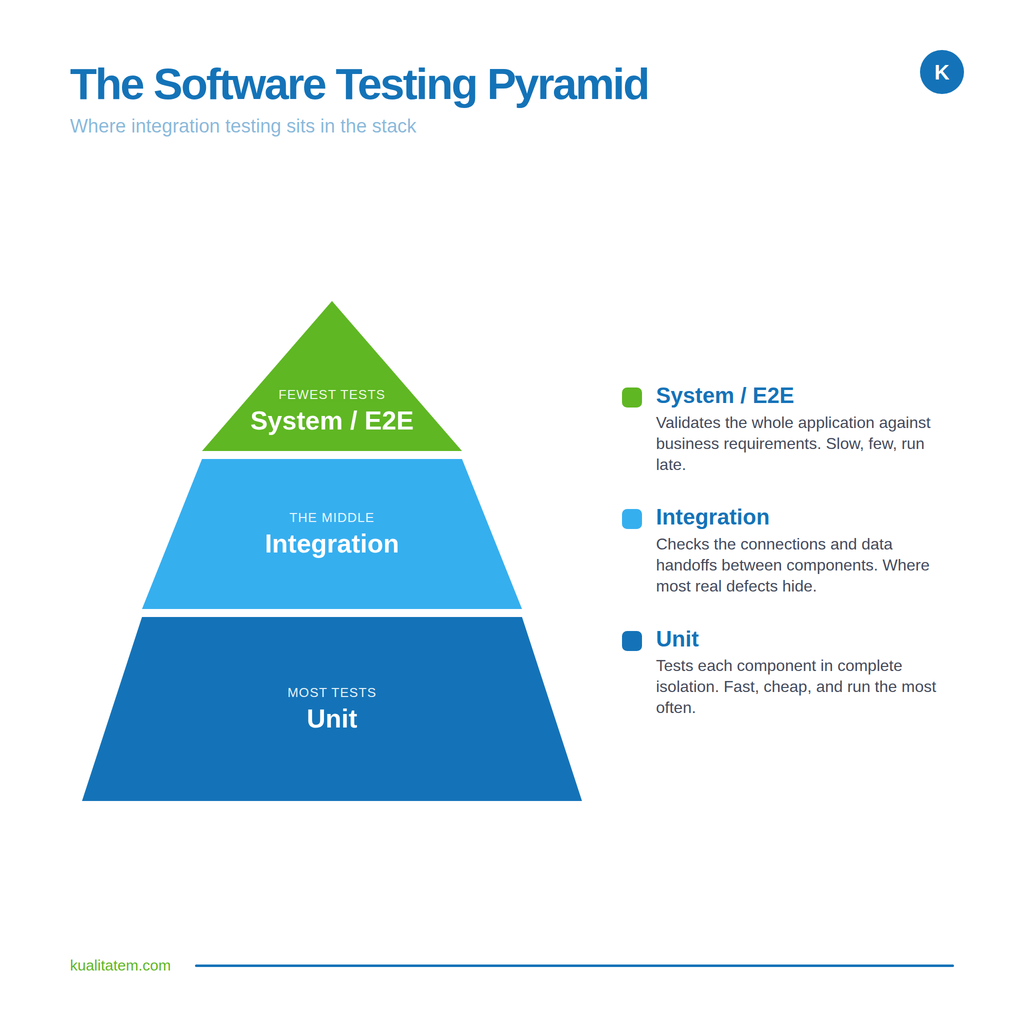
The difference between module (unit) testing and integration testing is subtle but critical:
Even when individual modules pass unit testing perfectly, failures often occur when they interact. Because most real defects don’t live inside any single component.
That is the gap integration testing exists to close.
Integration testing should be performed whenever changes could affect how application components communicate with each other. To maximise value, perform these tests at the following points in the SDLC:
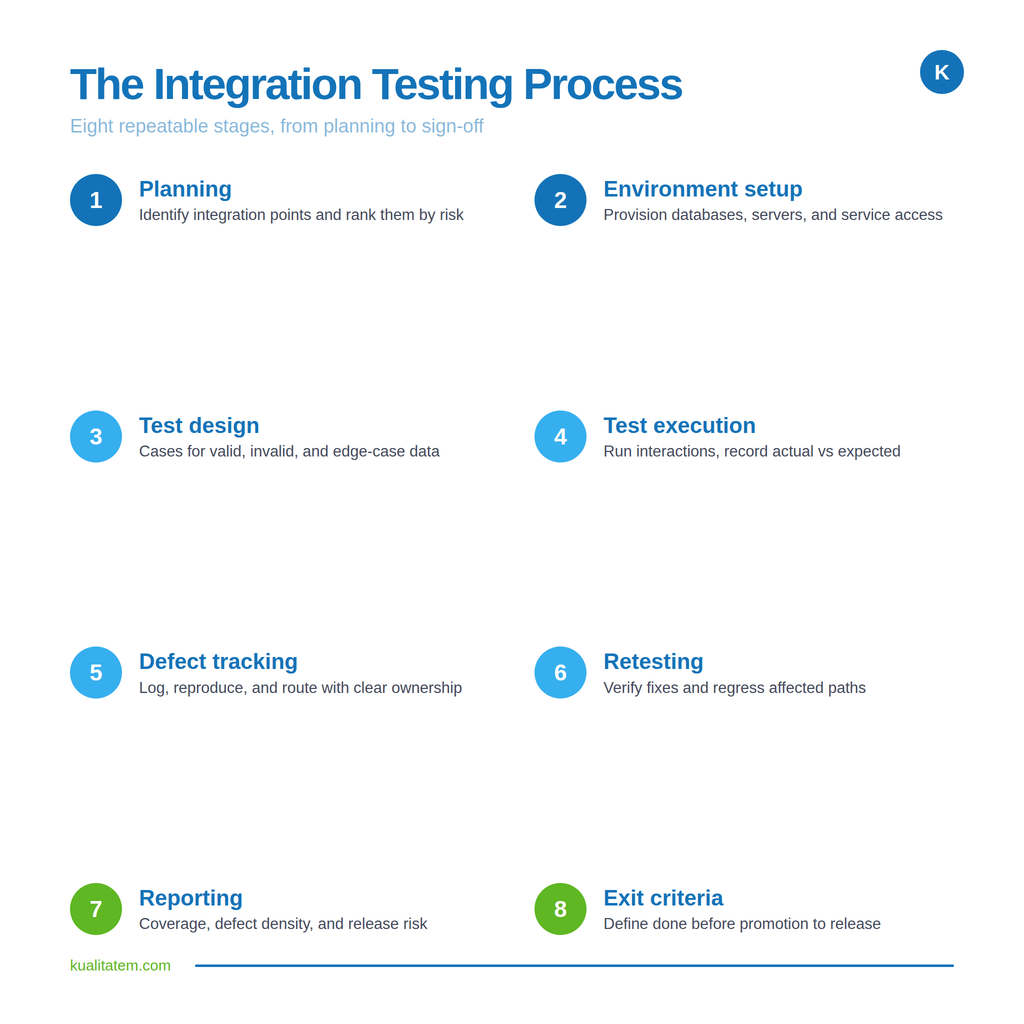
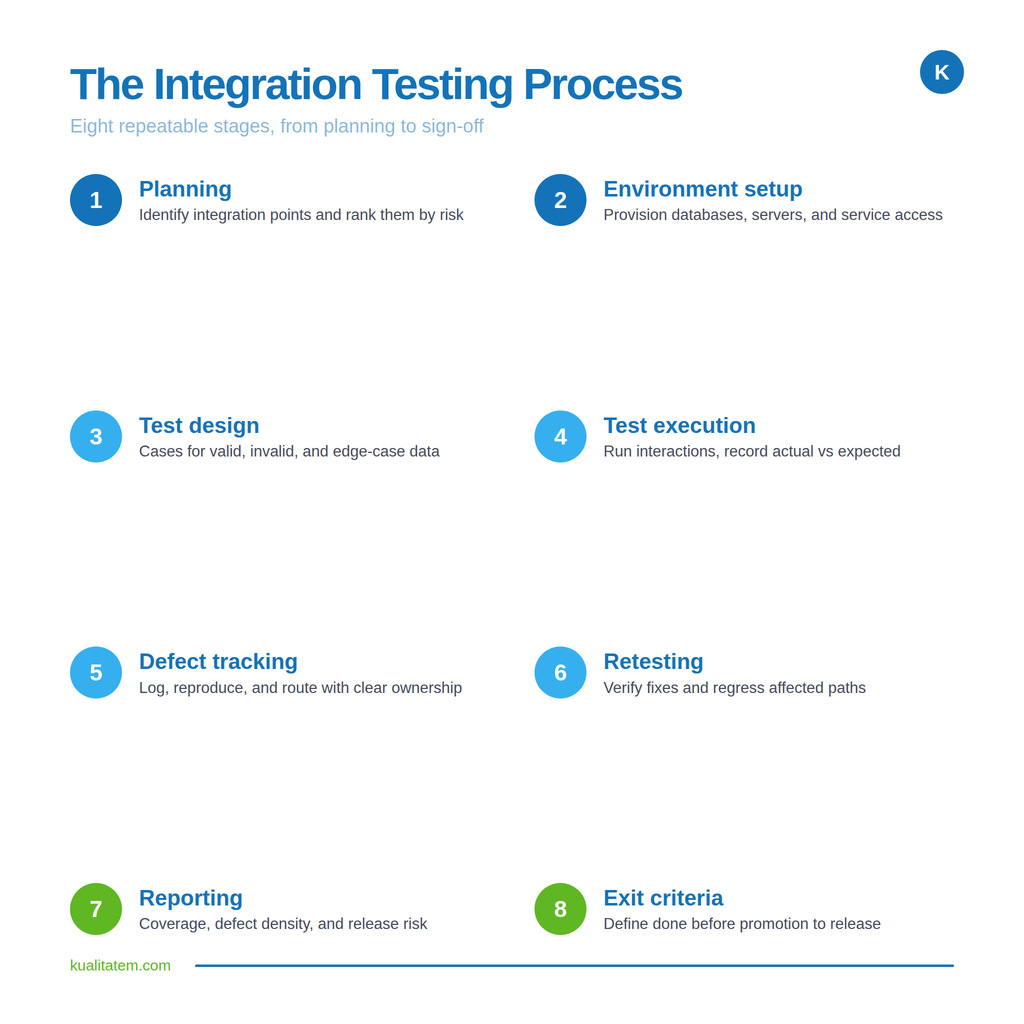
Two of those stages deserve their own gates. Entry and exit criteria decide when integration testing starts and when it is genuinely finished, and writing them down keeps the whole effort honest.
| Entry criteria | Exit criteria |
| Unit testing complete for all modules | All planned integration cases executed |
| Test environment provisioned and stable | Critical and high-severity defects resolved |
| Test data finalized (valid, invalid, edge) | Integration paths regression-clean |
| Test plans reviewed and approved | Coverage thresholds met |
| Required APIs and external services reachable | Sign-off recorded |
Beyond these four, most teams building on microservices now lean on a modern set of approaches.
These methods do not replace classic testing strategies. Instead, they make integration testing feasible when you have more services than you can realistically spin up at once.
| Strategy | Starts from | Advantages | Disadvantages | Best for |
| Big Bang | All modules at once | Minimal planning | Hard to isolate defects | Small systems |
| Top-Down | High-level modules | Early core-flow validation | Needs many stubs | UI-led designs |
| Bottom-Up | Low-level modules | Strong foundation testing | Late high-level validation | Data-heavy systems |
| Sandwich | Middle layer | Balances both directions | Complex to plan | Layered enterprise apps |
For teams in banking, finance, and government, the money and the compliance risk live in the handoffs, not the individual services.
APIs are where most integration defects live, because APIs are where most systems connect.
This is also where contract testing pays off. Instead of standing up every dependent service to test one API, contract testing verifies that a request and response match the agreed schema between consumer and provider in isolation. It lets a team validate its side of an integration without waiting on everyone else’s.
Integrating these tests into the pipeline turns testing from a phase into a continuous habit.
Tools: GitHub Actions, GitLab CI, and Azure DevOps are heavily utilized to automate these checks.
Tests should run on nightly builds, on every Pull Request and throughout the continuous integration cycle.
Integration tests act as gates, automatically blocking merges and deployment if interaction fails.
For anyone measuring release velocity, this is the part that matters. Ephemeral environments and pipeline-gated integration tests let a team move quickly without the usual trade-off of moving quickly and breaking things.
AI systems have added a whole new integration surface, and most older testing guides do not cover it. If your product touches an LLM, a retrieval pipeline, or an agent, your testing scope must expand.
New Integration Points to Validate:
AI generated code goes live faster than teams review it. And it can look perfectly correct while quietly breaking an API contract or changing a data format. That makes it harder to catch by eye, so it needs the same integration validation as human-written code.
Kualitatem already handles both AI and agentic systems testing. The approach does not change: the handoff is where things break, so that is where we start.
| Dimension | Manual integration testing | Automated integration testing |
| Speed | Slower, human-paced | Fast, runs on every commit |
| Cost | Lower upfront, higher ongoing | Higher upfront, lower per run |
| Accuracy | Prone to human error on repetition | Consistent and repeatable |
| Scalability | Limited by team size | Scales across builds and services |
| Maintenance | Low tooling upkeep, high effort per run | Scripts need upkeep as APIs change |
| Best for | Exploratory, first-time, complex flows | Regression, CI/CD, high-frequency paths |
Integration testing is one level in a wider stack. It sits alongside unit, system, functional, and regression testing, each with a different focus and timing.
| Testing type | Focus | When it runs |
| Unit | One function or module in isolation | During development |
| Integration | Interfaces between combined modules | After unit, before system |
| System | Complete application vs requirements | After integration |
| End-to-End | Full user journey across the stack | Late, pre-release |
| Functional | Features behave to spec | Throughout |
| Regression | Existing features after a change | After any change |
| Tool | Best for |
| Postman | REST and SOAP API testing |
| SoapUI | SOAP and API contract testing |
| REST Assured | Java API integration tests |
| Pact | Contract and consumer-driven contract testing |
| Selenium | Web UI integration paths |
| Cypress | Modern web app integration |
| Testcontainers | Running tests against real dependencies |
| WireMock / MockServer | Mocking and service virtualization |
| TestNG / JUnit / PyTest | Test frameworks for Java and Python |
| Docker Compose | Spinning up test environments |
| Jenkins / GitHub Actions / GitLab CI | Running integration suites in CI/CD |
The teams that ship confidently tend to do the same handful of things.
1. What is integration testing?
Integration testing evaluates how separate components behave when combined. Its primary goals are to:
2. Why is integration testing important?
Components can pass unit tests perfectly but still fail when interacting because most real defects live in the handoffs. It is critical because it:
3. What are the different types of integration testing?
The four classic types are:
4. What is the difference between integration and system testing?
Integration testing checks the connections between combined modules and runs after unit testing. System testing validates the complete, integrated application against business requirements and runs after integration testing. One checks the wiring, the other checks the finished product.
5. What tools are used for integration testing?
The right mix depends entirely on your stack, but common tools include:
6. Can integration testing be automated?
Yes, and most integration testing in modern pipelines is automated. Automation handles the repetitive, high-frequency checks that run on every commit. Manual and exploratory testing still covers complex, first-time, or judgment-heavy integration paths where a human catches what a script would miss.
7. When should integration testing be performed?
Run it after unit testing, before system testing, after API or database changes, on every commit inside CI/CD, and before every production release. The underlying rule is to test integrations whenever a change could affect how components communicate.
8. How is contract testing different from integration testing?
Contract testing checks that a request and response match an agreed schema between a consumer and provider in isolation, without running every dependent service. Integration testing verifies actual runtime behaviour when components interact together. Contract testing is faster and narrower; integration testing is broader and closer to real conditions.
9. Should AI-generated code go through integration testing?
Yes. AI-generated code can look correct while quietly changing API behaviour, data formats, or error handling. It should go through the same integration validation as human-written code, and arguably stricter, because its failure modes are harder to catch by reading.
10. What are flaky integration tests and how do you fix them?
Flaky tests pass and fail inconsistently without any code change, usually because of timing issues, shared test data, or unreliable external dependencies. You fix them by isolating test data, controlling for timing, and using mocks or service virtualization so a test does not depend on another service being up.
Software rarely fails inside a single component. It fails at the connections, which is exactly what unit testing leaves unchecked. That is why integration testing is essential, and why in Agile and DevOps teams it has to run inside the pipeline on every commit.
The right approach depends on your stack: incremental for most work, contract testing and virtualization once you are on microservices. The strongest teams pair automated checks in CI/CD with manual testing on the complex, high-risk paths.
Kualitatem’s engineers validate every integration point across your modules, APIs, and third-party systems before your users see the release. Speak to an Expert →

Nabeesha is a Digital Content Executive at Kualitatem Inc. With a background in communication and extensive knowledge of QA and cybersecurity, she brings a business-first lens to technical content. Her work helps CTOs and engineering leaders cut through the noise and make confident decisions about software quality.
Not sure where your QA stands?
Speak to an Expert

Our experts are all ready. Explain your business needs, and we’ll provide you with the best solutions. With them, you’ll have a success story of your own.
Contact us now and let us know how we can assist.