Testing Services for Temenos Banking Systems
October 2, 2026



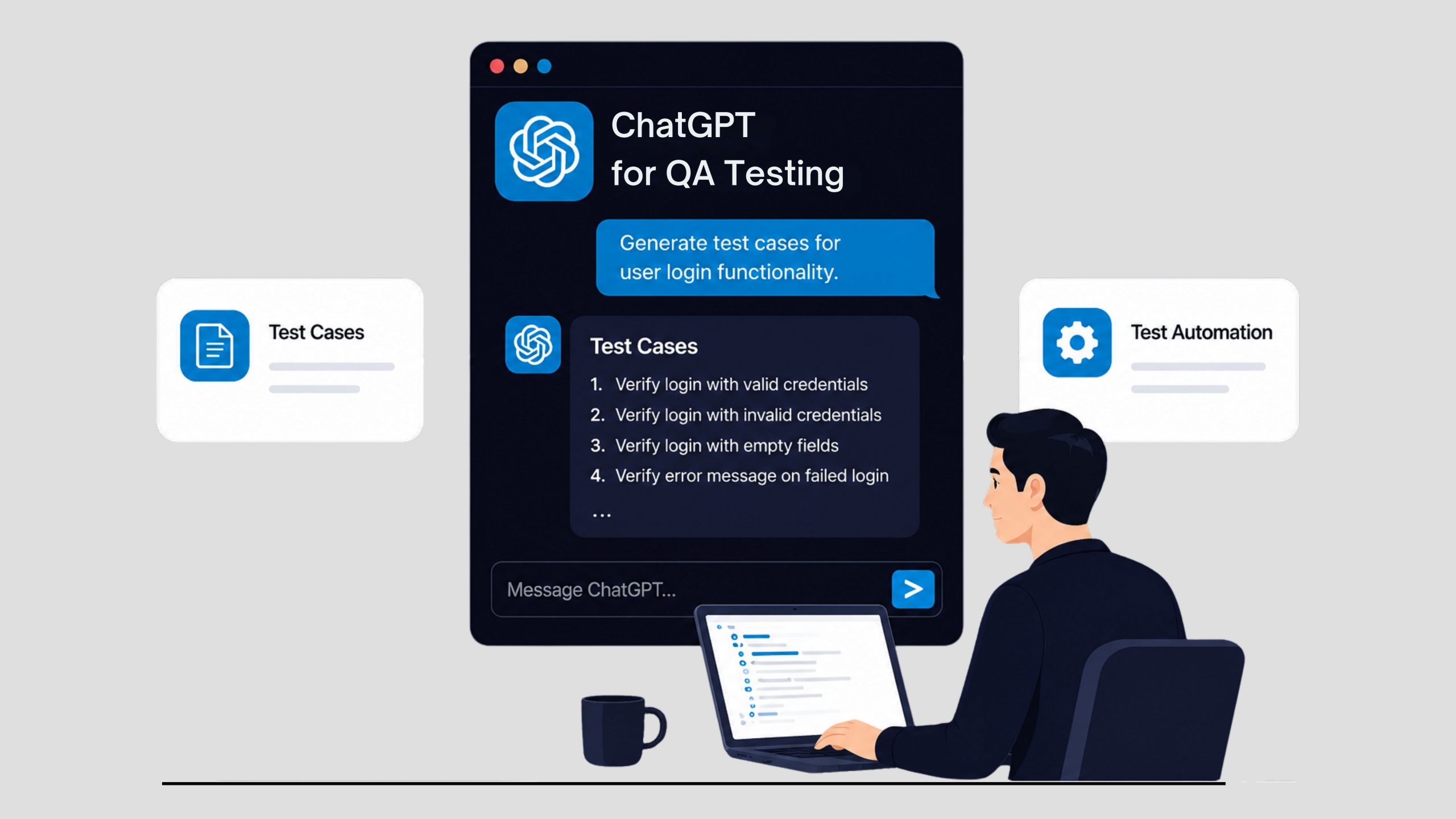
Generative AI has moved from experiment to operational reality within engineering organizations. 72% of QA teams now use AI tools for test creation. Teams report coverage increases of up to 85% and cost reductions of roughly 30%. Yet only 15% of organizations have scaled AI usage across their QA functions with proper governance.
That gap is not a tooling problem. It is a process problem.
CTOs who treat ChatGPT as a productivity shortcut for individual testers will see marginal gains. CTOs who embed it into structured, governed QA workflows, the broader qa workflow, and the end-to-end testing workflow will see it compound across every release cycle: faster test coverage, shorter sprint cycles, reduced late-stage defect discovery, and QA engineers spending their time on judgment rather than documentation.
This guide is written for engineering leaders making that organizational decision. It covers where AI creates measurable leverage across the QA lifecycle and across different software testing tasks, where human judgment remains non-negotiable, and how mature teams are building AI into their QA processes without introducing new risk.
Manual testing is not a legacy practice waiting to be automated away. It is the layer that protects against business logic failures, compliance gaps, and user journey breakdowns that no automated tool catches reliably. What ChatGPT changes is not whether manual testing happens. It changes how fast and consistently your team can design it.
The operational shift: QA engineers who previously spent days drafting structured test coverage from requirements can now produce first drafts in hours, improving test design and reducing manual effort in early-stage writing test cases, then invest recovered time in the analytical work that actually requires their expertise.
In regulated industries, a missing negative test scenario is not a quality gap. It is a compliance exposure. One uncovered failure path in a banking login flow or healthcare portal can mean a production incident or an audit finding.
ChatGPT can generate test cases from a user story or requirement spec and turn them into structured test cases spanning positive flows, boundary conditions, and expected behavior for both successful and failing paths. What previously took a QA engineer a full day to produce can be drafted in under an hour, reviewed, and refined into detailed test cases, including negative test cases.
A senior QA engineer should review the draft to ensure negative tests cover invalid or missing data scenarios see Kualitatem’s testing services for expert validation and traceability.
The business case: Faster test case generation compresses the time between requirements sign-off and test-ready coverage. That directly reduces the late-cycle defect discoveries that delay releases and inflate remediation costs.
Limitation: AI-generated test cases require expert review. ChatGPT will hallucinate field names, assume error messages that do not match your spec, and miss domain-specific business rules. In regulated environments, every generated test case needs traceability to a specific requirement before it enters execution, with reviewers also checking for additional tests and confirming expected output.
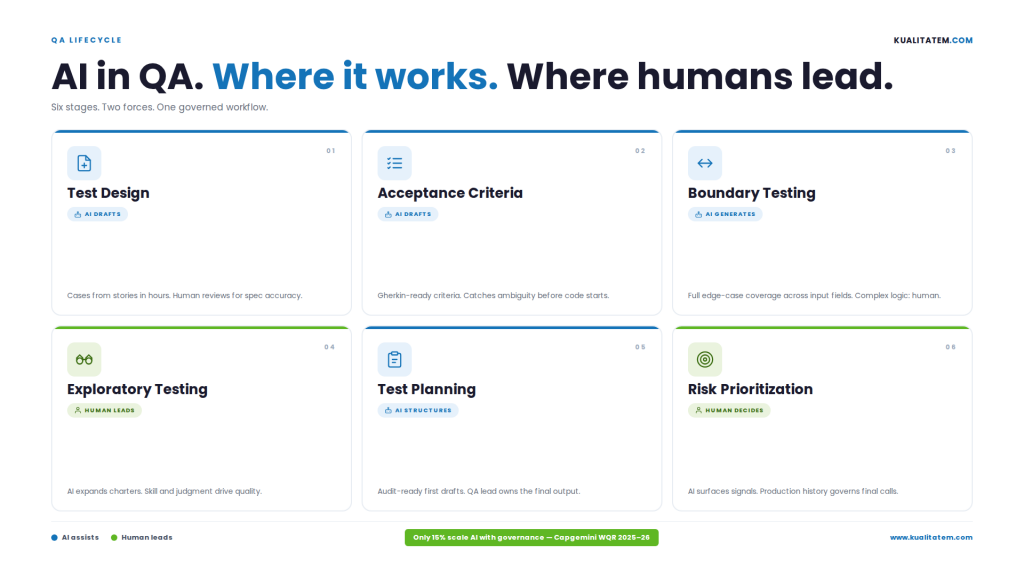
Ambiguous acceptance criteria are one of the most expensive sources of rework in software delivery. When product, engineering, and QA operate from different interpretations of done, defects surface late, sprints slip, and the cost of correction multiplies.
ChatGPT accelerates the translation of user stories into structured acceptance criteria that align all three functions before a line of code is written. Using the following user story as prompt context, it can also generate test scenarios or test cases in Gherkin format from the same input. Effective prompts define role, task, domain context, and output format to improve output quality. The value is not the syntax. It is catching ambiguity during grooming rather than in production.
For regulated industries, this has an additional dimension. Clearly defined, traceable acceptance criteria are audit artifacts. The faster your team produces them, the more release cycles you can run per quarter without sacrificing documentation integrity.
Limitation: Generated criteria tend to omit non-functional requirements including performance SLAs and accessibility standards. Product owner review remains essential before criteria enter development.
Input validation failures are among the most consistent sources of customer-visible defects and compliance findings in regulated industries. They are also among the most tedious to cover manually, which is precisely why they get under-tested.
ChatGPT generates systematic boundary value and equivalence partition coverage across input fields, ranges, and data types faster than any manual process. For a loan application with age and income constraints, or a payment form with amount limits, AI can generate boundary-focused inputs, include invalid data types where relevant, and support identifying edge cases beyond simple ranges. For example, you can prompt it to generate boundary data for fields and validations so it returns the full set of limit cases, invalid ranges, and error condition tests in minutes.
The organizational impact: Engineering teams close input validation gaps without assigning senior QA time to mechanical test generation. That capacity goes elsewhere.
Limitation: Multi-field boundary conditions, where combinations of inputs trigger different validation rules, require human analysis. While large language models help with this analysis, human expertise is still required for complex conditional logic. ChatGPT handles single-field boundaries reliably. Complex conditional logic needs a QA engineer.
No test plan covers everything. Exploratory testing is the layer that catches what scripted tests miss: unexpected user journeys, environmental edge cases, and interaction patterns that only surface through creative investigation.
The challenge for engineering leaders is coverage. A QA team with finite capacity can only explore so many charters per sprint. ChatGPT expands that surface area by generating risk-focused exploratory charters across functional, UX, performance, and security dimensions faster than testers can brainstorm them manually.
The result is broader exploratory coverage within the same sprint capacity, and a more systematic record of what was investigated and why.
Limitation: AI-generated charters are starting points. The quality of exploratory testing still depends entirely on the tester’s product knowledge and investigative skill.
According to the AICPA SOC 2 Trust Services Criteria, change management protocols require documented evidence of system testing before production deployment.
In regulated sectors, a structured test plan is not optional process overhead. It is an audit artifact. PCI DSS, HIPAA, and SOC 2 frameworks expect documented evidence of testing scope, coverage decisions, entry and exit criteria, and sign-off.
The time QA leads spend producing that documentation is time not spent on coverage strategy and risk analysis. ChatGPT accelerates first-draft test plan production, generating structured plans covering scope, test levels, test types, entry and exit criteria, a test strategy with environment needs, risk-based priorities, and reporting structures, while also pointing teams toward the target test environment for execution readiness in a fraction of the time a manual draft requires.
The governance benefit: Faster documentation production means more release cycles can complete with proper audit trails without increasing QA headcount.
Limitation: Generated plans will not match organization-specific templates or compliance framework requirements without manual adjustment. QA leads own the final structure and terminology.
Engineering leadership cannot test everything before every release. The decision of where to concentrate QA effort is one of the most consequential calls a QA organization makes, and it is made under time pressure every sprint.
Risk-based testing is how QA and engineering leadership align on coverage priorities. AI improves that prioritization by processing module complexity, change frequency, defect history, and recent code changes faster than manual review allows, surfacing the highest-risk areas for regression testing and mapping them to appropriate test types before the team commits its capacity.
For a CTO, this is not a testing technique. It is a resource allocation tool. The QA team that uses AI to prioritize intelligently will consistently find more critical defects per sprint than the team working from intuition and habit.
Limitation: AI cannot access production incident history, real defect trends, or regulatory findings. Risk prioritization outputs must be combined with historical data and domain knowledge, and human review should account for the effect of code changes on downstream modules before priorities are finalized.
Poor UX in regulated industries does not stay internal. It drives app store ratings down, increases support volume, generates regulatory complaints, and accelerates churn. For a CTO, that makes UX quality a revenue and reputation risk, not just a design preference.
Manual usability evaluation does not scale. A QA team cannot heuristically review every flow, every persona, and every accessibility requirement on every release. ChatGPT extends that coverage by generating usability review checklists, WCAG 2.2 AA accessibility checks, and scenario-based tests for specific user populations, including journeys where performance testing helps surface usability risks under load.
The result: Broader heuristic coverage without proportional headcount growth.
For CTOs managing microservices or integrated platforms, individual component quality is not the primary risk. The risk lives at the integration points. A system where every component passes its unit tests but fails at the seams is a system that produces production incidents.
End-to-end scenario coverage validates that the whole system behaves correctly under real conditions across all integration points. Designing that coverage manually across a loan origination flow integrating credit bureau, KYC, and notification services is among the most time-consuming QA activities.
ChatGPT reduces the design time for that coverage significantly, decomposing high-level business flows into detailed end-to-end test scenarios across multiple stages of the flow, with cross-system checkpoints and data dependencies.
Limitation: AI will misrepresent system interfaces and data formats without accurate architectural context. QA architects must align generated flows with real integration contracts before execution.
The senior engineers on your automation team spend a disproportionate share of their time on scaffolding and boilerplate. Initial test script structure, assertion patterns, fixture organization, and refactoring legacy suites are necessary but low-leverage work for engineers at that level.
ChatGPT reduces that overhead across every major automation framework. For automation testing, AI supports code generation by producing usable starting structures for test scripts, assertion libraries, and refactoring patterns, and it can help create automation scripts in languages like Python and Java that engineers would otherwise write from scratch. The freed capacity goes toward framework architecture, coverage strategy, and the engineering decisions that actually require senior judgment.
The organizational math: If AI reduces automation scaffolding time by 40%, a five-person automation team gains the equivalent of two engineer-sprints per quarter without adding headcount.
Framework design, CI/CD configuration, synchronization logic, test data management, and ongoing maintenance remain engineering responsibilities. All AI-generated code requires review before entering your pipeline. Sensitive system details should never be included in prompts to public AI models.
Whether your team runs Selenium, Playwright, or Cypress, AI generates usable starting structures for common flows like a login page, including checks for successful authentication with valid credentials, assertion patterns, and data-driven test variations, including page-object drafts that help with repetitive tasks. Senior engineers review and refine rather than write from scratch, because teams still need engineering judgment before they execute tests, compressing the time from coverage decision to executable test.
Legacy automation suites accumulate duplication, flaky patterns, and recurring test failures over time, which can also erode test reliability in legacy suites. ChatGPT functions as a first-pass reviewer, identifying readability issues, missing negative scenarios, unnecessary waits, refactoring opportunities, and helping structure a bug report from failing automation output before peer review. This supplements peer review and gives engineers a structured starting point for maintenance work rather than approaching legacy code without context, though analytical skills are still needed to interpret AI suggestions correctly.
In distributed architectures, API contract failures are a leading cause of production incidents. In broader software testing, this is a common example of how defects slip across team boundaries when contracts are not validated early. A downstream team changes a response schema. An upstream consumer does not know until their tests fail in production. Large language models use natural language processing to help teams interpret API requirements and responses more clearly, which can shorten the gap between a contract change and detection. The window between contract change and detection is where incidents live.
AI-assisted API test generation increases the volume and variation of tests your team can run per release cycle. ChatGPT generates structured api test cases and detailed test cases across endpoints covering valid requests, authentication failures, schema violations, rate limiting, and idempotency, with a Test ID and clearly stated expected output so the artifacts are ready for review and would otherwise take a QA engineer hours to write manually.
For teams managing dozens of microservices, this capability directly impacts release velocity. More API coverage per cycle means a narrower detection window and fewer contract failures reaching production.
Limitation: Generated URLs and schemas are mocked. All AI-generated API tests must be validated against actual OpenAPI or Swagger specifications before execution.
When upstream systems are unavailable, realistic test data is a bottleneck. ChatGPT generates synthetic data matching schema requirements, varied status conditions, and boundary value scenarios, and teams can use natural language prompts or detailed prompts to generate test inputs and generate test data for boundary conditions while supporting broader test creation in the test environment, including records that intentionally violate business rules to validate downstream error handling.
Limitation: Synthetic data must align with anonymization policies and will not cover all real-world edge cases without manual supplementation.
Poorly written bug reports are a hidden tax on engineering velocity, and a weak bug report slows triage and communication across the QA workflow. Vague steps, missing environment details, and inconsistent severity classifications create back-and-forth between QA and development that adds days to resolution time. Across dozens of defects per sprint, that overhead compounds significantly.
ChatGPT structures informal defect descriptions into clean, actionable reports with all fields required for immediate triage, especially when you define the output format to include reproduction steps, environment, severity, and expected output. The impact is measurable: faster developer comprehension, fewer clarification cycles, and shorter time-to-fix.
The same capability applies to log analysis. Pasting application logs or test runner outputs into ChatGPT and asking for error pattern summaries mapped to system layers gives QA leads faster initial signal before they open their monitoring tools. It can also turn runner logs into a prompt example for repeatable triage summaries, along with example output teams can standardize across investigations.
Limitation: AI-assigned severity is a starting point. Final triage decisions must follow your organization’s defined rules.
The difference between QA organizations that get sustained value from AI and those that see marginal gains is not which tools they use. It is whether AI is embedded in governed process or used ad hoc.
Teams that build standardized prompt templates with practical chatgpt prompts into their QA playbooks strengthen the testing process across the overall testing workflow, establish review gates for AI-generated outputs, and integrate AI assistance into existing workflows to reduce manual handoffs during test creation, review, and test execution. Teams that use AI informally produce variance: coverage gaps that look filled, test cases that pass review but miss the spec, and automation scripts that work until the system changes.
For a CTO, this is an organizational design decision. The question is not whether to allow AI in QA. It is how to structure its use so that it multiplies your team’s judgment rather than bypassing it.
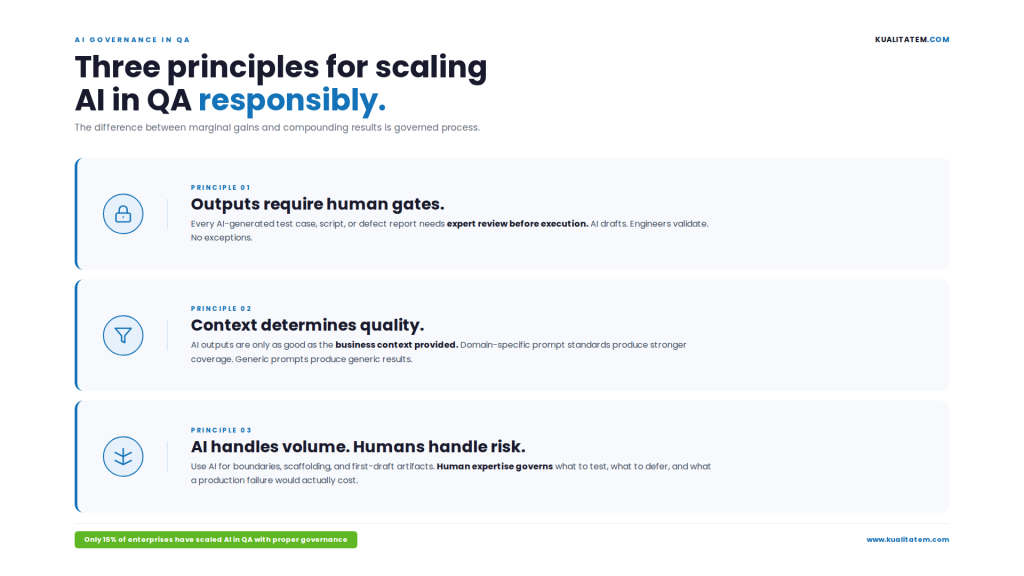
Outputs require human gates. Every AI-generated test case, script, or defect report needs expert review before it enters execution or your tracking system. AI drafts. Engineers validate.
Context determines quality. AI outputs are only as good as the business context provided. Teams that invest in detailed, domain-specific prompt standards that define role, task, context, and format get stronger output quality across different software testing tasks. Teams that prompt generically get generic coverage.
AI handles volume. Humans handle risk. Use AI to support multiple stages of work, from the boundary cases and scaffold to first-draft artifacts across several testing activities. It can assist with several workflows, but human expertise still governs the decisions that carry organizational risk: what to test in this release, what to defer, and what a failure in production would actually cost.
This example demonstrates what AI-assisted QA looks like end to end, using a scheduled funds transfer feature in an online banking platform.
As a user story, a banking customer can schedule a funds transfer up to 30 days in advance. Transfer amounts range from $1 to $50,000. The system must validate sufficient balance, recipient account, and scheduling date.
The QA lead provides the full requirement to ChatGPT with business context, including the following user story and the desired output format. The output is structured test cases: a first draft of approximately 15 test cases covering the happy path, boundary conditions, and error handling, and it can include Test ID fields and structured detailed test cases. The QA lead reviews, discards redundant cases, and flags two expected results that do not match the actual spec.
Where human judgment is essential: Identifying which generated cases reflect real system behavior versus AI assumptions about how validation works, and spotting missing additional tests.
A follow-up prompt has the QA lead ask ChatGPT to generate boundary-focused inputs for the amount field ($1 to $50,000) and the scheduling date range (today plus one through today plus 30), while identifying edge cases, negative test cases, and negative tests where values fall outside the allowed range. AI adds boundary cases for $0, $1, $50,000, $50,001, invalid dates, and out-of-range scheduling windows.
Where human judgment is essential: Confirming that the system’s actual validation rules match the boundaries AI assumed from the requirement.
The top five scenarios are converted into structured acceptance criteria for the development team, and the same prompt can also generate Gherkin-style acceptance criteria or test scenarios when needed. The product owner reviews for accuracy and flags one scenario where the proration logic was described incorrectly.
Where human judgment is essential: Product domain knowledge that AI does not have and cannot infer from the requirement alone.
An automation engineer prompts for a test skeleton and code generation for automation scripts in Python or Java, covering the happy path for a login and transfer scheduling flow with API interception for the transfer scheduling endpoint and valid credentials. The output provides structure, navigation, form interaction, and response assertion patterns, supporting automation testing by reducing repetitive tasks, though it cannot execute tests itself. The engineer adapts locators, adds synchronization, and integrates into the existing framework.
Where human judgment is essential: Framework architecture decisions, selector reliability, and CI integration that AI cannot configure.
A senior qa engineer on the QA team reviews all outputs, discards three redundant cases, corrects two expected result descriptions, adds one regression testing scenario after reviewing recent code changes, adds one security scenario for CSRF token validation that AI did not generate, and maps the final suite into Kualitee for execution tracking; this human review step keeps the qa workflow aligned with real system behavior.
The outcome: A release-ready test suite produced in a fraction of the time a fully manual process would require. The speed gain came from AI. The quality standard came from the engineers.
ChatGPT creates measurable leverage across the QA lifecycle. Faster support across software testing tasks. More systematic boundary coverage. Reduced automation scaffolding time and less manual effort. Structured defect reporting. For engineering organizations running complex systems under release pressure, that leverage compounds across every sprint.
But the organizations that benefit most are not the ones with the most AI adoption. They are the ones with the most disciplined AI integration. Governed process. Standardized templates with detailed prompts. practical ChatGPT prompts as governance tools. Human review gates at every output stage.
The CTO’s role is not to evaluate AI tools. It is to decide how AI fits into the engineering organization’s quality standard. Used as a shortcut, it introduces risk. Used as a force multiplier within mature QA processes, it is one of the highest-leverage investments an engineering organization can make right now.
Kualitatem helps regulated enterprises build that governance layer, integrating AI assistance into structured QA workflows through Kualitee’s test lifecycle management platform, so the speed gains are real and the quality standard holds.

Nabeesha is a Digital Content Executive at Kualitatem Inc. With a background in communication and extensive knowledge of QA and cybersecurity, she brings a business-first lens to technical content. Her work helps CTOs and engineering leaders cut through the noise and make confident decisions about software quality.
Not sure where your QA stands?
Speak to an Expert

Our experts are all ready. Explain your business needs, and we’ll provide you with the best solutions. With them, you’ll have a success story of your own.
Contact us now and let us know how we can assist.