Testing Services for Temenos Banking Systems
October 2, 2026



Penetration testing is a systematic security assessment that simulates realistic attacks to identify and validate vulnerabilities and understand their potential impact on an organization.
A structured penetration testing methodology helps organizations conduct assessments consistently, manage testing risks, and turn technical findings into actionable security improvements.
This detailed guide will explore the major frameworks used for penetration testing, the phases along with the practical implementation of these methodologies in real-world scenarios.
Different security engagements require different penetration testing frameworks. The appropriate framework depends on the target environment and testing objectives.
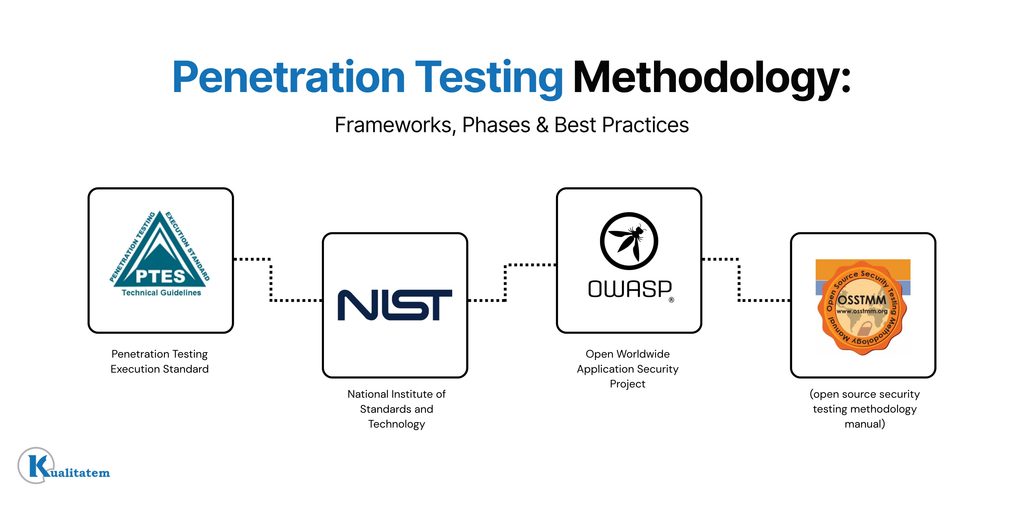
PTES provides you with a practical end-to-end structure to conduct penetration testing for your organization. It covers all of the following seven major phases of the testing lifecycle:
It provides a structured flow for managing the engagement from planning through reporting.
NIST SP 800-115, Technical Guide to Information Security Testing and Assessment, provides guidance for planning and conducting technical security testing and assessments.
Its structured approach is particularly useful when an organization needs a clearly documented assessment process.
NIST helps establish how testing should be:
This makes NIST relevant to enterprise security teams that need consistency and traceability throughout an assessment.
The OWASP Web Security Testing Guide (WSTG) provides detailed testing guidance for web applications, web services, and APIs. Unlike a complete end-to-end penetration testing lifecycle, it focuses more deeply on the technical testing of web technologies.
It covers areas such as:
When the primary target is a website, web application, or API, WSTG provides detailed guidance for testing web-specific security controls. It helps by combining a broader lifecycle framework such as PTES to provide both engagement structure and detailed web testing coverage.
The Open Source Security Testing Methodology Manual (OSSTMM) takes a broader approach to security testing, focusing on operational security rather than limiting an assessment to a particular technology or application.
It can be useful when your organization needs to examine security across broader operational areas and understand how different components of its environment contribute to overall security.
Different testing objectives may require different frameworks or complementary guidance. Based on the objectives and environment of the engagement, you can use the following combinations.
| Framework | Primary focus | Useful for |
| PTES | End-to-end pentest lifecycle | General penetration tests |
| NIST SP 800-115 | Technical security assessment | Enterprise/security assessment |
| OWASP WSTG | Web application testing | Websites, web apps and APIs |
| OSSTMM | Operational security testing | Broader security assessments |
Penetration testing follows a specified sequence instead of jumping towards scanning and then exploitation. It follows the primary structure of PTES lifecycle. The phases provide a structure for:
The phases work in a sequence. Skipping any phase directly impacts the quality of testing and the final results.
Before the actual testing process, testing teams and organizations mutually decide what is actually intended to be achieved from the engagement. They mutually decide the following:
Why it matters:
Setting clear boundaries between the testing team and the organization helps reduce the risk of performing tests on the wrong systems. This prevents the disrupting of the production services and the unauthorized performing activities.
What the tester produces:
Scope documentation, written authorization, and rules of engagement.
Before the exploitation begins, testers get a clear understanding of the target. They identify the following data:
The information gathering may involve passive or active reconnaissance.
Why it matters:
This helps the testers to have a clear understanding about the environment. Better reconnaissance also reveals the overlooked assets which helps with the testing on genuine attack surfaces.
What the tester produces:
An understanding of the target environment, identified assets, technologies, exposed services, and potential entry points.
The data collected via reconnaissance is used to identify most relevant attack scenarios. The scenarios are designed considering:
Why it matters:
This helps shift the focus from random vulnerabilities to priority scenarios that have the potential of damaging the important systems, data and business operations.
What the tester produces:
A set of relevant threat scenarios, prioritized attack paths, and testing priorities.
A combination of automated discovery and manual validation is used to identify potential weaknesses. It may include:
Manual validation is important because automated tools can produce false positives or miss weaknesses that require context and human analysis.
Why it matters:
FInding the vulnerability and proving it as exploitable may differ. Validation examines whether the vulnerability is actually a genuine attack threat.
What the tester produces:
Validated vulnerabilities, supporting evidence, affected assets, and an understanding of which weaknesses warrant further exploitation.
Validated vulnerabilities go through controlled exploitation to find out if they can actually be used. This also helps figuring the access and the impact they could provide. On the basis of engagement, this also includes validating scenarios like:
Why it matters:
This proves the risks with the help of evidence. This is crucial as it does not simply state that this is a vulnerability, exploitation tells what sort of risk or impact it may create. The exploitation is done at a controlled pace, without disrupting the environment.
What the tester produces:
Evidence demonstrating successful or unsuccessful exploitation, the access obtained, and the potential impact of the validated weakness.
Post-exploitation activities are authorized. Testers examine what can be achieved realistically after gaining access. This investigation may include:
Why it matters:
This helps clearly understand what the attacker could actually access and what could be done with that access.
What the tester produces:
Evidence of the potential attack path, additional access or exposure identified, and a clearer picture of the potential business impact.
The reporting phase converts the technical work into actionable findings that can be easily used by stakeholders. Professional testers give you a detailed report that includes both executive view and detailed technical findings.
Executive report covers:
Technical report covers:
Why it matters:
Penetration testing can be useful if the findings can guide the decisions and remediation. Reporting helps connect the technical evidence to the risks different teams require to address. It includes security, engineering and even business teams. After the remediation, retesting can also be performed to figure whether the vulnerabilities have actually been fixed.
What the tester produces:
An executive report, detailed technical findings, remediation guidance, and when requested, a retest report confirming the status of previously identified vulnerabilities.
Different methodologies serve different purposes. The right one is determined based on:
For selection of the right frameworks for your penetration testing process, you need the consider:
| Frameworks | Consider to Question |
| Target environment | Are you testing a web application, , API, network, cloud environment, or enterprise infrastructure? |
| Testing objective | Are you identifying vulnerabilities, validating attack paths, assessing controls, or understanding business impact? |
| Scope | Which systems and assets are authorized for testing? |
| Required depth | How extensively should each component be assessed? |
| Compliance requirements | Which regulatory, contractual, or internal requirements apply? |
| Technology | Which applications, infrastructure, and security controls are involved? |
Based on different organizational requirements, different combinations of frameworks can be used to gain the maximum output.
| Testing Requirements | Practical Combinations | Impact |
| APIs or Web Applications | PTES + OWASP WSTG | PTES: structures the overall engagementWSTG: provides detailed web and API testing guidance. |
| Enterprise infrastructure | PTES + relevant NIST guidance | PTES: provides the penetration testing lifecycleNIST: supports structured technical assessment and documentation. |
| Broader operational security | OSSTMM where required | OSSTMM: provides a broader operational security testing perspective. |
You do not need to strictly stick to one single framework. Different frameworks are used to serve different purposes.
PTES: For Overall engagement structure
NIST: For structured technical assessment
OWASP WSTG: For in-depth web testing and API testing
OSSTMM: For broader operational perspective
The right one is the one that meets your requirements. To fulfill all, you may need combinations that provide you the right structure and do not limit to a single guidance.
A defined methodology provides you with a defined structure for penetration. However, the quality of the engagement may affect depending on how the methodology was practically applied. The following practices help you make your testing process safe, reliable and useful for further decision-making.
To see how a penetration testing methodology works in practice, consider a hypothetical e-commerce web application.
The organization wants to determine whether an external attacker could gain unauthorized access to customer information. Instead of immediately scanning and exploiting the application, the testing team works through the methodology step by step.
The organization defines the web application, related APIs, and the systems that are authorized for testing. Testing boundaries, exclusions, and other rules are agreed upon before the engagement begins.
Goal: Make sure testing remains focused on the intended environment.
Testers examine the application’s externally visible attack surface, identifying relevant endpoints, technologies, APIs, and other exposed components.
Goal: Understand what an external attacker could potentially discover and interact with.
The team uses this information to identify attack scenarios that could have meaningful consequences for the business.
For this application, priorities might include:
Goal: Focus testing on realistic paths to sensitive systems and data.
Testers assess the application’s security controls, including authentication, authorization, input handling, and APIs. Automated tools may assist with discovery, while manual validation helps determine whether identified weaknesses are genuine and relevant.
Goal: Identify and validate weaknesses that could contribute to the prioritized attack scenarios.
Where a vulnerability is confirmed, testers safely validate whether it can actually provide the type of access identified during threat modeling.
Goal: Establish the real-world impact of the weakness without causing unnecessary disruption to the application or its data.
If access is obtained within the authorized scope, testers determine how far that access could realistically extend. For example, they may assess whether the compromised position could provide access to sensitive customer information.
Goal: Understand the potential consequences of the initial compromise.
The findings are documented with the relevant evidence, affected systems, potential impact, risk, and recommended remediation.
The report should make it clear not only what vulnerability was found, but also how it contributed to the broader attack path and why it matters to the organization.
After the organization implements fixes, testers can return to the affected areas and verify that the original vulnerabilities have been addressed.
Goal: Confirm that the remediation works and that the previously identified attack path is no longer viable.
What This Example Shows
The key point is that penetration testing is not simply a sequence of scans and exploits. Each phase builds context for the next from defining what can be tested to understanding the target, prioritizing realistic threats, validating weaknesses, assessing their potential impact, and verifying remediation.
That structured process is what turns individual technical findings into a meaningful assessment of real-world security risk.
A structured checklist helps teams confirm that the key stages of a penetration testing engagement have been addressed. It can also serve as a quick reference for security, engineering, and compliance teams before, during, and after testing.
Before testing
Before testing begins, make sure the engagement has clear authorization and boundaries. This establishes what the testing team is permitted to assess and helps prevent misunderstandings about systems, activities, or testing limitations.
During testing
Evidence collected
During the assessment, the team should follow the agreed methodology while continuously documenting relevant findings and evidence. This helps ensure that vulnerabilities are validated rather than simply reported based on automated results.
After testing
After testing, the results should be translated into actionable findings. Prioritizing issues, explaining their potential impact, providing remediation guidance, and performing retesting helps organizations move from identifying weaknesses to addressing them.
Use this checklist as a practical quality check for a penetration testing engagement not as a replacement for the methodology itself. The depth and specific activities will vary depending on the organization’s environment, scope, and testing objectives.
The 7 seven phases of penetration testing are:
PTES: Provides a lifecycle with a proper structure from engagement to pre-engagement activities .
NIST SP 800-115: Provide you with a broad guidance for planning, executing, accessing and reporting for the technical security testing and assessments.
Use PTES for engagement structure and NIST guidance for assessment activities and documentation.
OWASP is a detailed testing framework used for testing web applications and web services. It provides guidance for:
Vulnerability scanning uses automated tools to identify potential security weaknesses across systems or applications. Penetration testing goes further by manually validating relevant findings, testing realistic attack paths, and assessing potential impact within an authorized scope. Scanning can therefore be one component of a penetration test, but it does not replace a full assessment.
Penetration testing identifies and validates security weaknesses and provides remediation instead of fixing the issues itself. After remediation, organizations can request retesting to verify whether the identified vulnerabilities have been addressed and whether the previously demonstrated attack path remains viable.

Nabeesha is a Digital Content Executive at Kualitatem Inc. With a background in communication and extensive knowledge of QA and cybersecurity, she brings a business-first lens to technical content. Her work helps CTOs and engineering leaders cut through the noise and make confident decisions about software quality.
Not sure where your QA stands?
Speak to an Expert


Our experts are all ready. Explain your business needs, and we’ll provide you with the best solutions. With them, you’ll have a success story of your own.
Contact us now and let us know how we can assist.