Payment Gateway Testing: Complete Guide, Test Cases & Checklist 2026 – Content gap
October 11, 2026



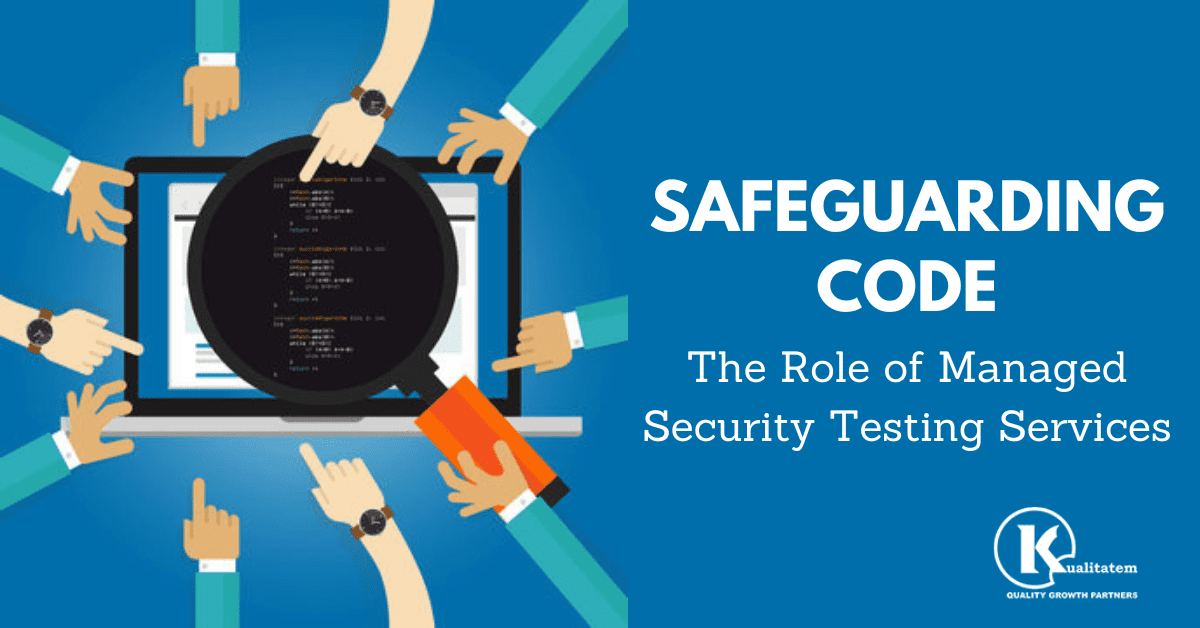
Application softwares are more vulnerable to attack these days. One minor bug can result in:
Although traditional security measures can uncover most of the application’s code, configuration, APIs, infrastructure, or authentication weaknesses, they are not always sufficient. Managed security testing services can come to your aid at this point.
Managed security testing integrates security expertise, testing methods, and ongoing testing to discover and confirm security vulnerabilities before criminals exploit them. These services can be used for penetration testing, vulnerability assessments, code reviews, and security testing throughout the Software Development Lifecycle (SDLC), providing a structured approach for enhancing application security.
This guide provides an overview of managed security testing, its importance, the role of penetration testing, and how organizations can leverage these services to enhance their applications’ resilience.
Managed Security Testing Services are security testing services that are outsourced to organizations to continuously discover, validate, & remediate security vulnerabilities in applications, APIs, infrastructure, and other digital assets.
As per the needs of an organization, managed security testing can encompass:
The overall objective is very straightforward: to find the vulnerabilities that are present in a system before they can be exploited by hackers and to offer practical solutions to these vulnerabilities.
Applications are dealing with increasingly sensitive customer, financial, employee and business data. This means they are an easy target for the cybercriminals.
The average cost of a data breach around the world was $4.44 million, according to IBM’s Cost of a Data Breach Report 2025. The report also revealed that in the United States, the average cost of a security incident was $10.22 million, underlining the financial risks posed by security incidents.
The impact of the threat is also shown in the Verizon 2025 Data Breach Investigations Report (DBIR), which examined over 22,000 security incidents and verified over 12,000 breaches.
These statistics illustrate why application security should not be done at the end of the process. Security should be considered in development, testing, deployment and maintenance.
An understanding of the modern cyber threat landscape.Knowledge of the current cyber threat environment.
Cyber threats are becoming ever more complex.
The threat of cyber is as diverse as the threats that come in the form of financially oriented crime or ransomware, or as a targeted attack against an organization and critical infrastructure.
There are several vulnerabilities that can be targeted by attackers include:
The problem is the new vulnerabilities and attack methods are still being discovered. An application that is secure when it is launched can be vulnerable to new security issues as the code, dependency, integrations, or infrastructure changes.
Digital systems are becoming more and more interconnected and vital to organizations. Valuable information may be found in any kind of banking platform, healthcare application, government system, SaaS platform or ecommerce application, and they may provide access to critical business functions.
If one part of an application is susceptible, this could impact connected components.
A flaw in an application’s security logic could allow a hacker to gain access to information that he or she should not have. Security testing is a useful process to uncover these vulnerabilities before they can turn into an actual security incident.
Application Code has many parts that are vulnerable to attacks.
Not all security vulnerabilities are apparent. They can be present in application logic, third-party components, API implementations, configuration, authentication, etc. or in access control processes.
Common areas that security testing involves:
|
Area |
What does Security Testing Look For? |
|
Authentication |
Poor login controls and authentication flaws. |
|
Authorization |
Users who access resources to which they do not have access.Users who use resources they are not supposed to use. |
|
Input validation |
Handling of untrusted input that is not done properly. |
APIs |
Authenticity and authorization concerns, and data exposure concerns. |
|
Session management |
Weak session controls and/or vulnerabilities related to sessions. |
|
Configuration |
The application or server configuration is insecure.The application or server configuration is not secure. |
|
Dependencies |
Third party libraries & components that are vulnerable. |
|
Sensitive data |
Sensitive information improperly stored/possibly exposed to others |
That is why it’s important to go beyond automated vulnerability scanning for security testing. While automated tools can help discover possible things to fix, expert security professionals are able to confirm results and verify whether or not a weakness can actually impact the business.
Managed Security Testing Services allow organisations to gain access to security testing skills without having to create and maintain each of the skills internally.
A managed security testing provider can test applications and environments with a mixture of automated tools and manual testing techniques.
Services can cover (but are not limited to):
Penetration testing acts as a form of simulated attack on an app, API, network or infrastructure to find vulnerabilities and how much they affect the organization.
Penetration testing differs from a simple vulnerability scan because the process has to actually be analysed and validated by humans to see if identified vulnerabilities can be exploited.
A vulnerability assessment is the process of discovering known security vulnerabilities in systems and applications. They can assist organisations to create a prioritised list of vulnerabilities to focus on.
Security code reviews involve an examination of the source code of an application for security vulnerabilities that may be detected only by a code review, and not through external testing.
This can assist in the detection of application logic, authentication, authorization, input handling, and more.
Application security testing determines if an application can resist common attack scenarios, and if application security controls function as expected.
APIs are commonly used to communicate between applications and services in modern applications. API security testing involves reviewing authentication, authorization, input validation, data exposure and more for potential weaknesses.
You may want to opt for managed security testing services because:
There are various benefits that come with managed security testing, one of which is the proactive approach.
Rather than being vulnerable to a security incident, an organisation can be proactive and discover vulnerabilities in a controlled fashion and correct them before they are used against them.
An automated security solution can be very fast to scan large environments but can also give false positives or miss vulnerabilities that need to be analyzed in context.
Human knowledge is added to security solutions through:
This combination which gives a more complete security evaluation.
There are a number of organizations that have industry specific security and regulatory needs.
Security testing can be used to demonstrate the evaluation of security controls and mitigation of vulnerabilities. Testing alone is not a comprehensive compliance program, but it can help an organization’s overall risk-management and compliance program.
Security shouldn’t be an afterthought for application development.
The organizations can embed security testing in SDLC to find weaknesses earlier. It’s easier to find and repair a vulnerability than it is once it’s deployed.
Penetration testing is one of the most important methodologies used within managed security testing.
Penetration testing does not just uncover vulnerabilities, it is a process that tries to see if a vulnerability can be exploited under controlled conditions.
The testing approach can vary depending on how much information the tester receives about the target.
|
Testing Type |
Description |
Useful For |
|
Black-box |
Tester has limited information about the target |
Simulating an external attacker |
|
White-box |
Tester receives detailed information, such as source code or architecture |
In-depth security assessments |
|
Gray-box |
Tester receives partial information |
Simulating an attacker with some internal knowledge |
The appropriate approach depends on the objectives, scope, environment, and risk profile of the organization.
A standard penetration testing engagement can be broken down into a series of steps.
The testing team sets the goals, assets, scope, scope exclusions and rules of engagement.
This means that testing will be approved and will not unnecessarily interfere with business operations.
Testers perform a collection of information on the environment being targeted and discover possible attack points.
This can involve an understanding of applications, technologies, APIs, exposed services and other assets involved.
Potential vulnerabilities are identified and analyzed with regards to their severity, exploitability and potential business impact.
Where permitted, testers validate vulnerabilities without compromising the safety of the system, to understand if there is any possibility of them being exploited and what access or impact they may offer.
The goal is to not harm the environment, but rather give proof of the security risk.
The Testing team records the results, evidence, risk assessment, business impact and remediation suggestions.
A good report should clearly convey to both technical teams and business leaders what is wrong and why it should be.
Security testers can then retest identified vulnerabilities after remediation to ensure that the remediation was successful.
This completes the circle of identifying a vulnerability and confirming that the vulnerability is fixed.
Security testing is more effective when it’s performed as a part of the development process, and not as a standalone event.
Here is one way to do a practical approach:
The Development to Security Review to Testing to Remediation to Retesting to Deployment to Continuous Monitoring process.
For instance, a Saas company developing a new customer portal could have code reviews when developing the portal, test APIs for security issues before deploying it to production, test APIs for penetration before deployment, and retest after patching vulnerabilities.
This way, development and security teams collaborate, rather than security becomes the last line of defense.
A one-time security assessment can provide valuable insight into the security posture of an application at a particular point in time.
But, applications are evolving all the time.
New features, integrations, APIs, dependencies, infrastructure changes, and code changes can add new vulnerabilities.
For a more continuous security assessment, managed security testing offers a more on-going way to perform testing, enabling organizations to develop repeatable testing processes that continually address new risks.
|
One-Time Testing |
Managed Security Testing |
|
Point-in-time assessment |
Assessment that continues throughout or after a period of time. |
|
Engagement is restricted to a set duration. Only a set period of engagement allowed. |
Can support ongoing security requirements. |
|
Findings from 1 assessment |
Vulnerability identification and validation on a regular basis |
|
Organization manages follow-up |
If some students require retesting or remediation, Provider can validate this through retesting and/or remediation. |
|
Limited testing capacity |
Having dedicated security experts to help. |
A structured approach will yield more value from managed security testing for organisations.
Determine what to test, including applications, APIs, infrastructure, environments and assets.
Security testing must always have explicit rules of engagement.
Automation is fast and thorough, and manual testing is detailed and contextual.
Not all vulnerabilities are created equal. Focus on findings which are based on exploitability, affected assets, data sensitivity, and potential business impact.
Where appropriate, potential vulnerabilities should be validated, to differentiate between real vulnerabilities and false positives.
If a vulnerability has been patched, then it shouldn’t just be considered patched. Retesting ensures that the problem was solved.
When considering a testing provider, organizations should look at the provider’s list of testing tools, but that’s not enough.
Consider:
The right provider should be an extension of the organisation’s security and development teams, not a mere deliverer of a vulnerability report.
Managed security testing isn’t just about technical vulnerabilities.
It decreases the security risk, safeguards critical data, enhances application resilience, and integrates security into software development as a standard process.
The value is that CTOs and technology leaders can have greater visibility of the security vulnerabilities and actionable information to prioritize remediation efforts.
Rather than asking the question: Is our application secure, the question that should be asked is:
Managed security testing can provide answers to these questions with structured, evidence-based security testing.
Managed Security Testing Services are outsourced security testing services that enable organizations to detect, validate, prioritize and mitigate security risks of applications, APIs, infrastructure, etc. and all digital assets.
Services may include penetration tests, vulnerability assessment, application security testing, API security testing, source code review, security assessment, vulnerability validation and retesting.
This frequency is based on the risk of the organization, the changes in applications, the regulatory requirements, and the development practices. Testing can be done on a regular basis or when there are major changes in applications or infrastructure.
No. Vulnerability scanning does not seek to identify vulnerabilities, but rather uses automated tools to detect potential vulnerabilities. However, penetration testing extends beyond this to employing controlled methods and human skills to determine if vulnerabilities can be exploited and how far they could go.
Yes. Security testing may occur at various SDLC phases such as Code Review, Application Testing, API Testing, Pre-release Testing, Penetration Testing, and Post Remediation Retesting.
When security vulnerabilities are discovered only after an attacker has found them, they can cost you a lot of money. Managed Security Testing Services provide organizations with an active environment to find their security vulnerabilities, determine the actual risk and set a priority for remediation.
Through complete security testing and quality engineering services, Kualitatem assists organisations to bolster application security.
Interested in discovering vulnerabilities before security threats? Talk with Kualitatem about your security testing needs, and create a testing plan customized to your applications, risks and business objectives.

Not sure where your QA stands?
Speak to an Expert



Our experts are all ready. Explain your business needs, and we’ll provide you with the best solutions. With them, you’ll have a success story of your own.
Contact us now and let us know how we can assist.