Top Test Automation Tools in 2026: A Complete Comparison for CTO’s
September 21, 2026



The software industry has always treated quality as a last checkpoint. Once the software was built, it was thrown over the wall to testers. This old approach often resulted in delayed feedback and, at the end of the day, high bug-fixing costs.
Hence, Agile Software Testing came into play. With agile testing, testing started to happen continuously and concurrently with development. Agile testing broke silos by bringing testers directly into cross-functional teams with developers, product managers, and business stakeholders.
In 2003, Brian Marick set out the foundation of agile testing concepts called the “Agile Testing Matrix.”
These are also known as Agile Testing Quadrants that helped plan testing strategy inside an iterative sprint.
In this blog, we are going to learn Agile principles, processes, and techniques that you can use in 2026.
Worth knowing before you step into learning Agile.
The simplest way to understand agile testing is
“Agile software testing is a continuous, collaborative practice where software is tested as it is being built. This approach ensures bugs are caught instantly, and high-quality features reach users faster. ”
It helps testers to test within short development iterations. Enabling the QA team to be involved in the continuous process from requirements to refinement onward.
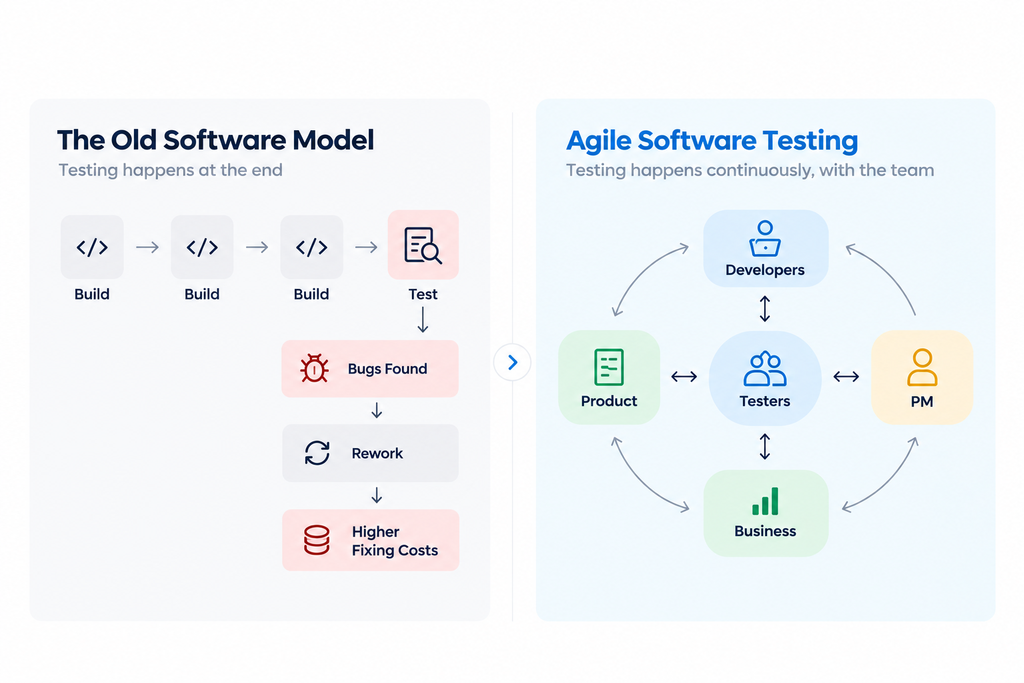
Through Agile testing practices, teams get:
Agile testing can make life easier for QA teams. If you’re still following traditional practices, here’s how you can gradually shift to an agile approach.
| Traditional / Waterfall | Shift to: Agile Testing |
| Testing happens primarily after development. | Start testing throughout development |
| QA gets involved later in the lifecycle. | Involve QA from planning and refinement |
| Feedback comes late. | Get continuous feedback. |
| Releases are larger and less frequent. | Release smaller, more frequently |
| Regression testing is periodic. | Make regression testing continuous where appropriate. |
| Testing is seen as primarily QA’s responsibility. | Make quality a whole-team responsibility. |
| Requirements are mostly fixed upfront. | Work with evolving requirements |
Agile testing isn’t simply “testing faster.” It’s about integrating quality into development from the start, with QA and development working together through continuous feedback across the SDLC.
New code is continuously being added, requirements are changing every few weeks or even days and features are moving through the development process continuously. Continuous integration and deployment means that the changes can be pushed to production much quicker.
That sounds efficient. There is a problem, though each one of those changes brings a new risk.
A developer changes one functionality, and it stops working today. Needs for a requirement change mid-sprint. The customer provides feedback, the team makes adjustments to the product and the cycle repeats.
That’s when testing is important.
Agile testing is up to speed in the development process. QA doesn’t wait till the end to find out if there are issues or bugs, but rather works with the developers and tests throughout the development process, and shares the findings with the developers.
You must make your team feel comfortable making a lot of releases, but without compromising quality.
Speed is the essence of Agile! Testing provides that confidence to be bug-free at that speed.
The principles are the ones that differentiate Agile quality work from traditional QA. They are more about the mindset of a team when thinking about reliability than about the tools.
Shift-left testing involves engaging QA to verify requirements before coding is finished, and review requirements to identify risk before it’s too late to make changes.
Verification is not just at the end of the sprint or the end of the development process, it is throughout the sprint and the development process.
Reliability is not wholly the responsibility of the testers. The trustworthiness of a release is determined by developers, product owners, and stakeholders.
The best value for QA is done before implementing uncovering uncertainty and risk in requirements before they get constructed.
Keep in place
With fast feedback, the team can correct problems when they are still fresh in their minds and not weeks later when it’s been forgotten.
Automate appropriate regression/validation activities and enable human testers to continue focusing on activities that require judgment.
Requirements, priorities change, so do the means of checking.
Focus efforts by customer impact, business criticality, technical risk and not for the sole purpose of coverage.
Kualitatem’s Agile testing philosophy is directly aligned to these principles:
They are clearly stated on Kualitatem’s Agile Testing Services page.
Agile testing is a cycle: plan, release and improve. Quality passes through each stage:
1. Backlog Refinement
Early in the process, QA can help the team look for things that are easy to overlook: testability, acceptance criteria, edge cases, dependencies, risks, and missing requirements, all before they turn into code.
2. Sprint Planning
The team clarifies what needs to be confirmed, the scope, the environments and test data that needs to be used, the needed level of automation, and the acceptance criteria to indicate “done”.
3. Test Design
Testers develop scenarios, cases, and acceptance tests including positive and negative paths, boundary conditions, and exploratory ideas to pursue.
4. Development & Continuous Testing
As developers and QA test functions during construction, there are unit tests, integration tests, API tests, automated validation, and code level validation.
5. Test Execution
Planned checks run, results documented, defects noted and prioritized, fixes retested, and regression suites verify nothing has been broken.
6. Sprint Review & Acceptance
Functionality is validated against the acceptance criteria, business requirements, user expectations, and product goals.
7. Retrospective & Improvement
The team asks questions to see what defects were not caught: What were the verification techniques used? What were the obstacles? What is next in the automation program? What changes are there for the upcoming sprint?
This is the Agile Testing Flow
The main purpose of the backlog refinement is to ensure that the Product Backlog is relevant to the Sprint.The primary function of the Backlog Refinement is to make sure that the Product Backlog is suitable for the next Sprint.
Not all the types below are required for all the projects. It will depend on the product risk and context; a payment flow will not require the same risk coverage as a marketing page.
Unit Testing: testing individual components individually, at developer level.
Integration Testing: validates the interaction between components, APIs, databases and services.
In Functional Testing, the features are validated to meet the requirements and acceptance criteria.
Regression Testing: Ensures that new changes have not disrupted the existing functionality.
Exploratory Testing: Leverages human judgment to uncover the unexpected behaviour that can’t be captured by scripted checks.
Acceptance Testing: Verifies that the functionality fulfills business and user requirements.
API Testing: Directly verifies service-level behavior and integrations.
Performance Testing: Certifies responsiveness, scalability and stability, when it matters.
Security Testing: Looks for vulnerabilities in the development process, not only before its release.
Usability Testing: Tests features to see if they are usable by real users.
It’s not about having the maximum coverage. It’s the appropriate coverage for the risk that you have.
Continuous verification is possible because of automation. If not, manual regression will become the obstacle that every fast release eventually confronts.
In the agile world automation covers:
Automate first work that is repetitive, stable and high volume.
Repetitive regression tests
Appropriate and predictable behavior, which varies only occasionally.
Wait for volatile, judgmental tasks those that are more expensive to automate than to do by hand.
There are several types of tooling. The purpose is to build a connected stack, NOT a longer list.
Test management platforms allow teams to keep all cases, executions, defects and QA activity in one place, rather than spread across various spreadsheets. Kualtee’s value lies in the fact that it is a pragmatic platform that spans test planning, test scenarios, test cases, test execution, and defect management in the workflows teams are already familiar with. It enhances visibility and release confidence without necessitating a process change.
They are generally Selenium, Cypress, Playwright, or Tricentis Tosca.
Automated checks run on every change with Jenkins, Git based workflows and Azure DevOps.
Jira and Azure DevOps are linked to the backlog and the sprint board.
Currently, Kualitatem’s own testing ecosystem includes tools such as
selected to match the needs of each client and not impose a single tool chain.
Metrics should inform decisions, not embellish a dashboard! The ones below are helpful to QA managers and engineering leaders to assess readiness for release, provided that they are focused on action, not vanity.
Test Coverage: Percentage of functionality or risk being verified.
Test pass / fail rate: Current picture of execution outcomes.
Defect Density: Defects per size of the product or release.
Defect Leakage: Defects that go undetected to later environments or production.
Automation Coverage: % of the necessary regression workload that is automatically performed.
Defect Resolution Time: The time it takes to take a defect from discovery to resolution.
Regression Results: New changes causing failures?
Release Quality: The process of relating verification results to actual release readiness.
If a metric does not affect a choice then it is noise. If you need a more detailed analysis, read Kualitatem’s article on the top test automation KPIs.
Rush schedules limit verification, and teams must make difficult decisions on what to verify and what to skip.
Changing the acceptance criteria can cause rework because of failed test cases in the middle of the sprint.
As debt increases, regression and automation get increasingly difficult.
The higher the release frequency, the quicker manual regression becomes a bottleneck.
If testers are not engaged early in the process, verification is reactive, and defects further downstream.
An unstable environment creates false failures and slows things down.
When it comes to verification, it’s more meaningful to have realistic, controlled data, rather than theoretical.
Unreliable tests lead to loss of trust, or “noise” in CI/CD pipelines.
Most of them can be solved using the proper process and support. Kualitatem covers the recurring ones in detail in challenges and solutions in software testing services.
Involve QA early: Include testers in backlog refinement and sprint planning, not execution.
Set Clear Acceptance Criteria: Define requirements in a manner that is testable prior to development.
Shift Testing Left: Shift quality activities to higher levels in SDLC, in which fixes are less costly.
Automate Regression Testing: Eliminate those repetitive checks that are valuable on each run.
Keep Tests Maintainable: Avoid creating automation that is more costly than bugs it detects.
Test Continuously: Start verifying during development and CI/CD processes.
Prioritize Risk: Prioritise effort on key workflows and functionality first.
Encourage Whole-Team Ownership: Reliability is the responsibility of the developers, testers, product owners, and stakeholders.
Track Meaningful Metrics: Don’t look busy; look at data to find risk and improve process.
Make progress after each sprint: Use retrospectives to make changes to the verification strategy.
On shifting left specifically, Kualitatem has a dedicated walkthrough of implementing shift-left testing in Agile teams, and a fuller look at best practices for Agile testing.
The context is: an eCommerce team wants to implement a “Buy Now Pay Later” option. Let’s see how Agile testing unfolds throughout the sprint.
Backlog Refinement
The risk areas are identified in advance by QA: payment-provider dependencies, eligibility rules, failed-payment situations, security issues, success and acceptance criteria.
Sprint Planning
The team determines which require functional testing, which require API testing, what should be automated, and what should be explored.
Development
Unit and Integration Tests are written along with the feature.
QA Testing
As the feature is being assembled, functionality, API and exploratory and regression testing are conducted.
Defect
A payment failure comes to light when certain combination of user and transaction conditions occurs. The way forward is evident:
Test → Fail → Defect → Developer Fix → Retest → Regression → Pass
Sprint Review
The team validates the completed feature with the acceptance criteria.
Retrospective
The lesson: the payment-failure scenario should be made a regular automated regression test, it should never sneak back in again.
This is the entire process (refine, more robust regression suite) within a single sprint.
Agile Testing is different from DevOps Testing, and they are frequently mistaken. They are supporting, not competitive strategies.
| Aspect | Agile Testing | DevOps Testing |
| Main focus | Iterative development: main focus on quality | Continuous delivery: focus on quality throughout |
| Testing scope | Primarily within sprints | Across the entire CI/CD pipeline |
| Feedback | Iterative feedback (often) | Continuous, automated feedback (often) |
| Automation | Important | Critical and deeply integrated |
| Deployment | Frequent releases | Continuous, automated releases |
| Monitoring | Development and release validation | Continues through production and operations |
Agile testing integrates quality into the design, development, and improvement of features in every iteration. DevOps testing takes that quality discipline and applies it throughout the software delivery lifecycle from code commits to builds, deployment, and monitoring in production.
Mature teams rely on both: Agile provides quality in development, and DevOps provides
This article offers a straightforward approach to creating an agile testing strategy.
An easy-to-use, eight-step process that you can give to a team.
Step 1
Get to know Product Risk. Determine the critical workflows and business risks that really count.
Step 2
Define Quality Goals. Determine the actual meaning of good enough to release.
Step 3
Map Testing Levels. Identify the placement of unit, integration, system and acceptance checks.
Step 4
Make the decision for what to automate. Focus on high value, low change, repetitive tests.
Step 5
Embed Test in the CI/CD pipeline. Perform proper automated tests on each code modification.
Step 6
Create Test Management. Collect and organize cases, executions, defects and reporting in a single location.
Step 7
Define Metrics. Select measures to assist with release decisions.
Step 8
Continuously Improve. Revisit goals and adjust plan every sprint.
Agile software testing: What is it?
A method in which quality and verification activities are performed not only during the coding phase at the end of the project but continuously throughout the development of the Agile project.
What are the agile testing principles?
Test early, test continuously, treat quality as a whole team responsibility, don’t look for defects, have short feedback loops, automate repetitive tests, embrace change, and prioritize by business value and risk.
How does Agile testing work?
The sprint is a continuous process of refinement of the backlog, planning, design of tests, development with continuous testing, execution, review, and retrospective, which can lead to improvements and feed into the next sprint.
So what is Agile testing process?
The whole process from the refinement of requirements and coverage planning to the construction and execution of the checks while the development work is going on, to the validation against acceptance criteria and enhancement of these checks in each sprint.
What are the various kinds of Agile Testing?
Unit, integration, functional, regression, exploratory, acceptance, API, performance, security, and usability testing, depending on the risk of the product.
What are the difference between agile testing and traditional testing?
Traditional testing occurs primarily in isolation at the end of development; Agile testing includes testing throughout development and is integrated with the entire team sharing in the responsibility of quality.
What is Agile testing cycles?
Verifying in alignment with fast, iterative delivery by continuously testing, reviewing, and retrospecting throughout a sprint; the repeating sequence of quality activities occurring throughout the sprint.
So, what exactly is shift-left testing in Agile?
Implementing quality activities earlier in SDLC, before coding starts, and have them check requirements and identify risk, defects are identified at the lowest cost.
Agile testing is possible because we are no longer inspecting for quality and begin treating quality as a part of the build. The teams who do well have the same habits:
The verification is embedded in the development process, rather than at the end.
QA gets involved from requirements to refinement, up until release.
Continuous checking results in quick feedback when contexts are fresh.
The repetitive load is left to automation, not entirely.
Ownership of reliability lies with all developers, testers, product owners, and stakeholders.
Risk-based prioritization means concentrating efforts where it matters.
Test management, automation, CI/CD, and meaningful metrics make quality scalable for teams.
Send more quickly with no shipping risk.
Agile development is fast-moving, and so is your quality process. Continuous testing, automation, risk-based testing, and expert quality engineers that integrate into your team are at the heart of Kualitatem’s approach to Agile delivery.

Nabeesha is a Digital Content Executive at Kualitatem Inc. With a background in communication and extensive knowledge of QA and cybersecurity, she brings a business-first lens to technical content. Her work helps CTOs and engineering leaders cut through the noise and make confident decisions about software quality.
Not sure where your QA stands?
Speak to an Expert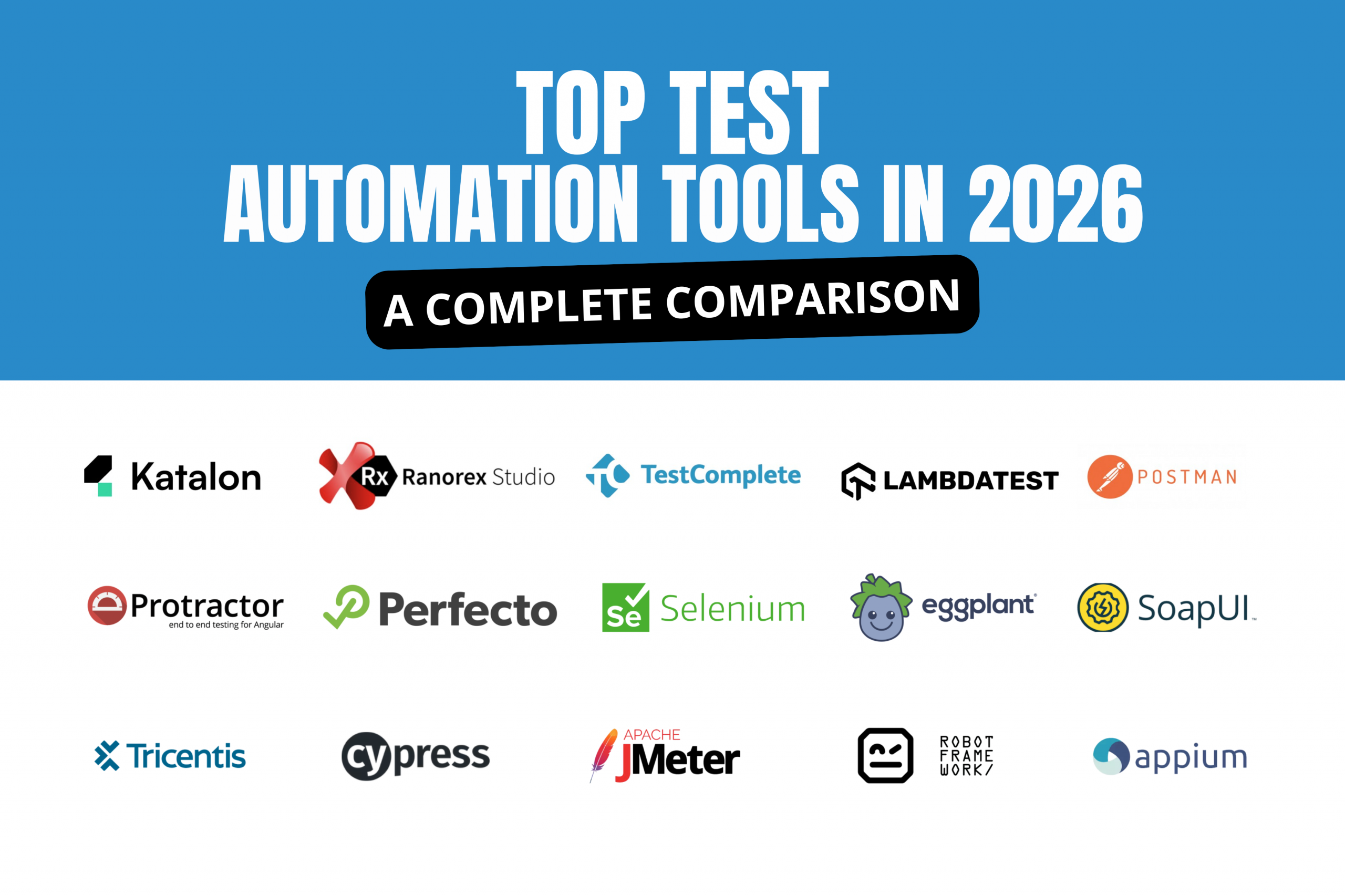



Our experts are all ready. Explain your business needs, and we’ll provide you with the best solutions. With them, you’ll have a success story of your own.
Contact us now and let us know how we can assist.