What Are the Key Software Testing Strategies and When Should You Use Them?
August 17, 2026




Building an effective test plan is an essential aspect of software testing that ensures high-quality software delivery. A comprehensive test plan helps to identify potential issues early in the development process, provides clear guidance to testers, and helps to meet project objectives. However, creating a detailed test plan can be a daunting task, especially for those new to the field of software testing.
It is a high-level document that outlines the overall test planning strategy, scope and phases for a project., starting from defining the scope of testing to selecting appropriate testing techniques, identifying the test environment, and developing a detailed test schedule. By following this guide, testers can ensure that their testing efforts are focused on meeting project goals and objectives, identify defects early in the development cycle, and deliver high-quality software to end-users.
A test plan is a detailed document that specifies the goals, parameters, strategy, tools, and schedule of a software testing project. It offers a thorough explanation of the testing procedures that will be used to guarantee that the software satisfies the necessary standards and specifications for quality.
The test plan serves as a guide for the entire testing process, from defining the test objectives to executing the tests and reporting the results. It provides a clear understanding of the testing goals, testing techniques, test environment, and testing schedule. It also helps to identify the risks and challenges associated with the testing process and provides a roadmap to mitigate those risks.
A test plan is a detailed, project-specific document that defines what will be tested, by whom, when, and how, while a test strategy is a high-level document that sets the overall testing approach, objectives, standards, and long-term direction across an organization or across multiple projects. If you are weighing test plan vs test strategy, the key difference is scope: the strategy guides testing at a broader level, and the plan turns that direction into execution for a specific release or application.
This distinction matters most to QA teams, software testers, project managers, and organizations that need consistent, efficient, and audit-ready testing especially enterprises and mid-sized technology companies in regulated environments. Getting the two documents right helps reduce defects, maintain compliance, and scale testing based on project size, risk, and complexity.
Teams implementing modern QA automation services often use both a Test Strategy and detailed Test Plans to standardize automated testing, improve collaboration, and ensure consistent quality across multiple releases.
What distinguishes a test plan from a test strategy? This is one of the most common questions for new testers and growing QA teams, so this comparison breaks down strategy vs test plan in practical terms: the differences in purpose, scope, components, timing, and how each one is used across the software development lifecycle.
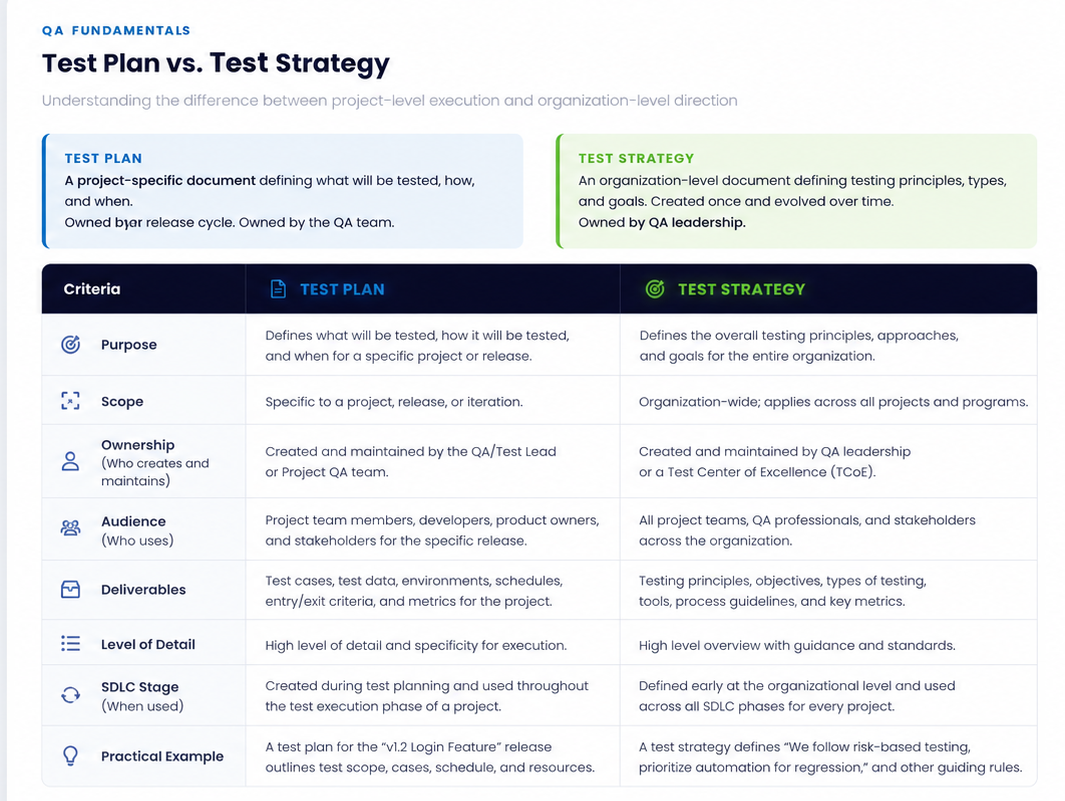
In summary, a Test Plan is a detailed document that outlines the specific testing scope, goals, schedule, resources, and execution steps for a particular software project, while a Test Strategy provides a high-level overview of testing, the overall testing approach, and long-term direction for an organization or for multiple projects. In this test strategy vs test plan comparison, the test strategy acts as the broader framework, while the test plan is project-specific and detailed. Put simply, the Test Strategy covers high-level long-term goals, whereas the Test Plan focuses on immediate actionable tasks for a specific project.
During a Dynamics 365 implementation for a manufacturing company, the organization first established a testing strategy that defined multiple testing cycles, including User Acceptance Testing (UAT). Based on this strategy, the project team created detailed test plans for each testing cycle, specifying the test scope, environments, test cases, schedules, and responsibilities. After encountering performance issues during go-live, Microsoft documented how the organization updated its testing approach by adding dedicated performance testing and refining future test plans based on the overall strategy.
Although the terms are often used interchangeably, a Test Strategy and a Test Plan serve different purposes. A Test Strategy establishes the overarching approach to quality assurance, while a Test Plan translates that approach into actionable tasks for a specific project or release. A Test Strategy usually remains stable across multiple projects or releases, providing a consistent framework through the project lifecycle. Understanding when to use each document helps teams avoid duplicated effort and maintain consistency across the software development lifecycle (SDLC), while Test Plans are updated more frequently as project details change during the lifecycle.
Organizations managing multiple products, large engineering teams, or highly regulated applications typically benefit from maintaining both a Test Strategy and project-specific Test Plans.
The Test Strategy defines long-term testing principles, and understanding test strategy starts with recognizing that a test strategy outlines testing objectives and methodologies, including:
Each Test Plan then applies those principles to an individual project by outlining:
This separation keeps organizational testing standards consistent while allowing each project to adapt its execution based on scope, timelines, and business priorities.
Not every project requires a standalone Test Strategy document. For smaller teams or short-term projects, a comprehensive Test Plan often provides enough guidance.
A Test Plan alone is typically sufficient when:
In these situations, including a brief testing approach within the Test Plan avoids unnecessary documentation while still ensuring testing activities remain organized.
The choice between using one or both documents often depends on project scale.
| Enterprise Projects | Small Projects |
|---|---|
| Multiple teams working simultaneously | Single QA team or tester |
| Several releases and parallel workstreams | Short release cycles |
| Standardized QA processes across products | Flexible testing practices |
| Higher compliance and audit requirements | Minimal documentation needs |
| Separate Test Strategy and Test Plan recommended | Test Plan usually sufficient |
Large enterprises rely on Test Strategies to maintain consistency across multiple projects, and those strategies usually stay stable across releases, while individual Test Plans vary by release and capture release-specific details. Smaller organizations, meanwhile, often combine strategic guidance and execution planning into a single document to reduce overhead.
Rather than replacing one another, the two documents work together across the SDLC, and effective plan and test strategy alignment keeps both direction and execution clear.
During planning, the Test Strategy establishes the organization’s testing philosophy, with test strategies guide testing approaches and risk management at a high level alongside automation objectives and quality standards.
As development progresses, the Test Plan converts those guidelines into project-specific activities by defining the testing scope, timelines, resources, environments, and execution schedule; this is where test plan work outlines specific testing activities and timelines for the release.
Throughout test execution, QA teams execute the Test Plan and Strategy in practice, following the plan day to day while remaining aligned with the broader principles established in the Test Strategy. If project priorities shift, the Test Plan can be updated without changing the organization’s overall testing methodology.
This layered approach provides both consistency and flexibility ensuring every release follows the same quality standards while allowing individual projects to respond to changing requirements, risks, and delivery schedules.
They serve different purposes. A Test Strategy defines the overall testing approach and objectives, while a Test Plan describes how testing will be executed for a specific project or release.
Not always. Many organizations maintain a single organizational Test Strategy that guides multiple projects. Individual projects typically create their own Test Plans based on that strategy. Only large, complex, or regulated projects may require a separate Test Strategy.
No. A Test Strategy provides high-level guidance, but it does not include project-specific details such as timelines, resources, environments, or deliverables. These are documented in the Test Plan.
Even small projects benefit from test planning. While the documentation may be simpler, defining the testing scope, objectives, responsibilities, and acceptance criteria helps ensure quality and reduces the risk of missed defects.
A Test Strategy establishes the “why” and “what” of testing at an organizational or program level, while a Test Plan defines the “how,” “when,” and “who” for a specific project. Understanding this distinction helps teams create clearer documentation, improve collaboration, and deliver higher-quality software.
A test plan typically includes the following major components.
The first step in building an effective test plan is to define the scope of testing. In a test plan document, the scope section defines what is and is not covered and outlines the scope, objectives, and resources for the testing effort. This entails determining the software’s features and functionalities that will be tested. It is important to define the scope of testing clearly to ensure that the testing efforts are focused and efficient. Clear boundaries prevent ambiguity in testing and reduce wasted effort. The scope of testing should be based on the following.
The next step is to set testing objectives. The goals of the test should be the following.
They should align with the project goals and objectives and focus on ensuring that the software meets the required quality standards. Engage stakeholders early to align testing efforts and goals.
Criteria for success determine if testing goals are met, and metrics for success help measure testing effectiveness. Examples of testing objectives include.
The methodology used to test the program is known as the testing approach, where the team chooses testing methodologies for how it will perform testing. It can use manual testing and automated testing as complementary options, and the plan may also define testing types such as performance testing and regression testing. The testing approach should be selected based upon the following.
Depending on project needs, the approach can cover unit testing, integration testing, system testing, and user acceptance testing.
Tool selection should identify the test management and automation tools used to support execution.
The testing approach should be.
The hardware, software, and other resources needed for testing make up the test environment. It includes the following.
It is important to identify the test environment early in the testing process to ensure that the testing efforts are efficient and effective.
The test schedule outlines the timeline for testing, including the start and end dates, milestones, and key deadlines for testing activities across each testing phase. The test schedule should be realistic, taking into account the available resources, timeline, and testing objectives within the detailed test plan. It should be reviewed and updated regularly to ensure that the testing process stays on track and to keep the detailed test plan current.
The outputs that will be produced as part of the testing process are referred to as test deliverables. Examples of test deliverables include.
Identifying test deliverables early in the testing process helps to ensure that they are produced on time and meet the required quality standards.
Identifying test risks and establishing risk management strategies is an essential component of the test planning process. It helps to identify potential risks associated with the testing process and provides a roadmap to mitigate those risks.
Examples of test risks include schedule slippages, resource constraints, and test environment issues. These strategies improve test coverage by focusing effort on the highest-risk areas first.
The success of the testing process depends on clearly defining the roles and duties of the test team, so roles and responsibilities clarify each team member’s ownership and specific testing tasks. It helps to ensure that everyone involved in the testing process understands their roles and responsibilities and is aware of what is expected of them. Through the software development process, QA leads create and update the Test Plan, test managers draft the Test Strategy, and Test Architects define testing methodologies and standards. Test leads manage human resources for efficient test execution, while project managers help ensure clear communication and coordination across the team during testing activities. Test team roles and responsibilities should be clearly defined and communicated to all stakeholders.
The final step in building an effective test plan is to obtain approval and sign-off from stakeholders. This involves reviewing the test plan with stakeholders, making any necessary revisions, and obtaining their approval and sign-off. By doing this, it is ensured that everyone is on the same page and that the testing procedure is in line with the aims and objectives of the project.
If you’re wondering how to write a Test Plan, the good news is that you don’t have to start from scratch every time. Most Test Plans follow a similar structure, regardless of the project. You can customize the level of detail based on your project’s size, complexity, and testing requirements.
Here’s a simple template you can use as a starting point.
| Section | What to Include |
|---|---|
| Objectives | What do you want to achieve through testing? |
| Scope | Which features, modules, or functionality will (and won’t) be tested? |
| Test Environment | What hardware, software, browsers, devices, or operating systems will be used? |
| Resources | Who is involved in testing, and what are their responsibilities? |
| Entry Criteria | What needs to be completed before testing can begin? |
| Exit Criteria | What conditions must be met before testing is considered complete? |
| Risks | What challenges could affect testing, and how will you handle them? |
| Deliverables | What documents and reports will the testing team produce? |
Let’s see how this template looks in a real project.
| Section | Example |
|---|---|
| Objective | Ensure customers can browse products, add items to their cart, complete checkout, and make payments successfully. |
| Scope | Product pages, search, shopping cart, checkout, payment gateway, and order confirmation. |
| Test Environment | Staging server, Chrome, Firefox, Safari, Edge, Android, and iOS devices. |
| Resources | Two QA Engineers, one Automation Engineer, one QA Lead, and the development team. |
| Entry Criteria | Development is complete, the staging environment is ready, and test cases have been reviewed. |
| Exit Criteria | All critical defects are fixed, 95% of test cases have passed, and the QA Lead approves the release. |
| Risks | Payment gateway outages, unstable test environments, or delays in feature delivery. |
| Deliverables | Test Plan, test cases, defect reports, automation scripts, test summary report, and release sign-off. |
Tip: A Test Plan doesn’t have to be lengthy to be effective. For smaller Agile projects, a concise document is often enough. Larger enterprise or regulated projects, however, usually require a more detailed Test Plan to keep everyone aligned and meet compliance requirements.
Creating a Test Plan doesn’t have to be complicated, but there are a few mistakes that teams make time and time again. The good news is that they’re easy to avoid once you know what to look for.
A common mistake is not clearly defining what will and won’t be tested. This usually happens when requirements are still evolving or different stakeholders have different expectations. As a result, testers may spend time on the wrong features while critical functionality gets overlooked.
To avoid this:
Objectives like “test the application” sound fine, but they don’t give the team much direction. On the other hand, setting goals that can’t realistically be achieved within the timeline can create unnecessary pressure and lead to rushed testing.
Instead:
Every project comes with risks, whether it’s an unstable test environment, delayed builds, or a third-party integration that isn’t ready. Ignoring these risks during planning often leads to unexpected delays later.
A better approach is to:
A Test Plan should make it clear who is responsible for what. Without proper resource planning, some team members may be overloaded while others are left waiting for work. This can slow down testing and affect overall quality.
To keep things on track:
A Test Plan isn’t just for the QA team. Developers, project managers, business stakeholders, and clients all rely on it to understand the testing approach. If the plan isn’t shared or updated, misunderstandings are almost inevitable.
Keep everyone aligned by:
One of the biggest misconceptions is that a Test Plan is written once and never touched again. In reality, projects evolve, and your Test Plan should evolve with them. If it isn’t updated, it quickly becomes outdated and less useful.
Make it a habit to:
A well-maintained Test Plan doesn’t just guide testing it helps the entire team stay aligned, adapt to changes, and deliver a higher-quality product with fewer surprises along the way.
Building an effective test plan is a critical component of the software testing process. It helps to ensure that the software meets the required quality standards and delivers value to end-users. By following the step-by-step guide outlined in this article, you can create a test plan that is focused, efficient, and effective. Remember that a well-designed test plan should be flexible enough to accommodate changes in the project requirements and should be reviewed and updated regularly throughout the testing process. By putting in the effort to build an effective test plan, you can help ensure that your software is of the highest quality and meets the needs of end-users.
Update it whenever there are significant changes to the project, such as new requirements, timelines, or resources.
Yes. Agile teams often use shorter, more flexible Test Plans that are updated throughout the project.
Without a Test Plan, teams may face unclear objectives, missed test scenarios, poor coordination, and increased project risks.
Yes. Kualitatem’s QA experts help organizations create effective Test Plans, define testing strategies, and build scalable QA processes that align with project and business goals.
Yes. Most software testing companies develop customized Test Plans based on your project’s scope, technology stack, timelines, and quality goals. Kualitatem works closely with clients to create practical Test Plans that align with industry best practices and business objectives.
Many QA providers, including Kualitatem, offer tailored testing solutions based on your specific project requirements rather than a one-size-fits-all pricing model.

Nabeesha is a Digital Content Executive at Kualitatem Inc. With a background in communication and extensive knowledge of QA and cybersecurity, she brings a business-first lens to technical content. Her work helps CTOs and engineering leaders cut through the noise and make confident decisions about software quality.
Not sure where your QA stands?
Speak to an Expert








Our experts are all ready. Explain your business needs, and we’ll provide you with the best solutions. With them, you’ll have a success story of your own.
Contact us now and let us know how we can assist.