Testing Services for Temenos Banking Systems
October 2, 2026




Quality Assurance (QA) is what keeps software reliable and users happy. But when companies tighten their belts, QA budgets often come under the microscope. CTOs and CFOs start asking whether QA headcount and expenses are really justified.
One option is keeping QA in-house; the other is outsourcing it.
Both have real costs:
This article walks through the trade-offs between in-house QA vs. outsourced QA so leaders can see the full financial picture, not just the headline numbers.
The highest cost of an in-house QA team is its people. QA engineer salaries vary by experience and location, but they usually fall between $79,000 and $111,500 per year.
On top of that, benefits like health insurance, retirement contributions, and bonuses can increase payroll costs by another 30%.
For a team of five, total annual personnel costs can easily go beyond $400,000.
QA tools get expensive fast. Beyond the base subscription fees, costs can rise with upgrades and extra user seats.
Here is the QA tools expense breakdown:
For many teams, total QA tooling expenses can still land in the broad $2,000 to $10,000 per month range once multiple subscriptions and integrations are included.
Ready to cut QA costs without cutting quality?
Visit Kualitatem to explore our services and request a customized quote that fits your team and budget ->
Keeping QA skills up to date is an ongoing investment, not a one-time cost.
Keeping QA skills sharp doesn’t come free.
From online courses to hands-on workshops, annual training can cost anywhere from $1,000 to $5,000 per employee based on the type of learning and how in-depth it needs to be.
Managing an in-house team adds another layer of expense.
This can account for 15%-20% of the total QA budget, as supervisors allocate time overseeing and managing the QA process.
Understanding hidden costs is crucial in making an informed budget:
Outsourcing QA provides flexibility and expertise.
These typically range from $20,000 to $50,000 monthly, depending on the services included.
Although it may seem higher initially, the comprehensive nature of these services often yields better overall value.
Outsourcing firms frequently offer managed QA services that cover:
Managed QA services make testing easier to run and easier to scale. They help businesses:
Investing in outsourced QA can deliver strong value. Outsourcing firms often bring experienced QA professionals and proven processes that can improve test coverage.
However, outsourcing is not a perfect fit for every organization. Some teams may face challenges with:
The best ROI usually comes when the outsourcing model aligns with the company’s goals.
Outsourcing can minimize various hidden costs:
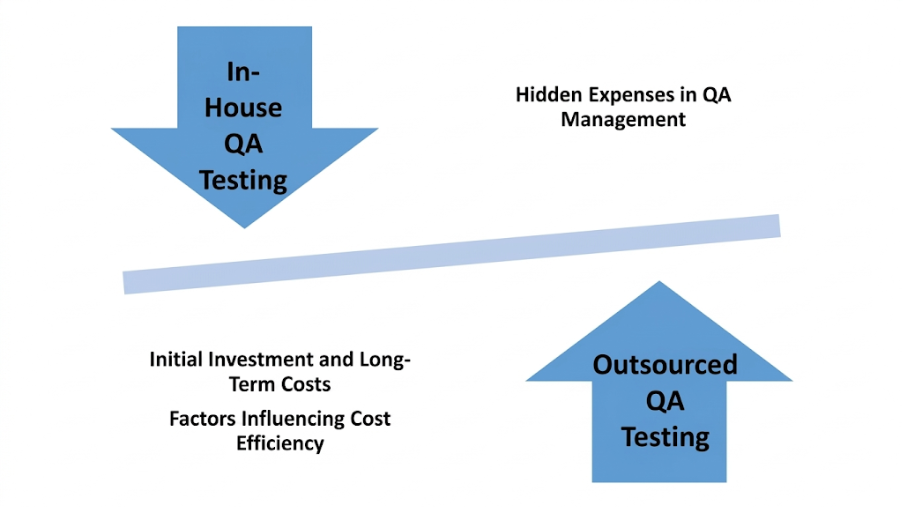
Comparing In-House and Outsourced QA Costs
Comparative Analysis: In-House vs Outsourced QA
Here’s a simple side-by-side comparison of in-house and outsourced QA costs:
| Cost Category | In-House QA | Outsourced QA |
| Salaries & Benefits | $100,000+ per engineer | $20,000 – $50,000 monthly |
| Tools & Technology | $2,000 – $10,000/month | Generally included |
| Training | $1,000 – $5,000/year | Usually covered |
| Management Overhead | 15%-20% of the budget | Included |
| Attrition Costs | High; 1.5-2.5x salary | Lower rates |
| Ramp Time | 3-6 months | Almost immediate |
| Idle Capacity | Often High | Close to zero |
When figuring out the total cost of QA ownership, it’s vital to consider factors beyond immediate expenses.
Here’s why many companies see more long-term value in outsourcing:
When you outsource QA, you can avoid many of the extra costs that come with hiring and training. Over time, that can make a real difference to your budget.
Outsourcing also gives you access to skilled QA professionals who know how to spot issues early and help deliver a smoother experience for your users.
Instead of spending time on day-to-day testing tasks, your internal team can focus on bigger priorities like product strategy, development, and growth.
Outsourcing makes it much easier to ramp testing up or down based on your project needs, without the pressure of building and maintaining a larger full-time team.
Outsourced QA can be a smart way to improve testing, but the challenges it comes with require every team to think through before making the move.
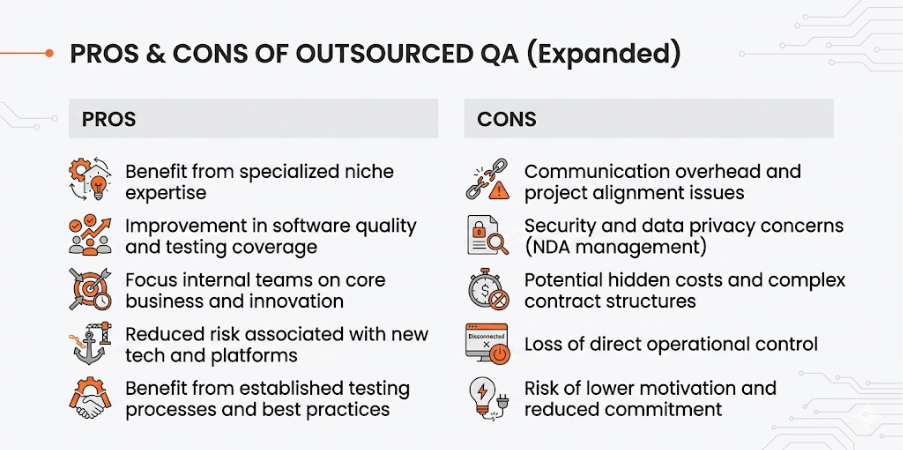
Most mature engineering organizations land on a hybrid model. Here is the structure that works:
This model gives you institutional knowledge (in-house core), scalable capacity (outsourced team), and specialized skills on demand (outsourced specialists).
| Risk | In-House | Outsourced | Hybrid |
| Key person dependency | High | Low (replacement guarantee) | Medium |
| Knowledge loss on turnover | High | Medium (documentation culture) | Low |
| Scaling speed | Slow (months) | Fast (weeks) | Fast |
| Domain knowledge depth | High | Medium (grows over time) | High |
| Cost overrun risk | Medium (hidden costs) | Low (predictable hourly) | Low |
| Quality consistency | High | Depends on partner | High |
With Kualitatem’s 94% client retention rate, the usual outsourcing concern of frequent turnover is significantly reduced, helping QA teams maintain continuity and build deeper product knowledge over time.
Choosing between in-house and outsourced QA comes down to understanding the full cost picture, including both the obvious expenses and the hidden ones.
While outsourcing may not always present lower initial costs, the potential savings in hidden costs can provide significant long-term value.
See how we helped a leading ANZ online retailer reduce their ramp-up time to zero in our case study. Performance And Business Process Stability Testing – Kualitatem
If you want to take a closer look at your QA needs, visit Kualitatem and connect with our experts to find the approach that best fits your team.

Nabeesha is a Digital Content Executive at Kualitatem Inc. With a background in communication and extensive knowledge of QA and cybersecurity, she brings a business-first lens to technical content. Her work helps CTOs and engineering leaders cut through the noise and make confident decisions about software quality.
Not sure where your QA stands?
Speak to an Expert


Our experts are all ready. Explain your business needs, and we’ll provide you with the best solutions. With them, you’ll have a success story of your own.
Contact us now and let us know how we can assist.