9 Top Test Automation Companies in the USA
September 10, 2026



“Quality is not an act, it is a habit,“ as Aristotle said
Right now, your customer experience is your market share. PwC data backs this up: 73% of customers cite a positive experience as the primary reason for brand loyalty and they’ll gladly pay a 16% premium for it.
But as your organisation scales, the cracks start to show. Software is shipping faster than ever, yet rigorous quality assurance struggles to keep pace.
In fact, 47% of development teams on the Gitlab Global DevSecOps Survey identify testing as the top reason their releases get delayed.
This is a governance failure and it starts at the top.
For senior decision-makers, a scattered QA process isn’t a massive disaster. It’s more of a slow bleed. Operational bottlenecks quietly eat into your profit margins and destroy your speed-to-market.
When you rely on fragmented, decentralised testing teams, every business unit ends up on its own island.
This setup inherently:
If your leadership faces any of these headaches, your application testing is an active financial liability:
If you are nodding at three or more of these, Kualitatem’s QA outsourcing services provide structured expertise without rebuilding your internal team from the ground up.
The Macro Drain: Poor software quality drains an estimated $2.41 trillion from the economy annually through lost productivity and failed deployments.
The Micro Impact: 91% of med-to-large enterprises report a single hour of system downtime costs them more than $300,000 in lost transaction and emergency engineering.
The Multiplier Effect: Fixing a defect during testing costs 15 times more than during design. Once it reaches production, that cost multiples by up to 100 times due to emergency patches and diverted engineering time.
The brand Risk: In competitive markets with low switching costs, a single application crash can permanently erode brand equity and drive clients to competitors.
| The real cost of poor enterprise software testing is every hour your best engineers spend fixing yesterday’s problems instead of building tomorrow’s features. |
For CTOs and product owners, protecting the brand means shifting away from reactive bug hunting. It requires predictable, resilient quality management , which is exactly what Kualitatem’s QA consulting practice delivers.
An ETS is a centralized, company-wide framework that dictates how you plan, execute, measure and improve software quality.
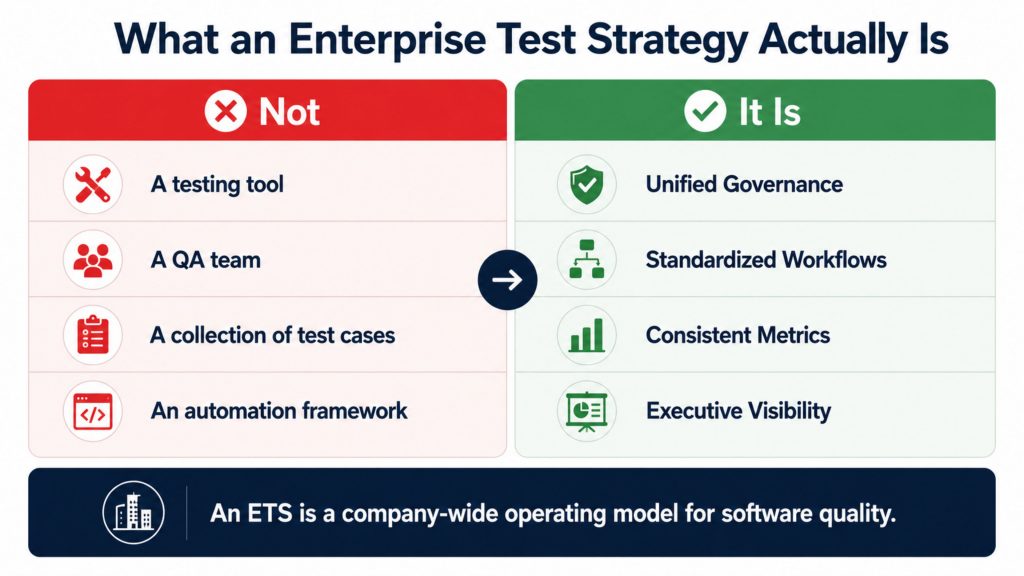
Crucially, it is not a testing tool. It is not a QA team. It is a strategic operating model featuring unified governance, standardised workflows, consistent metrics and executive-level visibility.
Organisations that scale successfully treat quality as a centralised business discipline.
Kualitatem’s Testing Center of Excellence (TCoE) model is built exactly around this principle.
Most guides tell why you need an ETS. Here is exactly how to build one, broken down into five structured phases designed for complex organisations.
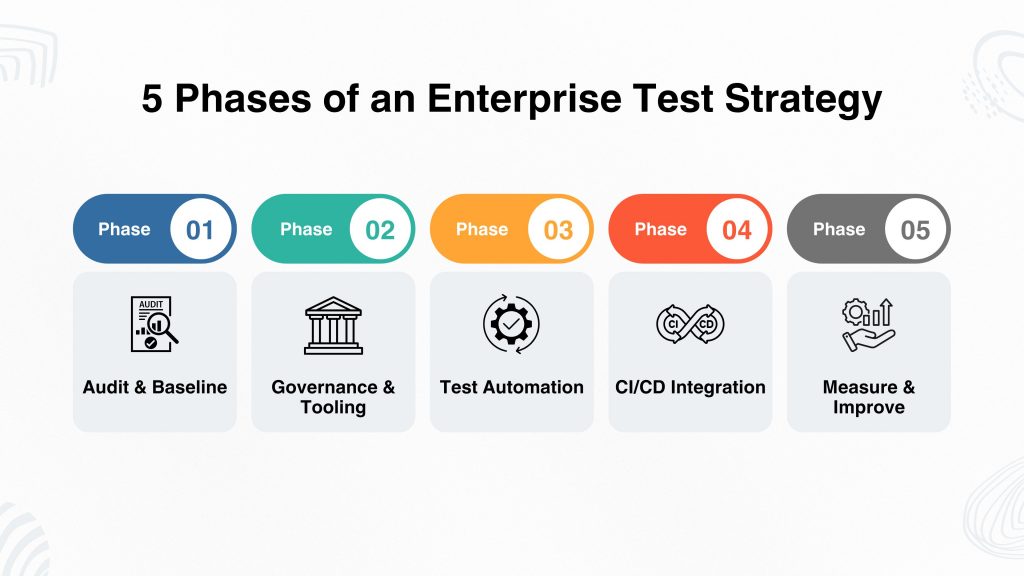
You can’t design a strategy without an honest inventory of where you stand.
Kualitatem’s QA consulting team is structured to run exactly this diagnostic mapping your current state, surfacing your critical gaps and producing a prioritised remediation roadmap. Start that conversation here.
Speak to an ExpertEstablish Kualitee as a central test management platform and single source of truth for metrics across all units. Define critical defects and eliminate redundant licenses.
Immediate ROI: This phase typically pays for itself through immediate license savings.
Manual testing at an enterprise scale is neither sustainable nor competitive. Enterprise test automation should handle repetitive, high-volume regression validation so your human testers can focus on exploratory, context-dependent scenarios.
For engineering leaders building the internal business case, Kualitatem’s automation ROI guide is a practical starting point.
Testing in isolation will always be a bottleneck. By integrating continuous testing into your CI/CD pipeline, your teams get immediate feedback on every code commit, automated regression coverage that scales with deployment frequency and the elimination of late-stage test cycles that drag down go-to-market timelines.
A strategy without measurement is just a memo.
Build executive dashboards tracking defect escape rates and mean time to resolution. Hold quarterly reviews to reassess risk.
For a formally validated quality maturity benchmark, Kualitatem’s TMMi certification services provide an internationally recognised assessment of where your processes stand and a structured path to improve them.
Avoiding Common Strategic Mistakes
Before investing in tooling, avoid these traps:
Strategy without proof is just theory. We know that.
Here’s how Kualitatem’s enterprise testing services have actually moved the needle for organizations facing the exact bottlenecks outlined in this guide.
Resolving Infrastructure Problems Before Customers Notice
The Client: Arab National Bank
The Problem: In regulated financial sectors, infrastructure limitations often stay completely invisible under normal loads, only to trigger catastrophic failures at peak demand. A reactive, late-stage testing model simply won’t catch them in time.
The Kualitatem Solution: We used performance testing practice to surface these hidden risks during a stress test to their API infrastructure over the APIgee platform.
The ROI: Identified infrastructure and application bottlenecks, leading to a “great increase in performance and stability,” according to Arsalan Qureshi.
Explore Kualitatem’s banking and finance testing practice for more on regulated-sector engagements.
From Manual to Automated: Driving Shorter Release Cycles
The Client: Loadio Inc
The Problem: Moving from manual to automated testing is usually where enterprise growth stalls because the structured approach isn’t there.
The Kualitatem Solution: We identified Proof-of-Concept candidate test cases, selected the optimal technology and did most of the leg work in setting up the initial automated framework.
The ROI: Measurable, compounding acceleration of go-to-market speed resulting in “shorter production release cycles,” as confirmed by CEO Timur Eligulashvili
Securing Revenue-Critical Systems
The Client: AAJ Technologies (testing the reservation system for a world-class hotel chain)
The Problem: When the stakes are tied directly to revenue, your testing strategy has to be airtight across functional and integration layers.
The Kualitatem Solution: We complemented their strategy, skill set and execution methodology by performing functionality, integration and regression testing before layering automation on top to crush ongoing costs.
The ROI: A thoroughly tested, flawless platform that is currently “a critical source of revenue generation,” according to CTO Asad Shamim.
See Kualitatem’s QA services overview for how this end-to-end approach is structured.
An Extension of Your Team, Not Just a Vendor
The Client: Motista Inc
The Problem: The biggest hesitation CTOs have about external QA is friction and whether the partner will just become another layer of coordination overhead.
The Kualitatem Solution: We provided thorough and complete test plans and seamlessly embedded with internal talent to adapt to constantly changing needs.
The ROI: Eliminated silos and bottlenecks without slowing the team down, delivering what CTO Chris McNeilly called an “outstanding value.
Browse Kualitatem’s full case studies library and client testimonials for more examples across industries and organisation sizes.
Tolerating a decentralised QA model compounds tech debt and erodes trust. Shift from reactive bug hunting to proactive quality engineering to protect your capital and brand.
Kualitatem offers a no-obligation 30-minute QA Ecosystem Audit with senior consultants who specialise in enterprise transformation. In one session, you’ll walk away with:
Connect with Kualitatem’s Enterprise QA Team →
Speak to an Expert
Nabeesha is a Digital Content Executive at Kualitatem Inc. With a background in communication and extensive knowledge of QA and cybersecurity, she brings a business-first lens to technical content. Her work helps CTOs and engineering leaders cut through the noise and make confident decisions about software quality.
Not sure where your QA stands?
Speak to an Expert



Our experts are all ready. Explain your business needs, and we’ll provide you with the best solutions. With them, you’ll have a success story of your own.
Contact us now and let us know how we can assist.