
Shift-Left Is Not Broken. It Is Just Not Enough
April 8, 2026



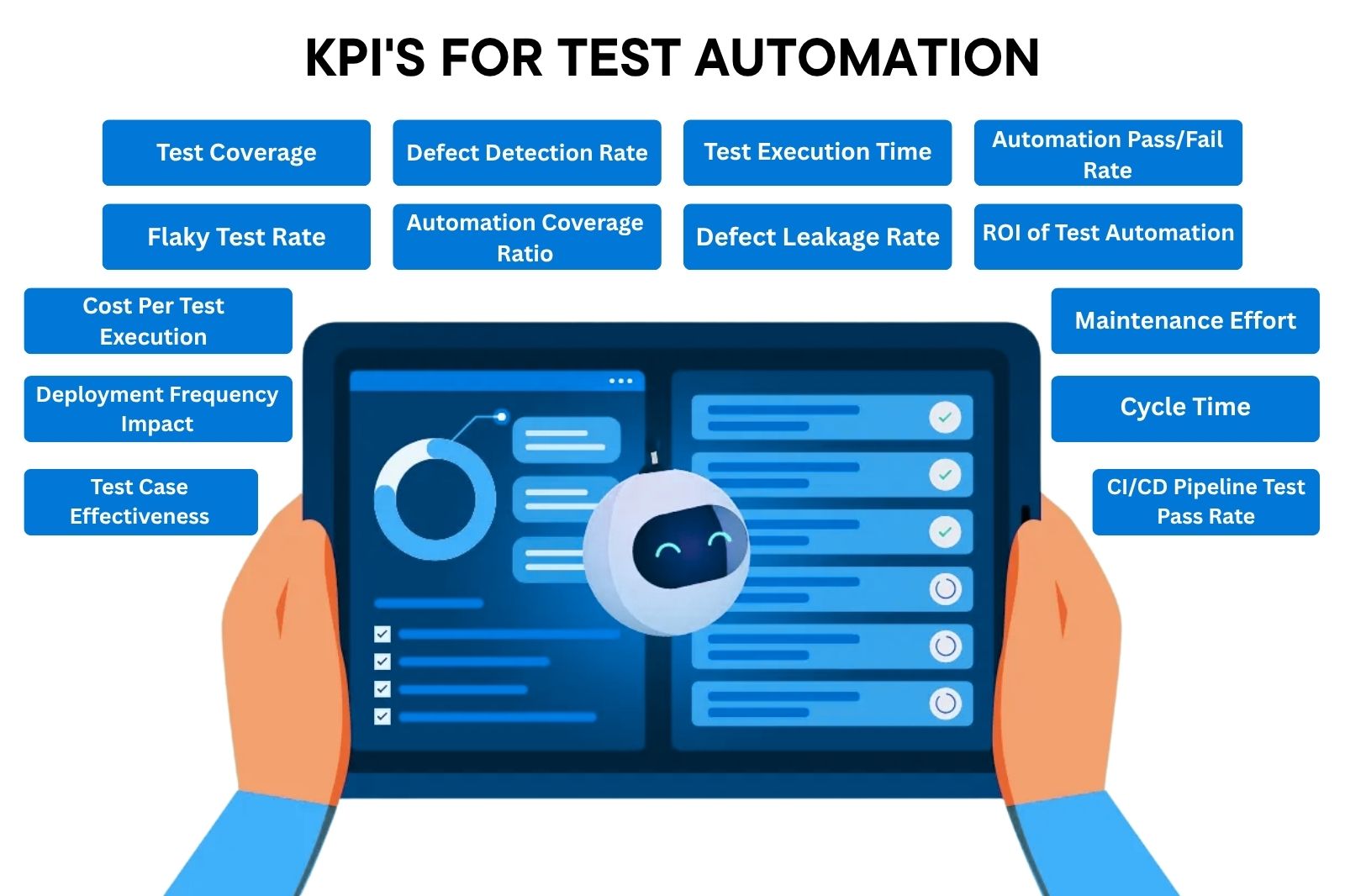
As a technology leader, when you walk into a quarterly review with 14 dashboards, 5,000 automated test cases, and a 92% pass rate.
You never end up with any descion. Because your numbers are too techy for business people. What your C-suite really cares about is:
If you don’t say what they wanna hear, your automation program might not get sufficient funds
Track all 15 KPIs in one place. We built a free metric tracker so you can stop guessing and start measuring what the board actually cares about.
Download Metric Tracker →
This article translates the 15 most important test automation metrics into that language for you.
For each metric, you will find how to calculate it, what the benchmark looks like in practice, where the business risk lives if you ignore it, and how long it realistically takes to achieve a healthy baseline.
But first, let’s understand what Key Performance Indicators are for Automation Testing and why they are so important.
Stakeholders want to know if testing justifies the budget, supports release decisions, and delivers real ROI. Four business outcomes make automation metrics worth tracking:
Release visibility: Know if a build is safe to ship, backed by data not gut feeling.
Risk reduction: Catch issues before customers, regulators, or the press do.
Cost control: See whether your cost of quality is trending in the right direction.
Speed assurance: Confirm automation is actually accelerating delivery, not just running alongside it.
A metric is a number. A KPI is a number tied to a business goal with a target and a consequence.
Test execution count is a metric.
“Maintain a CI/CD pipeline pass rate above 90% to support weekly releases” is a KPI.
KPIs create accountability. Metrics get noted and forgotten. When a threshold is tied to a business outcome, people act.
Teams that track the right metrics, surface signal over noise, and align QA data with business goals share one thing in common: they make faster, smarter decisions.
Test coverage tells you what percentage of your application your automated tests actually exercise.
For executives, the real question is whether the right areas are covered.
A banking platform with 80% coverage that excludes payment processing is not 80% safe. It is 100% exposed where it matters most.
Coverage gaps discovered in production do not stay in QA reports. They show up in incident logs, SLA breaches, and customer complaints.
Risk-based coverage, prioritizing business-critical flows, gives leadership a defensible answer when auditors or the board ask how quality is being ensured.
KPI Formula
(Automated Test Cases / Total Testable Requirements) × 100 = Test Coverage
Benchmark
70–85% for mature teams; below 60% is a red flag for regulated industries.
Time to Achieve
Baseline within 30 days; 70%+ achievable in 3–6 months with a structured automation program
This metric tracks how many defects your automation suite catches before they reach production. It is one of the most direct indicators of whether QA is delivering real business protection or just running scripts.
A low defect detection rate before release means higher costs after. For enterprise software, that ratio climbs further when you factor in customer impact, rollback overhead, and regulatory scrutiny.
KPI Formula
(Defects Found in Testing / Total Defects Found) × 100 = Defect Detection Rate
Benchmark
Best-in-class teams detect 85–95% of defects pre-production
Business Risk
Defects escaping to production damage trust, increase support costs and in regulated environments, can trigger audit findings.
Time to Achieve
Measurable from day one; improvement tracked sprint over sprint
Every hour your test suite takes to run is an hour your engineering team waits to deploy. At scale, slow test suites force teams to either delay releases or cut testing, neither is acceptable when speed and quality both matter.
For organizations running continuous delivery pipelines, test execution time directly affects deployment frequency. Teams that move from 4-hour suites to 30-minute suites do not just ship faster; they ship more often with faster rollback capability when something goes wrong.
KPI Formula
Total wall-clock time from test run trigger to results report
Benchmark
Under 10 minutes for unit/integration; under 30 minutes for full regression in a CI/CD pipeline
Business Risk
Slow suites create a bypass culture, developers skip or shortcut testing to meet deadlines, increasing production risk.
Time to Achieve
Parallelization and infrastructure upgrades can cut execution time 50–70% within 60–90 days
Pass rate is often misread as a quality signal. A 95% pass rate means nothing if 30% of those passes are false positives from poorly written tests.
What matters is whether the failures flagged are real, actionable issues, and whether the passes are genuine assurance.
❓Executives should ask: when the pass rate drops, does the team know immediately, and does it block release?
Teams with strong governance treat any unexpected pass rate drop as an escalation trigger, not just a metric to note in the next weekly report.
KPI Formula
Test Automation Pass Rate Formula
Pass Rate (%) = Number of Passed Tests/Total Executed Tests ×100
Pass Rate (%)= Total Executed Tests/ Number of Passed Tests ×100
The same goes for fail rates
🧠 Example
Total tests executed = 100
Passed = 85
Failed = 15
Pass Rate = 85%
Fail Rate = 15%
Benchmark
Stable mature suites: 90–98% pass rate on clean builds
Business Risk
False passes create false confidence. False fails create alert fatigue and get ignored, the same problem, opposite direction.
Time to Achieve
Meaningful signal within 2–4 weeks of consistent test execution
A flaky test is one that sometimes passes and sometimes fails without any code change. Individually they look harmless. Collectively, they are the number one reason engineering teams lose trust in their test suites, and stop acting on failures.
Google’s engineering team documented that flaky tests at scale created a “false signal“ problem that took significant effort to remediate. For enterprise teams, flakiness above 5% means your test suite is actively misleading the people making release decisions.
KPI Formula
(Tests That Produce Inconsistent Results / Total Tests) × 100 = Flaky Test Rate
Benchmark
Under 2% is the industry standard; above 5% requires immediate attention
Business Risk
High flakiness causes engineers to re-run tests rather than investigate failures, masking real defects.
Time to Achieve
Detection is immediate with proper logging; remediation takes 4–8 weeks of dedicated cleanup
This is distinct from test coverage. Automation coverage ratio answers how much of your existing test library has been converted from manual to automated execution. It is the key signal for maturity of your automation investment and its scalability.
Manual testing does not scale with release velocity. A team running 500 manual regression tests on a two-week sprint cycle cannot realistically maintain that cadence as the product grows. Automation coverage ratio tracks whether you are building a sustainable quality operation or one that will require headcount every time the product expands.
KPI Formula
(Automated Test Cases / Total Test Cases) × 100
Benchmark
40–60% is a reasonable mid-maturity target; 70%+ for high-velocity teams
Business Risk
Low automation coverage creates a manual testing bottleneck that caps release frequency regardless of engineering speed.
Time to Achieve
Meaningful ratios achievable within 6 months with a dedicated automation program
Defect leakage measures how many defects escape your QA process and reach users. The board sees it in SLA reports; customer success sees it in support tickets.
In enterprise software, a single high-severity defect reaching production can cost more to resolve than an entire month of QA investment. For fintech and banking clients, leaked defects carry regulatory weight on top of the operational cost.
KPI Formula
(Defects Found in Production / Total Defects Found) × 100 = Defect Leakage
Benchmark
Under 5% for mature QA programs; under 2% for mission-critical systems
Business Risk
High leakage erodes user trust, triggers SLA penalties, and in regulated industries, creates audit exposure.
Time to Achieve
Tracked continuously; reduction of 30–50% achievable in one quarter with targeted automation improvements
This is the metric that justifies every automation investment conversation with leadership. The ROI calculation compares the total cost of building and maintaining automation against the cost savings from reduced manual testing, faster defect detection, and fewer production incidents. Most organizations that measure this properly find positive ROI within 12–18 months of a structured automation program.
KPI Formula
((Cost Savings from Automation − Cost of Automation) / Cost of Automation) × 100
Benchmark
Positive ROI typically within 12 months; 200–400% ROI over 3 years is achievable for large-scale programs
Business Risk
Without measuring ROI, automation spend looks like overhead. With it, it becomes a documented competitive advantage.
Time to Achieve
Initial ROI data available within 6 months; full ROI picture clear at 12–18 months
As test suites scale, execution costs scale with them, including cloud compute, infrastructure, licensing, and engineering time. Cost per test execution brings discipline to that growth, ensuring automation remains economically sound as it expands.
Teams that optimize this metric do not just save money; they make the business case for running tests more frequently. When each execution costs less, you can run tests on every commit rather than just nightly, catching issues earlier when they are cheapest to fix.
KPI Formula
Total Test Execution Cost / Number of Tests Executed (per period)
Benchmark
Highly variable by stack; aim for 20–30% cost reduction year-over-year as suites scale
Business Risk
Unmanaged execution costs can make automation economically unsustainable, leading to scaled-back testing frequency.
Time to Achieve
Baseline measurable immediately; optimization within 30–60 days of cost analysis
Test maintenance is the hidden cost of automation. Poorly structured test suites require constant upkeep every time the application changes, and if maintenance consumes more engineer time than the tests save, the automation investment becomes a net loss.
Best practice benchmarks suggest that maintenance should consume no more than 20–25% of total QA engineering time. Teams exceeding 40% are effectively working for their test suite rather than using it to work for them.
KPI Formula
Maintenance hours per sprint / Total QA engineering hours per sprint
Benchmark
Under 20% of QA time on maintenance; above 35% indicates architectural problems in the test suite
Business Risk
High maintenance burden slows automation growth and makes QA a bottleneck rather than an accelerator.
Time to Achieve
Measurable within one sprint; structural improvements take 2–3 months to implement
DORA research consistently shows that high-performing engineering organizations deploy more frequently and recover from failures faster. Test automation is a core enabler of that capability. This metric tracks whether your automation investment is actually moving the needle on deployment velocity.
The correlation is direct: teams with high-confidence automated suites deploy 2–5x more frequently than teams without. For SaaS organizations, deployment frequency maps directly to feature delivery speed and competitive responsiveness.
KPI Formula
Deployment frequency (before automation) vs. deployment frequency (after automation) — expressed as ratio or absolute change
Benchmark
Elite DORA performers deploy on demand or multiple times per day; high performers deploy daily to weekly
Business Risk
No improvement in deployment frequency after automation investment suggests the suite is not integrated into the CI/CD pipeline.
Time to Achieve
Measurable impact within 60–90 days of CI/CD pipeline integration
MTTD measures the lag between when a defect is introduced and when your automation catches it. Shorter MTTD means cheaper fixes, faster feedback loops, and less developer context-switching to diagnose issues days after writing the code.
Code that passes review but fails in QA three days later requires the developer to rebuild mental context around work they considered done.
Teams with MTTD under one hour operate fundamentally differently from teams where defects surface in the next day’s test run.
KPI Formula
Average time from defect introduction to test failure detection
Benchmark
Under 1 hour for teams with shift-left testing; under 24 hours for most CI/CD setups
Business Risk
Long MTTD means defects accumulate before discovery, making root cause analysis harder and remediation more expensive.
Time to Achieve
Baseline measurable immediately, shift-left improvements achievable within 30–60 days
Cycle time measures how long it takes from code commit to production deployment. Test automation is not the only variable, but it is often the largest bottleneck. When automation runs fast and reliably, cycle time compresses. When it does not, it becomes the ceiling on delivery speed.
For product-led organizations, cycle time is a competitive metric.
The teams that can take a customer-reported issue from report to fix in hours rather than days have a structural advantage in retention and satisfaction.
KPI Formula
Time from code commit to production deployment (average per release)
Benchmark
Elite DORA teams: under 1 hour; high performers: 1 day to 1 week
Business Risk
High cycle time creates release pressure that leads to skipping testing steps — the opposite of what automation should enable.
Time to Achieve
Improvement visible within 30–45 days of pipeline optimization
Not all tests are created equal. Test case effectiveness measures whether your tests are actually finding defects or just confirming that things already known to work still work. It also helps prioritize which tests to maintain and which to retire, a useful filter as suites grow.
KPI Formula
(Number of Defects Found by a Test / Total Executions of That Test) = Test Case Effectiveness
ranked and analyzed
Benchmark
No universal benchmark; focus on identifying the bottom 20% of tests that find zero defects over 90 days
Business Risk
Low-effectiveness tests waste compute and engineer time while providing no incremental quality signal.
Time to Achieve
Analysis possible within one quarter of tracked test execution data
This is the metric your DevOps and engineering leadership watches most closely. Pipeline pass rate determines whether code can move forward or gets blocked, making it the frontline indicator of build health and automation reliability.
KPI Formula
(Builds Passing All Automated Tests / Total Builds) × 100 — tracked per pipeline stage
Benchmark
85–95% for stable teams; consistently below 80% indicates suite or infrastructure problems
Business Risk
Low pipeline pass rate breaks developer trust in automation and creates a manual override culture that defeats the purpose of CI/CD.
Time to Achieve
Measurable from day one of pipeline integration; stabilization within 30–60 days
The data behind these metrics lives in a few places: your CI/CD pipeline (Jenkins, GitHub Actions, GitLab CI), your test management platform, and your observability stack.
Most teams already have the raw data. The gap is usually in aggregating it into a coherent picture that engineering, QA, and business leadership can all read.
Where the Data Lives
• CI/CD pipelines: Execution time, pass/fail rates, pipeline health, deployment frequency
• Test management tools, coverage, defect detection, test case effectiveness, maintenance tracking
• Incident and support systems: Defect leakage, MTTD, production impact
• Cloud cost platforms: Execution cost, infrastructure overhead
Real-time dashboards that pull from these sources give QA leads and engineering managers a current-state view. BI tools layered on top support trend analysis, which is where the executive narrative comes from. Showing that defect leakage dropped 40% over two quarters, while test execution time halved, tells a story that a static number cannot.
AI-assisted QA analytics platforms like Kualitee are moving this further, surfacing anomalies, predicting coverage gaps, and generating reports in formats that translate directly into executive briefings.
Tracking Vanity Metrics
Test count and execution count are the most common offenders. A suite running 10,000 tests sounds impressive. If 3,000 of them are duplicates and 2,000 are flaky, the number means nothing. Focus on metrics with a direct line to business outcomes.
Poor Data Quality
Metrics are only as good as the data feeding them. Test results that are not logged consistently, defect records that are not categorized properly, and pipeline runs that are not tagged to specific releases all degrade your ability to draw conclusions.
Metrics Without Context
A 70% pass rate on a brand-new suite in active development reads differently than 70% on a stable suite that was at 95% last quarter. The number alone does not tell you whether to act. Trend data and business context do.
The fix is straightforward in principle: track fewer metrics more rigorously, tie them to explicit business objectives, and automate the reporting so the data stays current rather than becoming a monthly manual exercise.
The tools available for automation metrics have matured significantly. Three capabilities matter most from a business perspective: real-time visibility, CI/CD integration, and reporting that translates QA data into language leadership can act on.
• Kualitee: AI-powered test management with built-in analytics, CI/CD integration, and executive reporting that maps test data to business outcomes. Designed for teams that need both QA depth and stakeholder visibility.
• Jira + Xray: Strong for Agile teams already in the Atlassian ecosystem; coverage and defect tracking integrated with project management.
• TestRail: Structured test management with solid reporting; works well for compliance-heavy environments that need audit trails alongside metrics.
Metrics are not the goal. The goal is reliable software, confident releases, and a quality engineering program that earns its investment. Metrics are how you know whether you are getting there.
The 15 metrics in this article give leadership a framework to ask the right questions — not just “is QA testing everything?” but “where are we exposed, what is it costing, and how fast are we moving compared to where we need to be?”
Teams that track these metrics rigorously tend to find something counterintuitive: better measurement does not make QA more bureaucratic. It makes it faster, because decisions get made with data rather than waiting for the next incident to surface what the metrics already knew.
If your current QA reporting does not answer those questions today, that gap is worth closing before the board asks and you do not have the data to respond.
Ready to Turn Your QA Metrics Into Business Insights?
See how Kualitee brings all 15 of these metrics into one dashboard, with AI-driven reporting built for engineering leadership.
→ Book a Demo | Bookmark to keep this Metrics Checklist
Tags: KPI for Automation Testing Explained, Top Test Automation KPI Metrics, Test Automation Adoption KPI, Automated Test Success Rate KPI, KPI for Automation Testers




Our experts are all ready. Explain your business needs, and we’ll provide you with the best solutions. With them, you’ll have a success story of your own.
Contact us now and let us know how we can assist.