
How Microservices Testing Helps Businesses Create Bug Free Artchitecure
March 17, 2026



Every engineering team has lived through it. A single bug appears, seemingly minor, and within hours, it has halted deployments, blocked multiple teams, and turned a manageable technical problem into a business crisis. What separates teams that resolve these situations in twenty minutes from those still firefighting two days later is rarely talent. It is architecture.
Understanding why software failures happen so frequently, and what it actually costs when they do, is the first step toward genuinely resilient building systems.
The scale of software quality problems is larger than most business leaders recognize. According to research from White Test Lab, businesses lose an estimated $3.1 trillion annually due to poor software quality, a figure that exceeds the GDP of most countries. Separately, 40% of companies report experiencing at least one major software failure every quarter.
That means software failures are not rare events. They are routine ones.
And the cost compounds the longer a bug goes undetected. According to IBM’s Systems Sciences Institute, a bug that costs $100 to fix during requirements gathering rises to
“The cost of software quality is always lower than the cost of software failure.”
Consortium for Information & Software Quality (CISQ)
These failures persist for reasons beyond testing gaps. It is due to architectural design.
Most software built more than five years ago, and many systems still being built today, follow a monolithic architecture. Everything is connected. One large system, tightly wired together.
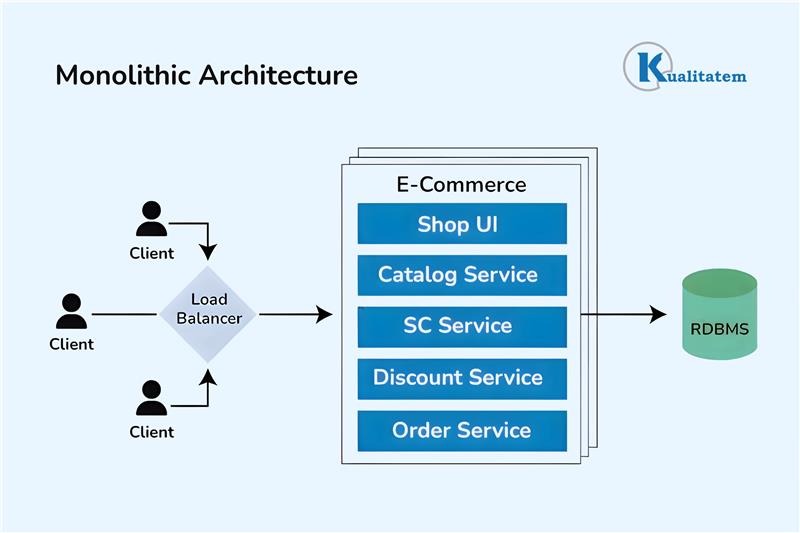
When something breaks in that system, the entire machine stops. Engineers dig through interconnected code looking for the fault. Deployments get blocked. Your whole team waits.
The data shows average engineering team already spends 30 to 50% of every sprint cycle firefighting defects instead of building new features. In a monolithic system, that percentage only grows over time because every new feature you add makes the system more complex, more fragile, and harder to test.
To solve this problem, many engineering teams are moving toward a different architectural model.
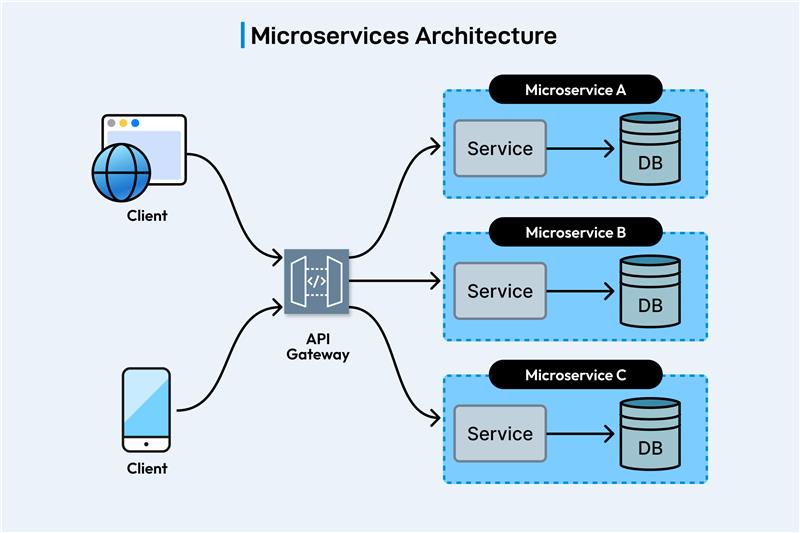
Microservices architecture addresses the core structural problem of the monolith. Instead of one large, interconnected system, the application is broken into a set of smaller, independent services. Each service handles a specific business function, such as login, payments, inventory management, or notifications. These services communicate with one another, but they are designed to operate independently.
The practical benefit is isolation. When a problem occurs in the payment service, it does not take down authentication or reporting. The affected service can be identified, fixed, and redeployed without touching the rest of the system. Teams working on different services can move in parallel without blocking one another. Deployment cycles shorten because a single service can ship independently of the whole application.
This is not a new concept, but it remains one of the most impactful architectural decisions a technology organization can make. The businesses gaining competitive ground today are often not the largest or best-resourced. They are the ones that can identify a problem on Friday afternoon and ship a fix before Monday morning.
Instead of one large, tangled system, imagine your software is built in independent pieces. One piece handles logins. One handles payments. One handles inventory. They communicate, but they don’t depend on each other to survive.
Break one piece, only that piece needs fixing. Everything else keeps running.
That’s microservices architecture.
📌 “Microservices testing is the discipline that makes this model actually work. It means testing each of those independent pieces carefully on their own, and together, before anything reaches your customers.”
The goal is simple;
“The businesses winning right now are not necessarily bigger or better-funded. They are faster. And their speed is architectural.”
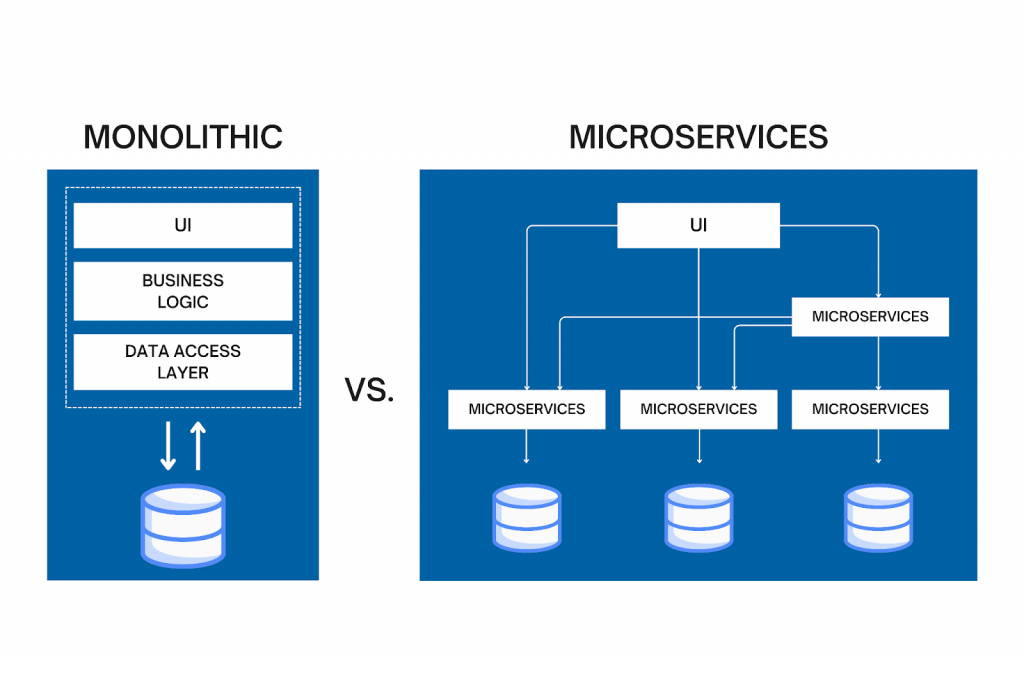
The difference becomes clearer when you compare how each architecture handles real-world situations.
| Scenario | Monolithic System | Microservices + Proper Testing |
| Bug in payment flow | Full deployment paused | Only the payment service was fixed and redeployed |
| New feature request | Waiting for the full release cycle | Feature service shipped independently |
| Two teams working simultaneously | Constant conflicts, re-testing | Teams work in parallel, no interference |
But architecture doesn’t just influence development speed. It also determines how much risk your business carries.
For B2B companies in regulated industries like financial services, healthcare, and logistics, software failures are not just technical issues. They are serious business risks. A data breach caused by a software vulnerability can trigger GDPR fines of up to 4% of global annual revenue. For a mid-sized company, that is not just a penalty. It can threaten the entire business.
💡Example:
The 2024 CrowdStrike incident shows how quickly one mistake can escalate. A faulty software update spread across 8.5 million Windows devices, disrupting airlines, banks, hospitals, and critical services worldwide. One defect created a global operational crisis.
Microservices testing helps prevent this kind of failure by making security and compliance part of every service, not something added at the end.
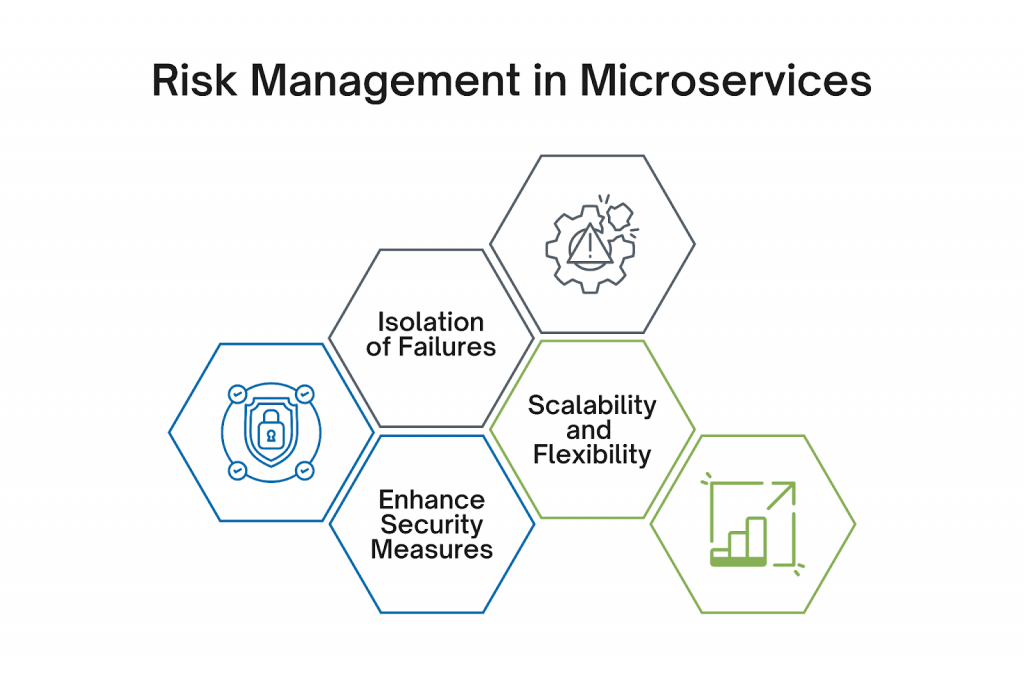
This modular structure doesn’t just improve reliability. It also opens the door for modern technologies like AI to work far more effectively.
One additional dimension that is becoming increasingly relevant is artificial intelligence. As organizations explore embedding AI capabilities into their products, the architectural model they use determines how effectively those capabilities can be deployed.
In a microservices environment, AI can be embedded at the service level, where it has access to specific, well-defined data and can act on it in real time. An AI component monitoring the payment service can process transaction data, identify anomalies, and respond to them without needing visibility into the entire application. Over time, AI models embedded across services can learn usage patterns and surface predictions or personalizations specific to each function. In a monolithic system, implementing the same capabilities typically requires either rebuilding significant portions of the application or accepting a less effective centralized approach.
You don’t need to rebuild everything. Most businesses can adopt microservices testing gradually and integrate it into their processes.
1. Map Your Services
List your core functions:
Each should be tested independently.
2. Test at the Service Level
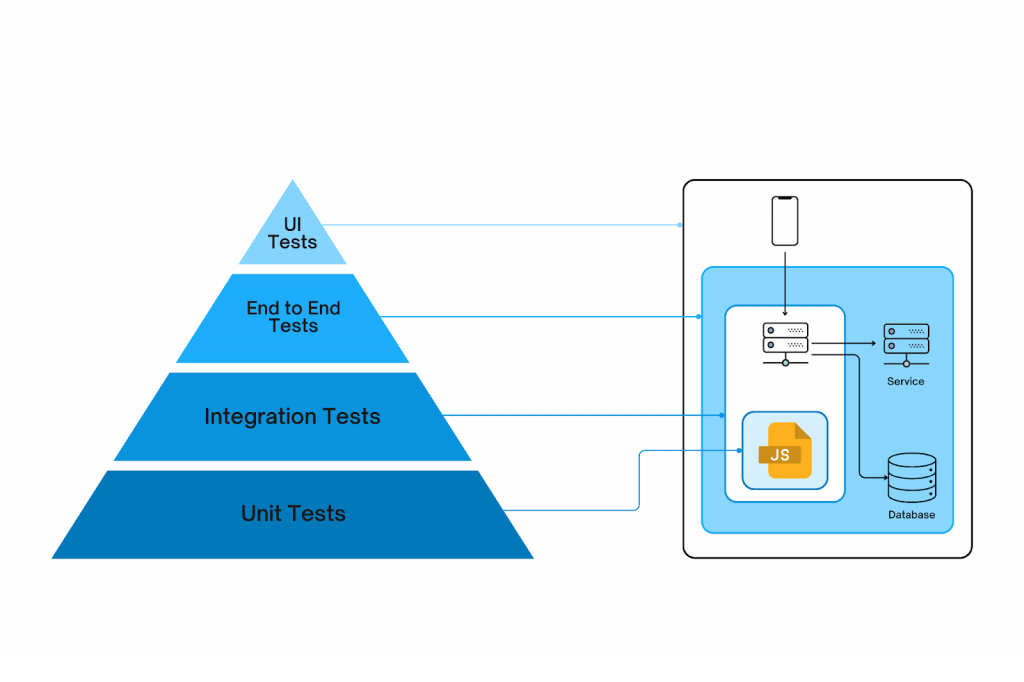
Don’t rely only on end-to-end tests. Add unit and integration tests for each service, starting with high-risk areas like payments and user data.
3. Add Contract Testing
Services communicate through data agreements. Contract testing ensures updates in one service don’t break another.
4. Automate Regression Testing
Automation helps catch issues faster and keeps QA coverage growing without increasing team size.
5. Integrate Security Testing
Run security scans and static analysis in your CI/CD pipeline so vulnerabilities are detected with every update.
Even with these practices in place, leaders should periodically step back and evaluate how resilient their architecture really is.
Software quality is ultimately an architectural question as much as a testing one. The systems that hold businesses back are usually not poorly written. They are poorly structured, in ways that make problems harder to find, harder to fix, and more expensive when they reach production.
Microservices testing, applied consistently, addresses that structural problem. It shortens feedback loops, reduces the blast radius of failures, and gives teams the confidence to ship faster without accepting more risk. That combination is increasingly the difference between organizations that lead their markets and those that are perpetually catching up.
At Kualitatem, we have spent 17 years helping B2B companies build software testing strategies that match their architecture, their risk profile, and their growth stage. If you want an honest assessment of where your QA stands today, let’s talk.




Our experts are all ready. Explain your business needs, and we’ll provide you with the best solutions. With them, you’ll have a success story of your own.
Contact us now and let us know how we can assist.