Testing Center of Excellence (TCoE) – Complete Guide
Testing becomes difficult to manage once an organisation grows past a few teams. A testing Center of Excellence (TCoE) pulls that back together. It:
- Centralises testing expertise under one roof.
- Standardised how teams handle quality projects across all projects.
- Gives leadership one reliable view of quality across every project.
Traditional project-level QA fails at enterprise scale because it cannot provide cross-project quality visibility, control software costs, or shorten release cycles consistently.
Drawing on Kualitatem’s enterprise implementation built on TMMi Level 5 and HP maturity frameworks, this guide breaks down to evaluate your readiness, choose the right operating model, set up governance, and measure long-term ROI.
What is a Testing Center of Excellence?
A Testing Center of Excellence is a framework for running quality as one coordinated capability. It replaces the usual mess of disconnected team efforts. Instead of every project solving the same testing problems alone, a TCoE gives the whole organization a shared foundation.
Here is what a TCoE is responsible for:
- Standardizing testing practices and methodologies
- Centralizing or coordinating QA expertise
- Setting up governance and quality standards
- Sharing tools, frameworks, and reusable assets
- Improving and scaling test automation
- Defining what “quality” means across teams
- Measuring testing performance with consistent metrics
- Supporting continuous improvement over time
A TCoE is about making testing repeatable, observable, and tied directly to release schedule.
TCoE vs. traditional testing department
This is the distinction that matters most. It’s also why TCoE exists in the first place. Setting up a testing department gives you people who run tests. Setting up a TCoE gives you a quality function with strategy, standards, and governance behind it.
| Traditional testing department | Testing Center of Excellence (TCoE) |
| Project-focused | Organization-wide |
| Testing execution | Testing strategy and execution |
| Team-specific processes | Standardized processes |
| Individual tools | Shared tooling and frameworks |
| Reactive quality management | Proactive quality governance |
| Limited knowledge sharing | Centralized knowledge and best practices |
| Test delivery | Continuous improvement |
A testing department answers one question. Did this project get tested? A TCoE answers a harder one. Is quality under control across everything we ship, and is it getting better?
Why establish a Testing Center of Excellence?
The TCoE case is a business case. It goes well beyond QA. Shifting away from isolated project testing delivers measurable business impact:
- Cutting resource costs by consolidating software licenses, testing infrastructure, and training programs.
- Shortening time-to-market by up to 30% and eliminating release slips caused by missing skills or resources.
- Scaling test automation coverage across portfolios to between 50% and 70%.
- Optimizing cross-project staffing and operations through repeatable, standardized processes.
- Dropping critical defect leakage to as little as 0.5% by basing releases on quantifiable business risk.
- Providing cross-project visibility into quality metrics, service reuse, and testing progress.
- Harvesting and standardizing organizational best practices across testing, SOA architecture, and governance.
- Aligning IT priorities directly with overarching business goals and end-user service quality.
- Creating clear career progression paths that direct top QA talent where they deliver the most value.
- Enforcing identical quality, security, and performance benchmarks across both in-house and outsourced teams.
- Starting small with existing resources so the model becomes self-funding as it proves value.
When should you implement a TCoE?
Not every organization needs a TCoE. And not every organization needs one now. Building one before the problems exist just adds overhead with no payoff. The signals below tell you the timing is right.
Operational and Cost Signals
- Testing bottlenecks consistently slow down releases and stall delivery schedules.
- Different teams use conflicting processes, standards, and tools with no shared definition of quality.
- Duplicated resources, heavy manual testing, and overlapping software licenses push costs up without improving quality.
- The same defect gets caught in one team’s workflow and missed in another’s.
Portfolio and Scaling Signals
- Multiple products or complex software portfolios must meet shared quality standards that are impossible to coordinate manually.
- Manual testing cannot keep pace with release velocity, driving a need to scale automation without matching headcount growth.
- Testing operations fail to scale smoothly as the business grows, adding friction with every new team or product.
Engineering and Governance Signals
- Moving toward continuous delivery requires embedding continuous testing directly into the CI/CD pipeline rather than bolting it on afterward.
- QA expertise lives in isolated individuals rather than shared, documented capabilities that survive team turnover.
- Regulated environments like banking, healthcare, or government demand stronger governance, audit traceability, and standardized quality controls.
TCoE Models: Centralized vs. Decentralized vs. Hybrid
Setting up a TCoE doesn’t mean pulling every teaser into one central team. The operating model is its own decision, and getting it wrong is a common reason these initiatives stall. There are three broad models to choose from.
| Model | Best For | Core Advantage | Main Trade-off |
| Centralized | Large or highly regulated organizations | Maximum consistency and shared automation frameworks | Delivery bottlenecks and slow sprint-level response |
| Decentralized | Fast-moving, product-focused Agile teams | Rapid sprint alignment and squad flexibility | Tool duplication and inconsistent execution standards |
| Hybrid | Complex global enterprises and multi-product portfolios | Centralized governance paired with distributed execution | Governance complexity in balancing squad autonomy |
The right choice depends on your size, your regulatory pressure, and how much autonomy your teams need to move fast.
How to set up a Testing Center of Excellence
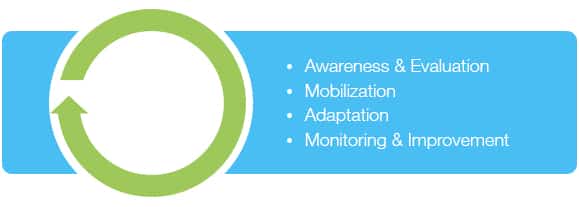
Kualitatem uses a phased approach to establish a TCoE. It’s designed to grow a small test team into a full quality services center for organization-wide needs. The model draws on years of implementing test processes across many organizations. It also draws on standards like the Testing Maturity Model (TMMi) and the HP Maturity Model. We customize it to each client’s requirements. And we keep it scalable enough to meet certification standards later if you want that.
The model runs across four phases. Assessment, then Mobilization, then Adaptation, then Improvement.
Phase 1: Assessment
Every TCoE starts with an assessment. You look at current QA processes, development practices, and overall organizational culture and maturity. Organizations vary widely in how they build and test software. So each assessment has to be tailored to the specific organization.
This phase looks at:
- Current QA maturity
- Existing testing processes
- Existing tools
- Current team structure
- Development practices
- Organizational culture dynamics
- Current pain points
- Gap analysis
Everything in the assessment feeds one central question. What does the organization actually need the TCoE to solve? The answer shapes every decision that follows. This includes operating models and tooling.
Phase 2: Mobilization
The mobilization phase connects the consultant team with key stakeholders in the TCoE initiative. These stakeholders sit across the organization.
This is where the TCoE transformation roadmap takes shape based on organizational maturity:
- Defining major activities, milestones, and timelines for each rollout stage.
- Setting phase-by-phase goals for automation, testing processes, environments, and governance.
- Finalizing the operating model (centralized, decentralized, or hybrid) to define daily execution.
- Mapping how the TCoE interfaces with delivery projects, leadership, and external vendors.
- Auditing internal skills to plan targeted hiring, team reassignment, or upskilling.
- Establishing core SME teams dedicated to test automation, governance, and asset management.
- Estimating infrastructure, test environment, and management platform investments.
- Running internal communications to secure organizational alignment and buy-in.
- Integrating TCoE KPIs into broader IT governance to support cost, speed, and quality goals
Phase 3: Adaptation
The adaptation phase accounts for roughly 50-60% of the implementation lifecycle. It embeds new quality frameworks into daily operations through team training, tooling setup, and workflow integration.
This phase standardizes:
- Core testing methodologies and automation frameworks.
- Enterprise tool selection and licensing consolidation.
- QA training programs and project-level onboarding.
To prevent resistance, separate mandatory controls from team autonomy:
- Fixed governance: Mandatory quality gates, compliance audits, and defect severity levels.
- Squad flexibility: Test case design granularity, specific tool variations, and sprint-level execution tweaks.
Phase 4: Improvement
The improvement phase runs on metrics. You generate them and set up regular checkpoints to evaluate process maturity. During this phase you also set up a knowledge management system. That helps the TCoE get adopted across the organization. Regular resource training sessions run alongside it.
During Phase 4, the TCoE evolves through scheduled audits and data-backed refinements:
- Running recurring TMMi or ITIL maturity assessments to identify workflow gaps.
- Refining automated suites based on historical defect hotspots and build runtimes.
- Maintaining an internal quality knowledge base to standardize team onboarding.
- Reviewing operational KPIs with engineering leaders to realign tooling and capacity.
Improvement is continuous by design. A TCoE isn’t finished at go-live. It matures over time as metrics show what’s working and what needs to change.
TCoE roles and responsibilities
A TCoE runs on people with clear responsibilities. The roles below are the ones most commonly involved. But the structure depends on organizational size and testing needs. Not every TCoE needs every role. Smaller organizations often combine several into one.
| Role | Primary responsibility |
| TCoE Leader / Manager | Strategy, governance, budget, stakeholder management |
| Test Architect | Testing architecture and frameworks |
| QA / Test Leads | Standards and delivery oversight |
| Automation Engineers | Automation frameworks and maintenance |
| Performance Engineers | Performance strategy and testing |
| Security Testing Specialists | Security and vulnerability testing |
| QA Engineers / Testers | Test execution and quality activities |
| DevOps Engineers | CI/CD and continuous testing integration |
| Business / Engineering Stakeholders | Requirements and organizational alignment |
The mistake to avoid is over-building the org chart. Start with the roles your current testing problems demand. Expand as TCoE proves its worth.
Standardizing testing processes and tools
Standardization is where a TCoE turns strategy into daily practice. The aim is a consistent, repeatable way of working that any team can pick up. And it does that without erasing the flexibility individual projects need.
A TCoE should standardize:
- Test planning
- Test case design
- Test execution
- Defect management
- Test data management
- Environment management
- Automation standards
- Documentation
- Quality gates
- Test reporting
Tool Rationalistation
Standardizing tools isn’t about forcing every team onto the same tool. Instead , it replaces disconnected, rogue software purchases with an approved enterprise toolkit:
- A shared test management platform tracks test coverage and defect metrics across all projects.
- Teams can adopt specialized testing tools or frameworks when a specific tech stack genuinely requires them.
Integrating TCoE with Agile, DevOps, and CI/CD
Modern delivery pipelines cannot afford an isolated QA department. A modern TCoE integrates directly into continuous delivery:
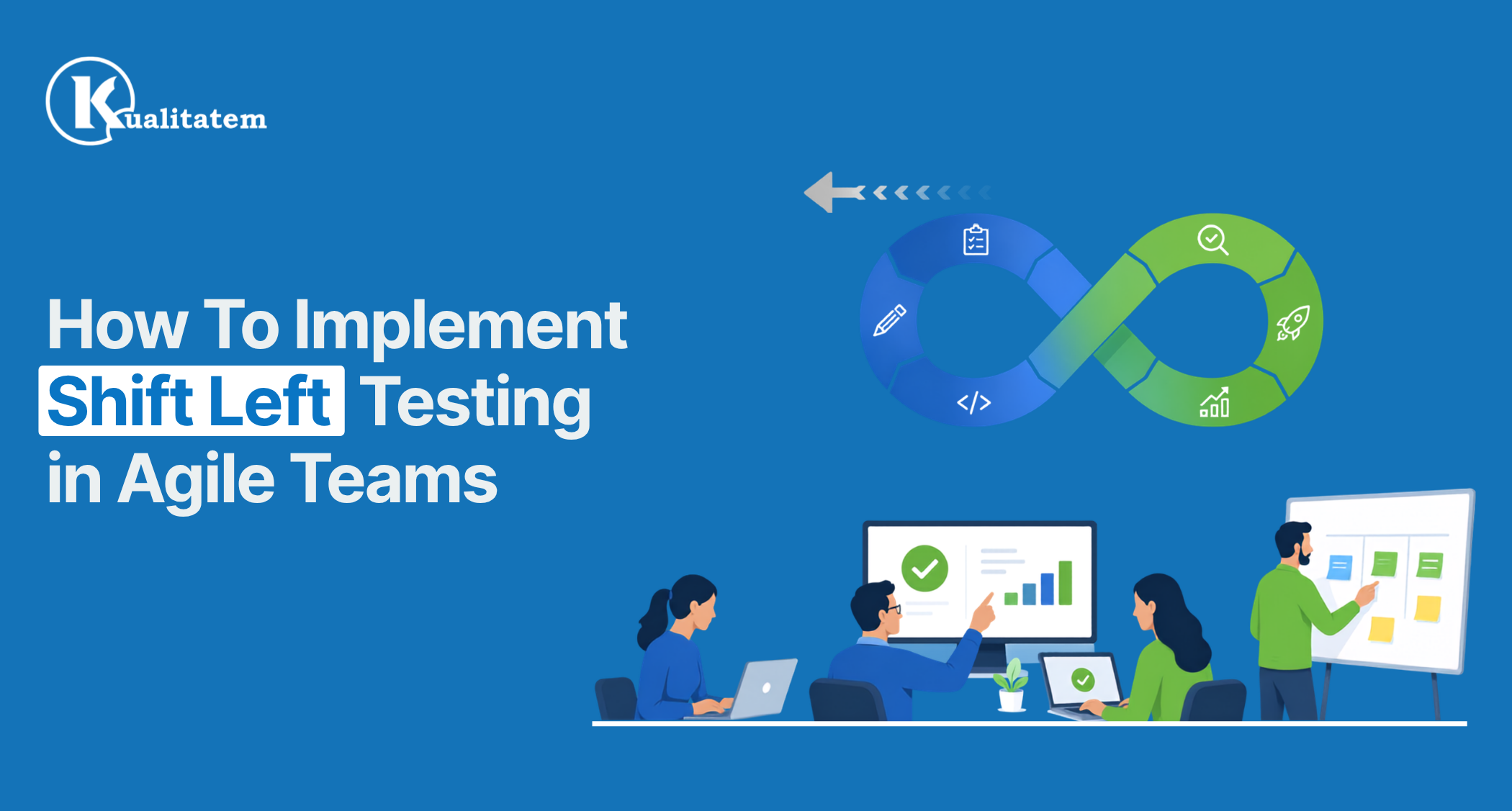
- Agile (Shift-Left): Testers embed directly into sprint planning to catch defect risks before code development begins.
- DevOps: Automated quality gates evaluate builds continuously, turning release readiness into a shared team metric.
- CI/CD (Continuous Feedback): Automated regression and API test suites execute automatically inside the pipeline:
Code → Build → Automated Tests → Quality Gate → Deployment → Monitoring
TCoE governance and quality standards
Governance is what keeps a TCoE consistent as it scales. It sets the road rules. It also defines where teams are free to make their own calls.
Effective TCoE governance covers:
- Testing policies
- Quality standards
- Roles and ownership
- Compliance
- Documentation
- Risk management
- Exception management
- Quality gates
- Reporting cadence
Governance only works if you draw a clear line between centralized control and team-level autonomy. Keep regulatory compliance, release gates, and severity definitions strictly uniform, but let individual squads determine their own daily sprint workflows and test scenario design.
This prevents TCoE from becoming an operational issue.
TCoE KPIs and success metrics
“Define KPIs” is easy advice to give and hard to act on. So here is what actually gets measured. Good TCoE metrics span three levels. Operational, quality, and business. A TCoE has to prove itself in each.
Operational KPIs
- Test execution time
- Regression cycle duration
- Automation coverage
- Test case reuse
- Test environment utilization
Quality KPIs
- Defect detection rate
- Defect leakage
- Production defect rate
- Defect severity trends
- Test coverage
Business KPIs
- Testing cost reduction
- Release velocity
- Time to market
- Cost per release
- Return on investment (ROI)
The business KPIs are what earn continued executive support. Operational and quality metrics show the TCoE is running well. Business metrics show it’s worth funding.
Pilot, measure, and scale the TCoE
You don’t need to roll a TCoE out across the entire organization on day one. You shouldn’t, either. A pilot lets you prove the model first. You gather real evidence and refine the approach before you scale it everywhere.
A practical sequence looks like this:
Select pilot → Define baseline → Implement framework → Measure → Collect feedback → Refine → Expand
Pick a pilot area with real pain and measurable outcomes. Capture a baseline before you change anything. That way, improvement is provable. Then implement, measure against that baseline, and gather feedback. Refine, and expand into the next area. Each cycle makes the case for the next one. That’s exactly what makes TCoE a self-funded initiative.
Common challenges when setting up a TCoE
| Implementation Challenge | Proven Mitigation |
| High initial investment | Prove ROI with a targeted pilot first. Early measurable wins secure the budget for broader rollout. |
| Resistance to change | Involve teams early, provide training, and clearly define where squad autonomy remains intact. |
| Integration with existing workflows | Roll out tools and processes in stages so active release pipelines aren’t disrupted. |
| Lack of executive buy-in | Speak to leadership in outcomes they care about, like cost reduction, faster releases, and lower defect leakage. |
| Resource allocation | Use a hybrid model to distribute day-to-day execution instead of creating a central queue bottleneck. |
| Balancing standardization and flexibility | Be explicit about which standards are mandatory and which are open to change. |
How Kualitatem can help establish a TCoE
Setting up an enterprise TCoE requires practical implementation experience. Kualitatem partners with organizations across banking, government, enterprise and SaaS to design, launch, and mature their testing capabilities using our TMMi Level 5 certification.
That support covers:
- TCoE strategy and roadmap
- QA maturity assessment
- Governance design
- Test automation
- Performance testing
- Security testing
- Test management
- QA staffing and augmentation
- Training and enablement
- CI/CD integration
- Continuous improvement
- Managed and outsourced testing
You might be trying to work out whether a TCoE is right for you at all. You might already be planning a pilot, or scaling something that’s up and running. Either way the underlying work doesn’t change. You connect quality to business outcomes and build a testing function that keeps getting better.
Schedule an initial consultation with our TCoE team to review where your QA stands today.
We’ll walk through your current setup, flag the gaps worth solving first, and show you what a realistic rollout looks like for an organization your size.
Frequently asked questions
1. What is the difference between a TCoE and a testing department?
A testing department is project-focused and focused on execution. A TCoE is organization-wide. It covers testing strategy, standardized processes, shared tooling, proactive governance, and continuous improvement.
2. What is the difference between centralized and decentralized TCoE?
A centralized TCoE concentrates governance, tools, and expertise in one team. That gives maximum consistency but risks bottlenecks. A decentralized TCoE keeps testing ownership within individual teams under shared standards. That gives more flexibility but risks inconsistency. A hybrid model combines central governance with distributed execution.
3. How does a TCoE support DevOps and CI/CD?
A TCoE embeds automated testing directly into the delivery pipeline. The flow runs from Code to Build to Automated Tests to Quality Gate to Deployment to Monitoring. It also supports shift-left testing, shared responsibility for quality, and continuous feedback. Together these enable genuine continuous testing.
4. How long does it take to establish a TCoE?
There is no fixed timeframe. Duration depends on organizational size, current QA maturity, the scope of the initiative, and the implementation model you choose. A phased approach with a pilot lets you deliver value early and expand from there. You don’t have to wait for a full rollout to show results.