
What a Test Automation Maturity Model Actually Looks Like
March 26, 2026




Just like every CTO, you want to deliver the highest-quality product on your end.
“The sooner the better.”
Your test automation is supposed to make your product ship faster and build better. Before the funds are poured, you need to know that most organizations get automation testing only partly right. They write the tests, set up the pipeline, and watch the green builds roll in. For a while, it works.
Suddenly, one script fails, and the test suite (nobody’s primary responsibility) starts falling behind. Engineers pass judgment, and you are stuck in the spiral of resolving the issues.
Test automation has existed for years now…
Most companies know what to do, but most still can’t execute at scale
The problem is the gap between planning and real implementation
According to the World Quality Report, 42% of organizations report that their test automation did not deliver the expected ROI. The same report shows that the QA teams with mature automation delivered 40% faster and reduced post-release defects by up to 35%.
That’s exactly where the automation maturity model comes in.
Test automation maturity is a structured way to measure how
An organization uses automated testing across its software delivery lifecycle. Also known as TMM, answers “how smart, fast, and trustworthy is that automation?” which is critical for C‑level decisions on speed, risk, and cost.
It maps how far your organization has moved from scattered, fragile scripts toward a predictable, integrated, and self‑improving automation system that can keep pace with CI/CD and product‑team velocity.
Why it matters for engineering leadership:
A trusted automation maturity model gives the CTO:
If you look at this model, it shows where your automation stands today and what to fix next.
At the start, teams mostly do manual testing with a bit of automation. As you improve, you bring in standard tools and processes. This makes testing more consistent and easier to manage. At higher levels, automation becomes part of your delivery pipeline.
Testing runs continuously, and you can release faster with more confidence. At this stage, cost of quality becomes clear. Fixing issues early is cheaper, faster, and reduces risk.
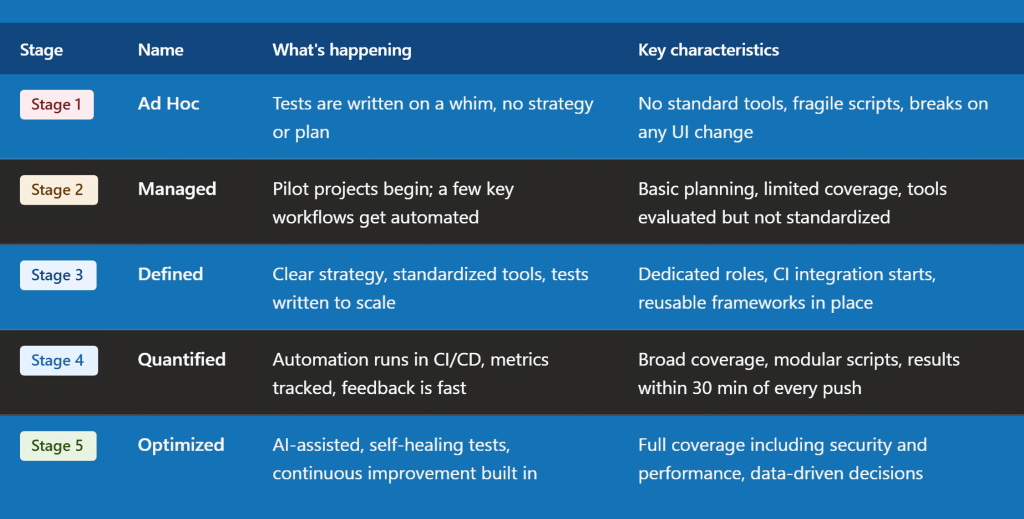
A strong 5‑pillar framework for test automation maturity typically covers:
Most teams treat test automation as a QA responsibility. That’s the first mistake. When engineering, product, and leadership all have a stake in what gets automated and why, the program starts driving real release confidence.
Companies that do this report up to 40% fewer critical-path regressions at release.
When writing tests at earlier stages, engineers tend to write tests that just pass, but they are not structurally made to last for longer execution. These scripts are tied to the UI, which is mostly brittle and rewritten every time something changes.
But this doesn’t mean that you start writing more test cases. It’s the better-designed ones. Adding test design reviews in sprint planning with reusable patterns, clear entry and exit criteria, and modular structures transforms maintenance into a routine that checks every block. This is mostly helpful at L2 to L3.
For example, one of our e-commerce clients here at the Kualitatem team cut their build times by 40% simply by refactoring fragile UI scripts into a shared, parameterized framework. If you also want to refactor your UI scripts, then connect with our team to learn more about this transformation.
Multiple teams using multiple tools is not flexibility; it becomes fragmentation. When every squad has its own distinct scripts, its own selectors, and its own way of running tests, nothing scales, and nothing is trusted.
Standardizing on one framework is the optimal solution. Playwright, Cypress, and Selenium with shared libraries and internal documentation give every team a common language. Most helpful at L2 to L3.
When QA is a separate function with no coding ownership, and developers have no stake in test quality, the suite drifts. The healthiest automation programs treat testing as a shared engineering discipline. This means creating clear career paths for automation engineers alongside developers, embedding QA in product squads, and co-owning CI/CD pipelines. This is mostly helpful at the L3 to L4 level.
At Kualitatem, our team opreats as a lean team working outside of silos, which helps us reduce flaky tests by 70% after pairing QA engineers with backend developers in dedicated test-maintenance sprints.
You cannot improve what you cannot see. Most teams at early maturity levels either track nothing or track the wrong thing, like total test count, which tells you almost nothing about suite health.
A proper quality dashboard shows flakiness rate, mean time to fix a failing test, defect escape trends, and ROI per test suite. This gives leadership something actionable, not decorative. Most helpful at L3 to L4. Here are some KPI’s your dashboard must measure in order to get outcomes. Here is the list of common KPI’s most CTO’s measure to check their test automation.
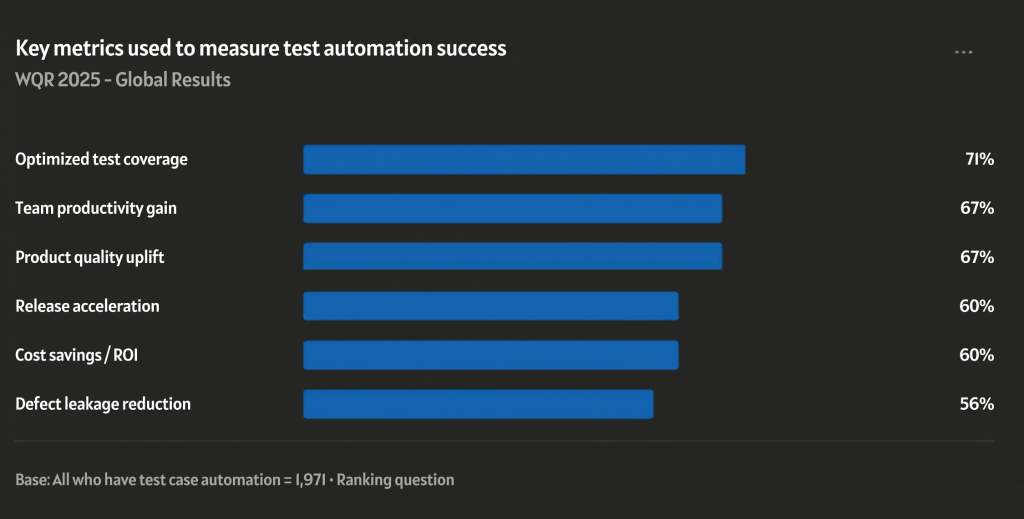
If you are at the initial stage, just keep this 3 Step plan, which our team at Kualitatem implements to create the best mature test automation plan.
The Trinity Test Maturity Model uses the three phases Triage, Transform, and Transcend to guide organizations from unstable automation to enterprise-wide, AI-driven quality practices. Together, they create a clear, structured path for a perfect test automation maturity program.
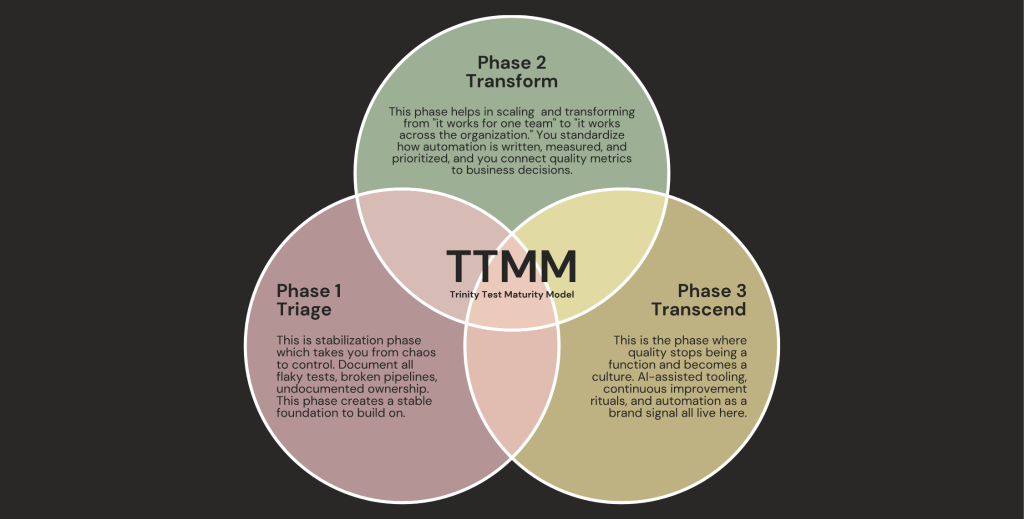
To implement the TTMM model, you can take help from Kualitatem’s expert teams to have a more mature test automation program, which reduces test flakiness up to 40%.
1. How do I know my organization is at L2 vs L3?
If tests are scattered, ownership is unclear, and you only trust a few smoke tests, you’re likely at L2. At L3, you have a shared framework, clear entry/exit criteria, and tests are integrated into CI/CD gates so teams actually rely on them.
2. Can’t we just buy a tool and call it ‘mature automation’?
No. Buying a tool only moves you from L1 to L2 at best. Maturity happens when you add governance, standard processes, and shared ownership; otherwise, you just trade manual flakiness for automated flakiness.
3. How much time should we spend on automation vs features?
A healthy balance is treating automation as part of your core feature work roughly 15–25% of planning effort in early stages, then rebalancing as you reach L3+ and automation starts cutting re‑work and regression time.



Our experts are all ready. Explain your business needs, and we’ll provide you with the best solutions. With them, you’ll have a success story of your own.
Contact us now and let us know how we can assist.