
How Microservices Testing Helps Businesses Create Bug Free Artchitecure
March 17, 2026



There’s a sentence nobody in the corporate world wants to hear, but deep down, every testing engineer, manager, and CTO knows it’s true:
If you’re not leaning towards testing automation in 2026, you’re signing your own unemployment letter.
Harsh? Maybe.
Accurate? Absolutely.
We’ve entered a decade where software companies don’t hide their intentions anymore. They want leaner teams, fewer human bottlenecks, and processes that run at 3 AM without waiting for someone to “check the logs.”
Automation isn’t a skill now. It’s a survival strategy. According to the World Quality Report, 70% of Agile teams now rely on automation to cut testing time by 30-50% and catch 85% more defects early. This saves many hours spent on fixing and delays. So, if you are relying solely on human effort, then you are not just slower, you’re exposed.
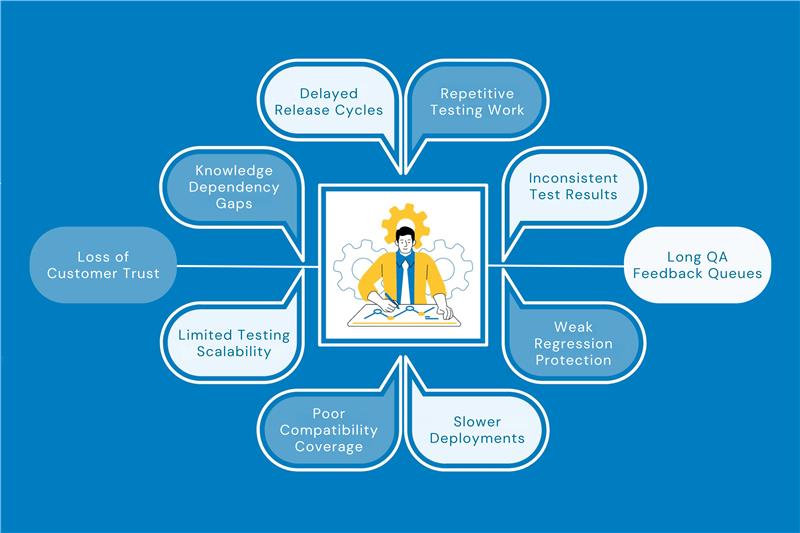
Below you will discover the 11 critical pitfalls of manual-only testing, backed by data-driven insights on how automation delivers massive business wins.
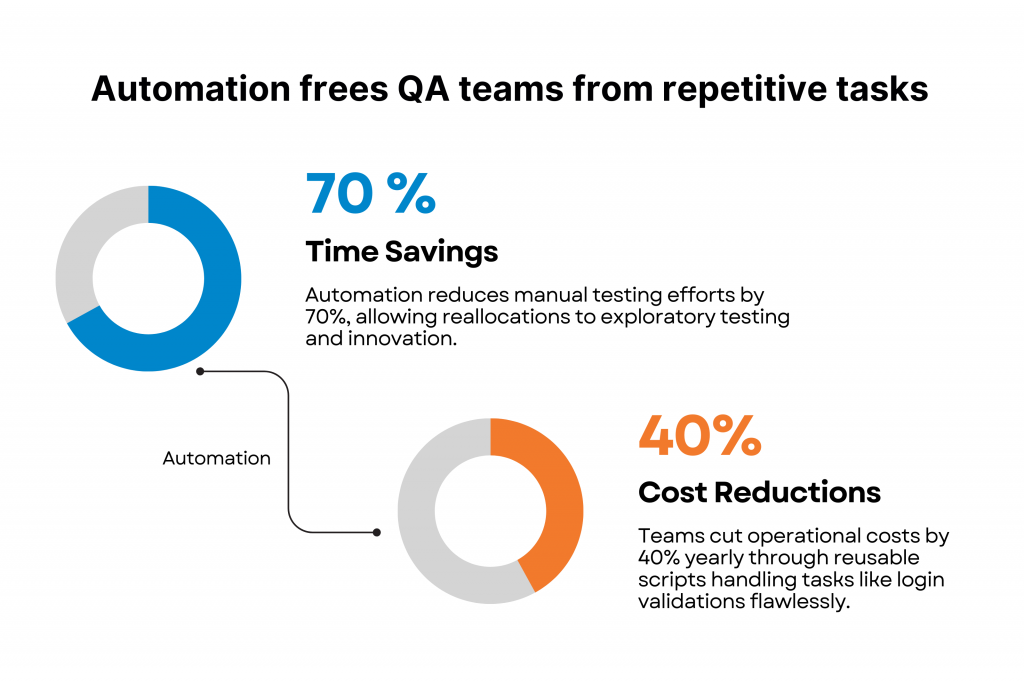
Manual testing means rigorous team hours spent on doing the same practice again and again, making it highly time-consuming, particularly for regression testing, where the same scenarios repeat after code changes. This slows down release cycles as testers painstakingly replicate actions across builds. Furthermore, on the same system if QA automation is applied, it becomes easier to run thousands of checks in minutes. Tools like Selenium or Cypress enable parallel execution, speeding up your workflow by 40%.
Manual testers repeat identical steps across runs, like login flows or form validations leading to fatigue, boredom and lapses in attention over long sessions. But on the other hand, testing automation scripts handle repetition flawlessly, executing the exact sequence every time without tiring, using reusable modules for easy updates.
QA testers often miss details or inconsistently apply steps, allowing bugs to slip through, especially in complex scenarios. Automation follows scripts precisely, eliminating variability and running consistently across environments.
AI-based automated defect detection systems achieve up to 90% accuracy, outperforming manual inspection by catching flaws like cracks or misalignments consistently.
The difference in knowledge produces different results. Sometimes junior testers miss issues that senior testers catch. Experienced testers each have their own approach, creating inconsistencies that require time to reconcile. Automated scripts run the same way every time, no matter who executes them. Once the testing scripts are captured in code, your team is not dependent on individual expertise. This way, rework is reduced up to 30% through consistent automated execution.
If you are looking to hire or outsource your testing automation services, then hire QA automation experts from Kualitatem.
As software evolves with new features, bug fixes and integrations, manual teams face exploding test case volumes executing hundreds of tests weekly, which overwhelms resources, creating backlogs that force rushed testing or skipped scenarios during crunch deadlines.
Modular frameworks like data-driven automation testing scale to thousands of cases effortlessly, where one script handles variations via external datasets (CSV inputs for user logins), auto updating suites through CI triggers without proportional human effort. This single effort alone achieves up to 70%+ test coverage growth without headcount increases.
With manual testing, you’re relying entirely on human attention to catch regressions. If a tester is tired or overwhelmed and misses a small UI change, that bug goes straight to production. The entire burden falls on QA to catch everything which is impossible.
Automation acts as a safety net that never sleeps. It automatically reruns critical test paths after every code change, catching subtle issues that slip past human eyes even at 3 AM. Catching bugs before production is 10-100x cheaper than fixing them after release.
According to a case study Fannie Mae saved $300K annually by automating regression tests, running cycles 90% faster and preventing costly production escapes.
Manual verification across 6+ browsers and devices is logistically impossible under deadlines, often limited to 2-3 configs. Cloud tools like BrowserStack/Appium parallelize 1000s of browser-device combos simultaneously, scripting once for universal coverage with real-device emulation and screenshots per failure. This delivers 99% compatibility assurance.
In most exploratory testing, developers commit code, then wait days for QA feedback, stalling merges and deployments in Agile flows. Seamlessly hooks into Jenkins/GitHub Actions, auto-triggering full suites on every commit for results in minutes, with pass/fail gating to block broken builds.
Repeated production bugs from manual misses erode user confidence, negative reviews, app store downgrades, and churn follow, as customers perceive unreliability. How Exhaustive, repeatable coverage blocks escape proactively, maintaining polished experiences across updates.
When devs wait hours for QA verdicts on fixes, fracturing dev QA rhythm increases the cycle times. Wth the deployment of automation testing, teams get quick feedback and clear failure details, making it easy to fix issues immediately. This results in compressed feedback loops up to 60-80%.
Manual API checks do not scale. When there are many endpoints, large data flows, and repeated payloads, people miss things or test them differently each time. Postman or Newman scripts run all scenarios automatically, including edge cases and heavy data loads. Responses are validated without manual effort.
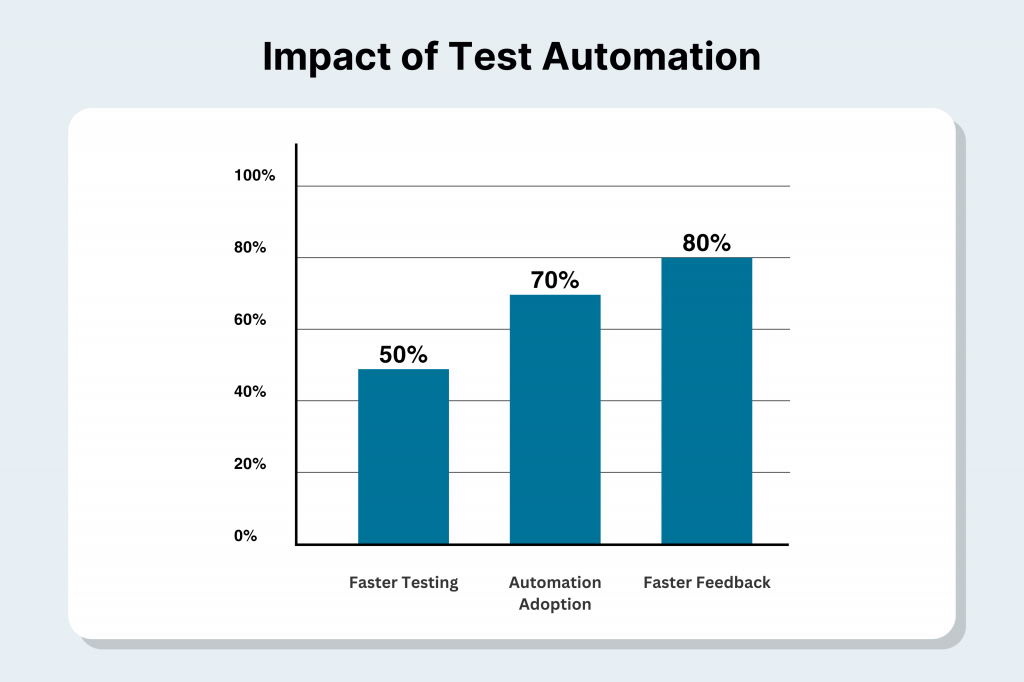
When you implement test automation, it changes the equation. It compresses release cycles, scales effortlessly with product growth, and creates a safety net that protects quality around the clock. More importantly, it frees skilled testers to do what humans do best: exploratory testing, critical thinking, and improving user experience while machines handle repetition with precision.
About us:
Kualitatem has set a long-standing benchmark for excellence in providing test automation as a service. We provide a triple-layer of trust through our internationally recognized certifications, including ISO 27001 for data security, ISO 9001 for process integrity, and TMMi Level 5 for world-class testing maturity.



Our experts are all ready. Explain your business needs, and we’ll provide you with the best solutions. With them, you’ll have a success story of your own.
Contact us now and let us know how we can assist.